Kenya · Washed
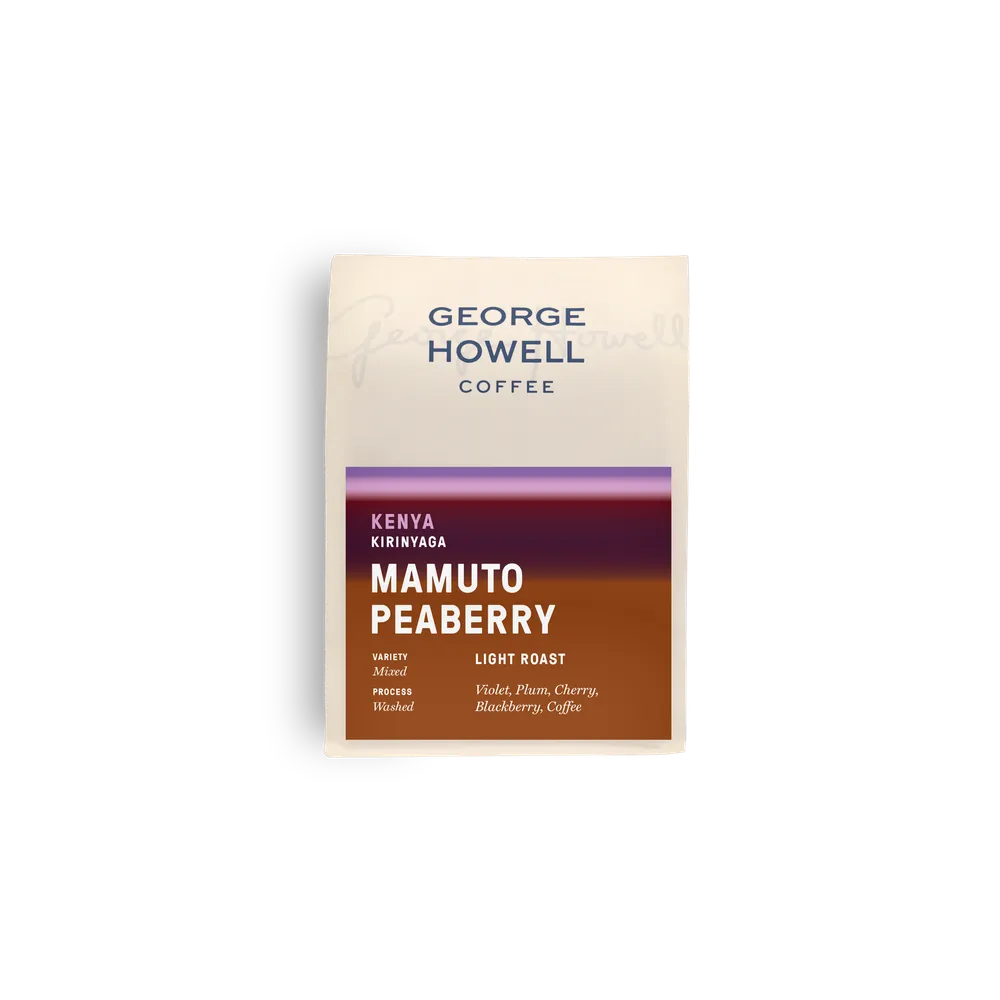
Mamuto Peaberry, Kenya
Roasted by George Howell Coffee
Kenyan peaberry from Mamuto farm beneath Mt. Kenya with dark fruit and lively character.
From the roaster
George Howell Coffee has been buying Mamuto since 2006. It has never faltered. The late Walter Mathagu always produced coffees that were perfectly ripe and sweet. Even as weather patterns challenged, they never overcame him. Year after year, the crop is exquisite, proving again and again to be the Grand Cru of coffee. Walter's legacy continues through his family - his sons, Peter, Jason, and Patrick Mathagu now run this great farm.
Walter was the small farmer pioneer of quality coffee in Kenya and a consummate craftsman until his passing in 2021. He was an agricultural officer serving the government of Kenya for seventeen years before retiring in 1987. More than anyone, Walter put the Kirinyaga coffee region on the map. He raised small farmer awareness to what is possible and brought seekers of great specialty coffee in growing numbers to his area.
Taking inspiration from their family, Mamuto means “father, mother, and children.” Walter and Abishag have six children: three boys and three girls. They named the farm by combining the first two letters of Mathagu (family name), Muthoni (his wife’s maiden name), and Toto (child in Swahili).
We continue to buy Mamuto’s entire crop. It grows beneath the slopes of the 17,000-foot Mt. Kenya. The soil is deep red-orange, set amongst a lush green and very gently undulating landscape. The coffee is processed at the farm right through drying. After drying, it remains in parchment for approximately six weeks, resting in aerated bins before being transported for final milling and packaging.
Kenya developed the most stringent processing and milling standards in the world. Mamuto is machine sorted, then hand sorted to remove any remaining blemishes. Beans are sorted into very narrow ranges of size in order to maintain even roasting. The top grade, AA, is comprised of the two largest sizes, followed by grade AB, the next two sizes. Peaberry is a mutation of the seeds which results in a single round bean instead of two elongated beans.
To experience Mamuto, roasted and brewed properly, is to drink coffee in every way comparable to the finest red wines. It's well-balanced with lively dark fruit notes that fully reflect the terroir. Farms around the world have tried to replicate it, but so far, none have come close to producing the lush flavors Kenya is capable of.
George and Jenny travel annually to visit the farm and the Mathagu family around harvest season in late December. It's one of our most cherished relationships. Over the years, we’ve collaborated with Mamuto on adding drying beds, conditioning bins, and a storage building as well as introducing moisture meters all for the sake of refining their process to push quality forward. Most recently, we’ve embarked on a DNA project of Mamuto’s coffee beans. Our goal is to help preserve one of the most special and elusive flavors in coffee and become a source of learning for others along the way. We look forward to updating you on this exciting journey!
— George Howell Coffee
Context
This peaberry lot from the Mathagu family's Mamuto operation in Kenya's Kirinyaga region arrives via George Howell Coffee as a washed-process coffee. The roaster identifies dark fruit notes alongside a lively, well-balanced character with lush body—qualities that reflect both the regional terroir and the clarity that washed processing typically imparts.
Peaberries, the naturally occurring single-seed variant of coffee cherries, are often sought for their concentrated flavor potential. This lot's combination of fruit-forward character and balance suggests it carries the brightness typical of Kenyan coffees alongside the weight and complexity that careful fermentation and drying can develop. Explore the flavor wheel to pinpoint the specific dark fruits you detect.
In the Encyclopedia
Frequently asked questions
Where is Mamuto Peaberry, Kenya grown?
Mamuto Peaberry, Kenya, roasted by George Howell Coffee, is sourced from Kirinyaga, Kenya.
What does Mamuto Peaberry, Kenya taste like?
Expect tasting notes of dark fruit, lively, well-balanced, and lush.
How is Mamuto Peaberry, Kenya processed?
Mamuto Peaberry, Kenya uses the Washed process.
More from George Howell Coffee
View all →Washed
Tenejapa Medium, Mexico
Washed Chiapas coffee from Tenejapa with dark chocolate and caramel notes.
Brazil · Natural
Daterra Calabria, Brazil
Balanced, heavy-bodied naturally-processed Brazilian coffee with dark chocolate and walnut notes.
Brazil · Natural
Daterra Sundrop Medium, Brazil
Natural processed Brazilian coffee from Daterra with full-bodied sweetness and fruit notes.
Colombia
El Meson Summer Harvest Medium, Colombia
Colombian Pink Bourbon with delicate cherry, honey, and floral notes from Finca El Meson.
More from Kenya
View all →Caffènation · Washed
FILTER - Kenya Kirinyaga KII PB
Washed Kenya Kirinyaga with citrus zest, lychee, and berry sweetness from Kii Factory.
Caffènation · Washed
FILTER - Kenya Kirinyaga KARIRU PB
Kenya Kirinyaga peaberry washed coffee with muscat grape and white tea notes.
Veneziano Coffee · Washed
Kenya Kamwangi Washed
Kenya Kirinyaga washed coffee with strawberry, lemon, and apple notes.
Supreme Roastworks · Washed
Kenya Inoi Ndimi AA, Kirinyaga, washed 250g
Vibrant washed Kenya with raspberry, red currant, plum and bright acidity.
More Washed coffees
Onyx Coffee Lab · Colombia
Colombia Juan Jimenez Pink Bourbon - Cafe Only
Colombian Pink Bourbon microlot with structured acidity and citrus character.
Onyx Coffee Lab · Colombia
Colombia El Tambo-AMACA
Single-origin Colombian coffee from a women's farming cooperative in the Western Cordillera.
ViewGreater Goods Coffee · Ethiopia
Kolla Bolcha - Light Ethiopia
Washed Ethiopian Heirloom with peach syrup, honeysuckle, and bright floral notes.
Cuvee Coffee · Colombia
Colombia
Colombian Huila coffee with washed Caturra varietal from high altitude foothills.
Last verified: June 29, 2026 · Browse all beans.