Knowledge · roasting
Light Roast
From first crack to the cup: understanding the science, sensory profile, and brewing demands of light-roasted coffee.
Key facts
- Roast Stage
- Stopped at or shortly after first crack
- Bean Color
- Pale to medium brown, dry surface
- Agtron Range
- Roughly 70–95 on whole-bean scale
- Key Flavors
- Bright acidity, floral aromatics, fruit-forward notes
- Caffeine Content
- Negligible difference from darker roasts by weight
- Bean Density
- Harder and denser than darker roasts
- Brewing Method
- Requires careful grinding and weight-based dosing
What Is a Light Roast?
A light roast is produced by ending the roasting process at or shortly after first crack — the audible popping event caused by steam and carbon dioxide rupturing the bean's cellular structure as internal pressure builds. At this stage, the bean has undergone significant chemical transformation through the Maillard reaction and early caramelisation, yet retains a large proportion of the compounds present in the original green coffee. As coffee roasting sources confirm, unroasted beans already contain high levels of acids, proteins, sugars, and caffeine; the light roast preserves more of these baseline constituents than any deeper profile.
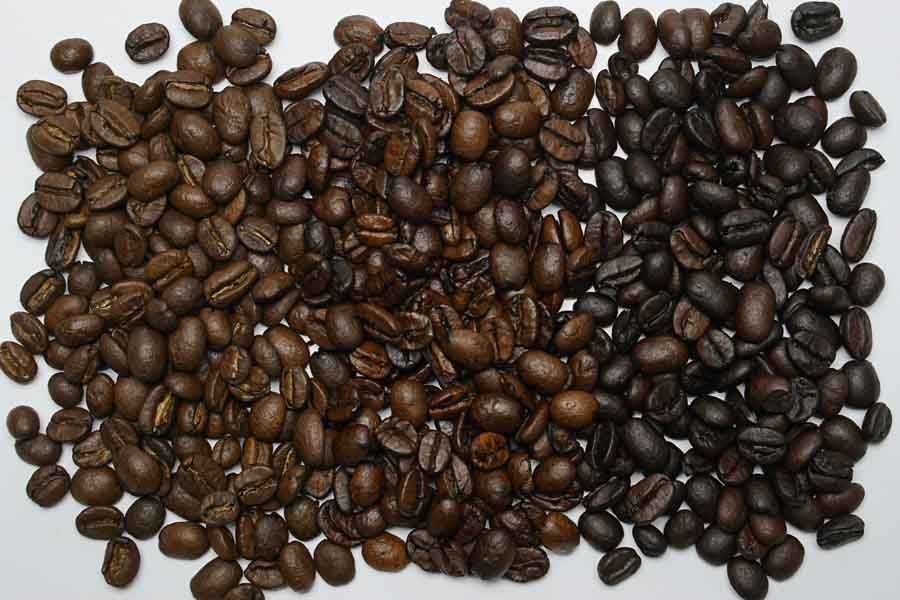
In appearance, light-roasted beans are pale to medium brown, dry on the surface (no visible oil), and noticeably denser and harder than darker-roasted equivalents. The lower internal temperature reached means less cellular expansion and less moisture and CO₂ driven off, so the bean retains much of its original mass and structural density.
Agtron Scale and Colour Ranges
The roast industry most commonly uses the Agtron spectrophotometric scale to assign an objective colour number to roasted coffee. Agtron readings are inverse to darkness: a higher number indicates a lighter roast. Light roasts are commonly cited as falling in the roughly 70–95 Agtron range on whole-bean readings, though exact band definitions vary between classification systems and individual roasters.
The Specialty Coffee Association (SCA) has published its own Coffee Roast Classification tiles that provide a physical reference alongside numerical targets, helping roasters and buyers communicate colour expectations consistently. When comparing roast levels, it is important to specify whether the Agtron reading was taken on whole beans or ground coffee, as grinding exposes interior tissue and typically yields a higher (lighter) number than the whole-bean surface reading alone.
For a full comparison of how light roast colour and development time sit relative to other profiles, see Roast Levels Explained.
Flavour and Sensory Character
Because the roast is stopped before extensive caramelisation and pyrolysis reactions develop the bitter, smoky, or chocolatey compounds associated with medium roast and dark roast profiles, light roasts tend to exhibit:
- High perceived acidity — bright, often fruit-forward notes such as citrus, stone fruit, or red berry, derived in large part from organic acids (chlorogenic acids partially degraded, malic and citric acids still prominent) that survive the shorter roast
- Floral and delicate aromatics — jasmine, bergamot, and tea-like qualities are common in varieties such as Ethiopian Heirloom or high-quality Gesha cultivars
- Sweetness without heaviness — sucrose is only partially caramelised, contributing lighter sweetness rather than the molasses or brown-sugar tones of darker profiles
- Origin and terroir transparency — varietal character, processing method (washed, natural, honey), and regional soil and climate influence are most legible in lightly roasted coffee because roast-derived flavours have not yet dominated the cup
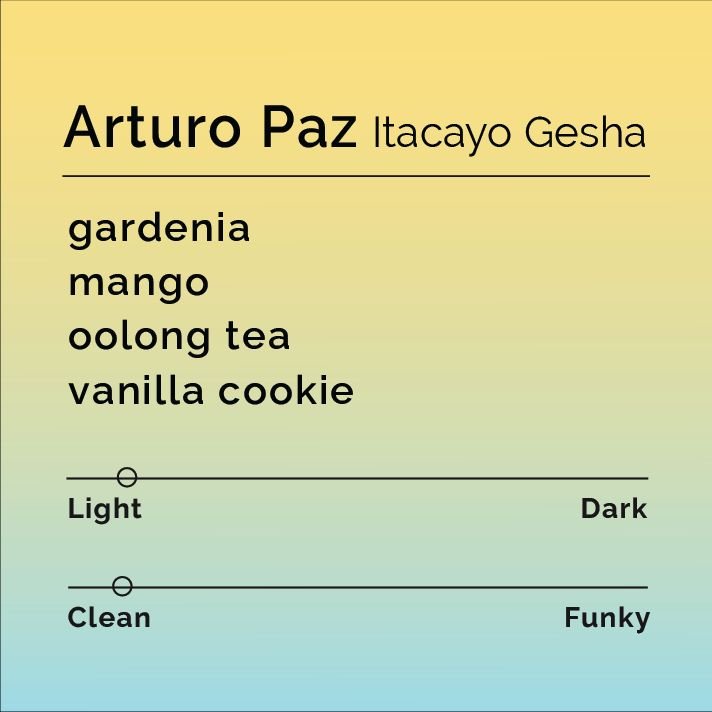
An expressive example of this terroir-forward philosophy can be found in carefully sourced Gesha lots such as the Arturo Paz - Itacayo Gesha by Black & White Coffee Roasters, where the light-roast approach is deliberately chosen to highlight the cultivar's celebrated floral and fruit complexity.
The Caffeine Myth
One of the most persistent misconceptions in popular coffee culture is that light roasts contain significantly more caffeine than dark roasts. The claim usually rests on two half-truths: that caffeine is degraded by heat, and that lighter beans are denser.
The reality is more nuanced. Caffeine is a thermally stable molecule and does not degrade meaningfully at the temperatures reached during conventional roasting. The difference in caffeine content between a light and a dark roast of the same green coffee is negligible in practical terms. What does change is bean density and mass: because darker roasts lose more moisture and CO₂, a gram of dark-roasted coffee represents more individual beans by count than the same gram of light-roasted coffee. Conversely, if you measure coffee by volume (scoops) rather than weight, a scoop of light roast contains denser, heavier beans and therefore marginally more caffeine per scoop — but this is a measurement artefact, not a roast-chemistry effect. When coffee is weighed (as the SCA recommends for brewing), the caffeine difference between roast levels is not a practical consideration for most consumers.
Bean Density and Grinding Challenges
Light-roasted beans are physically harder and more dense than their darker counterparts. This has direct practical consequences:
- Grinder wear — harder beans place greater stress on grinder burrs, particularly ceramic flat burrs, accelerating wear over time
- Grind consistency — dense beans are more resistant to fracture and may require more burr revolutions per gram to achieve the same particle size distribution, potentially generating more fines in underpowered grinders
- Dose and grind setting — because the beans are heavier per unit volume, a volumetric dose (scoop) will under-dose relative to a weighed dose; always dose by weight with light roasts
- Calibration — roasters and baristas often find that light roast grind settings sit noticeably finer on the same grinder than medium or dark roasts to achieve equivalent extraction, a counter-intuitive outcome for newcomers
Understanding how roast development affects bean structure is explored further in Roast Development & Crack.
Dialling In Light Roasts for Brewing
Light roasts are widely regarded as the most technically demanding profile to brew well, precisely because their dense structure and high acid content require careful parameter control.
Brew temperature is a key variable. Because fewer soluble compounds have been made readily accessible by the structural breakdown associated with darker roasts, light roasts typically benefit from higher brew water temperatures — the SCA's Brewing Control Chart and common specialty-industry practice suggest temperatures toward the upper end of the recommended range (commonly cited as 90–96 °C / 194–205 °F), with many specialty roasters recommending closer to 93–96 °C for filter applications.
Extraction yield targets also apply: the SCA commonly cites an ideal extraction yield of 18–22% for filter coffee, with light roasts often requiring grind adjustments, agitation, or extended contact time to reach the higher end of that range without sourness from under-extraction.
Total Dissolved Solids (TDS) — the measure of brew strength — follows the same SCA Brewing Control Chart, with a commonly cited ideal range of roughly 1.15–1.35% for filter coffee, though many specialty brewers working with light roasts adjust to personal or house preference within and around that band.
Practical tips for dialling in:
- Grind finer than you expect — light roasts extract more slowly; a coarser grind frequently leads to sour, under-extracted cups
- Use higher water temperature — don't drop temperature unnecessarily; heat drives solubility for the more intact cellular matrix
- Bloom thoroughly — a 30–45 second bloom (pre-infusion) with roughly twice the coffee's weight in water allows CO₂ to degas, improving extraction evenness
- Consider water chemistry — because acidity is a defining characteristic, soft water with low bicarbonate buffering will allow the natural brightness to express; hard water can flatten perceived acidity and sweetness
- Taste and adjust iteratively — sourness signals under-extraction (grind finer or increase temperature); bitterness at this roast level is unusual and may indicate over-extraction or poor-quality green coffee
For the chemical reasons behind these parameter sensitivities, see The Chemistry of Roasting.
Light Roast in the Specialty Coffee Context
The rise of light roasting is inseparable from the third-wave specialty coffee movement, which from the late 1990s and through the 2000s and 2010s shifted consumer and roaster attention toward single-origin transparency, cultivar diversity, and traceability. As Wikipedia's overview of coffee roasting history notes, the growth of specialty coffeehouses from the 1950s onward and the explosion of single-origin interest in the 1970s–1990s laid the groundwork for a culture that prizes what the green coffee itself tastes like — something light roasting expresses most directly.
Today, light roasts dominate competition brewing formats (such as World Brewers Cup and World Cup Tasters), drive demand for high-scoring lots at green-coffee auctions, and are the house style of many of the world's most acclaimed specialty roasters. They reward growers who invest in variety selection, careful picking, and meticulous post-harvest processing, because those investments are audible in the cup in a way that a dark roast would largely obscure.
Coffees demonstrating this
From our catalog of in-stock beans.
Frequently asked questions
- Are light roasts higher in caffeine than dark roasts?
- Not in any meaningful practical sense. Caffeine is thermally stable and survives roasting largely intact regardless of roast level. When coffee is measured by weight — as the SCA recommends — the caffeine difference between light and dark roasts of the same origin is negligible. The persistent myth stems from the fact that lighter beans are denser, so a volume measure (a scoop) of light roast weighs more and delivers marginally more caffeine, but this is a measurement artefact rather than a roast-chemistry effect.
- Why does light roast coffee taste more acidic?
- Light roasts retain more of the organic acids present in the original green coffee — including malic and citric acids — because the shorter, lower-intensity roast does not degrade or transform them as thoroughly as longer, hotter profiles do. This produces the bright, fruit-forward acidity that characterises well-made light-roast coffees. Perceived acidity is also shaped by water chemistry and brewing parameters.
- What Agtron number is a light roast?
- Light roasts are commonly cited as falling in approximately the 70–95 range on the Agtron spectrophotometric scale, where higher numbers indicate lighter colour. Exact boundaries vary between roasters and classification systems, and whether the reading is taken on whole beans or ground coffee affects the result. The SCA publishes physical colour-tile references to help standardise communication.
- Why is light roast harder to brew than dark roast?
- Light-roasted beans are denser and their cellular structure is less broken down by heat, which means soluble compounds are harder to extract. This requires higher brew temperatures, finer grind settings, and careful attention to contact time to hit the target extraction yield range (commonly cited as 18–22% for filter coffee by the SCA). Under-extraction — experienced as sourness or sharpness — is the most common pitfall.
- What brewing methods suit light roast coffee best?
- Light roasts are most commonly prepared as filter (pour-over, batch brew, Chemex, AeroPress) where the clean, high-clarity brew style allows the floral, fruity, and acidic origin character to express fully. Espresso extraction of light roasts is possible but technically demanding, typically requiring very fine grind, high temperature, and longer pre-infusion to achieve balanced extraction.
See also