Knowledge · plant
Coffee Diseases & Climate Threats
From leaf rust epidemics to a shrinking growing belt: understanding and mitigating the greatest threats to coffee production
Key facts
- Primary fungal pathogen
- Hemileia vastatrix
- Most damaging insect pest
- Coffee berry borer beetle
- Spore production capacity
- 300,000-400,000 spores per cycle
- Infection time
- 24-48 hours from contact
- Most prized coffee species
- Arabica
- 2012-13 Central America impa
- Reduced regional output by 16%
- Small producers supported
- Estimated 25 million worldwide
Coffee Diseases and Climate Threats: An Overview
Coffee is among the most economically significant agricultural commodities in the world, supporting the livelihoods of an estimated 25 million small producers in developing countries. Yet the coffee plant is beset by an array of pathogens, pests, and environmental pressures that can devastate harvests and erode quality with alarming speed. The major biological threats—coffee leaf rust (CLR), coffee berry disease (CBD), the coffee berry borer (CBB), and root-knot nematodes—are compounded by a structural, long-term challenge: climate change is progressively shrinking the geographic range suitable for growing Arabica coffee, the species most prized for specialty markets.
Effective responses require integrating genetic, chemical, cultural, and landscape-level strategies. Understanding each threat in depth is the first step.
Coffee Leaf Rust (Hemileia vastatrix)
Coffee leaf rust (CLR) is caused by Hemileia vastatrix, a multicellular basidiomycete fungus of the order Pucciniales. It is widely regarded as one of the most economically important diseases of coffee worldwide, with historical epidemics having destroyed the production of entire countries and more recent outbreaks causing severe regional damage.
Pathology and Identification
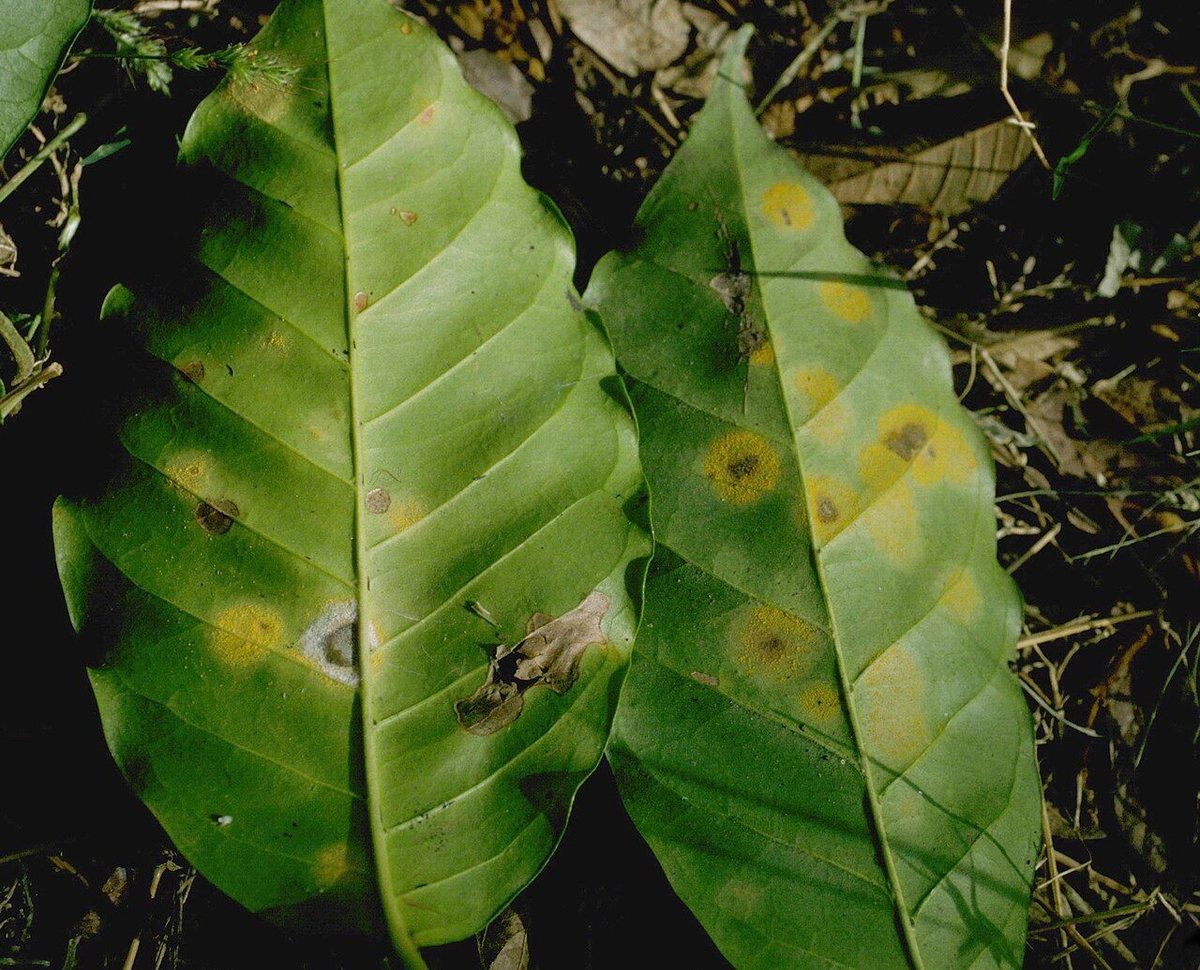
The fungus presents as yellow-orange, powdery lesions that appear on the underside of leaves. Young lesions are chlorotic or pale yellow spots a few millimetres in diameter; older lesions expand to several centimetres. The mycelium's uredinia are identifiable by their powdery, spore-laden appearance. Urediniospores are reniform in shape, measuring 26–40 × 18–28 μm, with a warted convex surface and a smooth concave side. Teliospores (26–40 × 20–30 μm) are also produced, though no alternate host capable of supporting the aecial stage has been identified.
The primary mechanism of damage is twofold: spore masses physically cover leaf surfaces and reduce photosynthetic capacity, and infected leaves drop prematurely. Both outcomes reduce the plant's metabolic resources, ultimately lowering the quantity and quality of flowers and fruit—and therefore the quality of the final beverage.
Life Cycle and Spread
Infection begins with uredospore germination through germ pores. The fungus produces appressoria that generate vesicles, which penetrate the substomatal cavity; infection is completed within 24–48 hours of contact. The leaf blade is then colonised, and sporulation occurs through the stomata. A single lesion can produce 4–6 spore crops over a 3–5 month period, releasing 300,000–400,000 spores per cycle—an extraordinary reproductive capacity that enables rapid epidemic spread.
The question of how H. vastatrix overcomes plant resistance remains incompletely resolved. The predominant hypothesis is that the fungus is heteroecious, requiring an alternate host (as yet undiscovered) to complete its life cycle. An alternative hypothesis holds that teliospores are vestigial and that sexual reproduction is carried out by urediniospores via cryptosexuality—hidden meiosis within what appear to be asexual spores. This cryptic genetic recombination may explain why new physiological races of the pathogen emerge so rapidly.
The 2012–13 Central American Epidemic
The most consequential recent outbreak of CLR occurred across Central America beginning in 2012. The epidemic reduced the region's coffee output by an estimated 16%, dealing severe economic blows to farming communities already operating on thin margins. The outbreak underscored both the inherent vulnerability of monocultural Arabica plantations and the need for coordinated regional responses that go beyond reactive fungicide applications.
Coffee Berry Disease (Colletotrichum kahawae)
Coffee berry disease (CBD), caused primarily by Colletotrichum kahawae, is one of the most destructive pathogens affecting Arabica in Africa. The pathogen attacks green (unripe) coffee cherries, causing a characteristic dark, mummified lesion that destroys the bean before harvest. Unlike many pathogens that affect the foliage, CBD strikes the economically critical cherry itself, making potential losses especially severe.
CBD is largely confined to African growing regions—particularly the highlands of Ethiopia, Kenya, and East Africa—where cool, wet conditions favour pathogen development. Its narrow host specificity (primarily Coffea arabica) and affinity for cooler, humid highland environments make it a critical threat in precisely the high-altitude zones that produce some of the world's most prized specialty coffees. Breeding programs have long prioritised CBD resistance alongside CLR resistance in African Arabica improvement efforts.
Coffee Berry Borer (Hypothenemus hampei)
The coffee berry borer (CBB), Hypothenemus hampei, is a small beetle native to central Africa and is considered the most harmful insect pest of coffee worldwide. Its presence affects the economy of over 20 million families dependent on the coffee harvest.
Biology and Damage
Adult females are small black beetles, typically 1.4–1.8 mm in length, with strong mandibles adapted for drilling through the coffee cherry. Males are slightly smaller (approximately 1.2–1.6 mm) and, critically, cannot fly—their wings are less developed. The female drills through the cherry's central disc (or through the side walls in dry fruit) to reach the endosperm, where she lays 35–50 eggs approximately two days after penetration. These eggs generate roughly 13 females for every male, ensuring a heavily female-biased and therefore highly reproductive population.
Maturation from egg to adult spans 24–45 days, varying with temperature. A single plant can host three to five beetle generations, with up to 100 individual beetles found in a single fruit. Sibling insects mate inside the seed before females emerge and disperse; males never leave the fruit. The insect is highly sensitive to desiccation and typically waits for rainfall before dispersing, which concentrates activity in wetter, less sun-exposed areas of a plantation.
Geographic Spread
Originally endemic to central Africa, the CBB has now spread to most coffee-producing countries through the accidental movement of contaminated seeds. Key milestones in its spread include its first recorded appearance in Brazil in 1926, its invasion of Guatemala and Mexico in the 1970s, Colombia in the late 1980s, and most recently its detection in Hawaii in 2010. This progressive globalisation of the pest reflects the difficulty of preventing insect movement through international trade.
Pest Management
Chemical insecticides are largely considered non-viable due to high cost, environmental impact, and documented resistance—notably to endosulfan, a highly toxic insecticide now banned in many countries. Management therefore relies heavily on biological control. Insectivorous birds, including the yellow warbler and rufous-capped warbler, have been shown to reduce CBB populations by up to 50% in Costa Rican coffee plantations. Hymenopteran parasitoids—including betylid wasps such as Cephalonomia stephanoderis and Prorops nasuta, introduced from Africa to Latin America during the 1980s and 1990s—and the eulophid Phymastichus coffea (discovered in Togo in 1987) are also deployed, though their population-level impact remains limited. Fungal entomopathogens targeting immature and adult beetles represent another active area of research.
Nematodes
Root-knot nematodes (Meloidogyne spp.) are microscopic soil-dwelling roundworms that parasitise coffee roots, forming characteristic galls that disrupt water and nutrient uptake. Nematode damage is often insidious: affected plants show above-ground symptoms—wilting, yellowing, stunted growth, and declining yields—that can be mistaken for nutrient deficiency or drought stress. The actual damage occurs underground, where root architecture is progressively destroyed.
Nematodes are especially problematic in sandy, well-drained soils in tropical and subtropical growing regions. They frequently act as a compounding stressor, weakening plants and making them more susceptible to secondary fungal and bacterial infections. Management strategies include the use of nematode-resistant rootstocks (an area of ongoing breeding work), cover crops, organic mulching, and the application of biological nematicides derived from soil fungi such as Paecilomyces spp. The interaction between nematode pressure and climate stress—both of which are exacerbated by rising temperatures—is an emerging concern for coffee agroecologists.
Climate Change and the Shrinking Arabica Belt
Of all threats to coffee, climate change presents the most structurally intractable challenge. Arabica coffee has narrow climatic tolerances—it thrives in stable temperature regimes, typically at altitude, with well-distributed rainfall and distinct dry seasons. Rising mean temperatures, increasing rainfall variability, and the intensification of extreme weather events are progressively eroding the suitability of traditional growing zones.
The consequences are multi-dimensional:
- Range contraction: Regions that currently support Arabica production are projected to become climatically unsuitable as temperatures rise, compressing the viable "coffee belt" from its current extent.
- Upslope migration: In mountainous regions, farmers can partially compensate by moving cultivation to higher elevations. However, this strategy has physical limits—there is only so much mountain—and higher altitudes often involve steeper terrain, thinner soils, and more difficult access for smallholders.
- Pest and disease range expansion: Warmer temperatures allow CLR, CBB, and other threats to colonise higher altitudes previously protected by cooler conditions. The 2012–13 rust epidemic in Central America was partly linked to weather anomalies that created unusually favourable conditions for H. vastatrix at altitudes where it had previously been less active.
- Phenological disruption: Shifts in rainfall timing and temperature disrupt the flowering and fruiting cycles of coffee plants, reducing yields and complicating harvest logistics.
The species most at risk is Coffea arabica, which has less genetic diversity and a narrower environmental range than Coffea canephora (Robusta). This asymmetry is driving renewed interest in genetic resources, including wild Coffea relatives, as sources of adaptive traits.
Mitigation Strategies
Responding to these converging threats requires action at multiple scales, from the individual farm to international breeding institutions.
Resistant Varieties and F1 Hybrids
Breeding for disease resistance is the most effective and durable long-term strategy. The most effective and durable approach against CLR, specifically, is the deployment of resistant cultivars, which reduces agrochemical dependence and lowers input costs—an important consideration given that chemical control can represent up to 50% of total production costs for some farmers.
Institutions such as CIRAD are developing F1 hybrid coffee varieties that combine broad genetic resistance to CLR with competitive yield and cup quality. Research indicates that F1 hybrids can outperform conventional Coffea arabica cultivars in both yield and quality metrics. A notable example is Starmaya, the first F1 hybrid that can be propagated via a seed garden rather than the technically demanding and expensive process of somatic embryogenesis—a breakthrough designed to make F1 hybrids accessible to smallholder farmers who could not previously afford them. Explore the broader landscape of coffee varieties and cultivars and the science behind coffee genetics and breeding for further context.
Shade and Agroforestry
Shade-grown coffee under a diverse canopy of trees offers multiple disease and climate mitigation benefits. Shade reduces leaf surface wetness—a key factor in CLR infection, since the extended presence of moisture on leaves facilitates H. vastatrix penetration. Canopy cover moderates temperature extremes, buffers against drought stress, and supports the bird populations that provide biological control of CBB. Agroforestry systems also store carbon and can improve soil health, reducing nematode pressure through enhanced microbial diversity.
Altitude Migration
Where topography permits, shifting cultivation to higher altitudes can temporarily offset warming-driven range contraction. Higher altitudes offer cooler temperatures that slow pathogen and pest development and can improve cup quality. However, this adaptation has limits: land availability, infrastructure, and the finite extent of highland terrain all constrain how far upslope migration can go as a long-term solution.
Chemical and Cultural Controls
For CLR, copper-based fungicides (such as Bordeaux mixture) serve as effective preventative measures, working best when applied at inoculum levels below 10%. Systemic fungicides are used as curative treatments once infection has taken hold. Cultural practices—including pruning to improve air circulation, reducing leaf wetness duration, and timely removal of infected material—complement chemical programs. The key principle is integrated disease management: no single intervention is sufficient, and the combination of genetic, chemical, and cultural approaches produces the most resilient outcomes.
Genetic Diversity and Breeding Investment
The long-term genetic vulnerability of Arabica—a species with comparatively low genetic diversity—underscores the importance of preserving wild Coffea relatives and investing in coffee genetics and breeding programs. Wider genetic diversity provides the raw material from which breeders can select traits for disease resistance, drought tolerance, heat adaptation, and cup quality as the climate continues to change.
For an understanding of the full species landscape and their differing vulnerabilities, see Coffee Species: Arabica, Robusta & Liberica.
Frequently asked questions
- What is coffee leaf rust and why is it so damaging?
- Coffee leaf rust (CLR) is a disease caused by the fungus Hemileia vastatrix. It reduces a plant's photosynthetic capacity by covering leaf undersides with spore masses and causing premature leaf drop, ultimately reducing both the quantity and quality of fruit. It is among the most economically important coffee diseases globally, with a 2012 epidemic in Central America cutting regional output by 16%.
- How does the coffee berry borer spread and why is it so hard to control?
- The coffee berry borer (Hypothenemus hampei) is native to central Africa but has spread to most coffee-producing countries through contaminated seeds. It is difficult to control because the beetle lives inside the coffee berry, shielding it from contact pesticides. Chemical insecticides are largely impractical due to cost, environmental harm, and documented resistance, so management relies primarily on biological controls such as parasitoid wasps and insectivorous birds.
- How does climate change threaten coffee production?
- Rising temperatures and shifting rainfall patterns are shrinking the geographic range suitable for Arabica coffee. This forces farmers to consider upslope migration to higher altitudes, but that option has physical limits. Warmer conditions also allow pests like the coffee berry borer and pathogens like coffee leaf rust to colonise higher altitudes previously protected by cooler temperatures, compounding the threat.
- What are F1 hybrid coffees and how do they help address disease?
- F1 hybrids are first-generation crosses between genetically distinct parent lines, developed by institutions such as CIRAD. They combine broad genetic resistance to diseases like coffee leaf rust with high yield and good cup quality. Varieties like Starmaya—the first F1 hybrid propagatable via a seed garden rather than expensive somatic embryogenesis—are designed to be accessible to smallholder farmers.
- Is shade-grown coffee more resistant to diseases and pests?
- Shade and agroforestry systems offer meaningful benefits. Canopy cover reduces moisture on leaf surfaces, which limits infection by Hemileia vastatrix. It also moderates temperature extremes and supports insectivorous bird populations that can significantly reduce coffee berry borer numbers. However, shade alone is not a complete solution and works best as part of an integrated management approach.
- What is coffee berry disease and where is it most prevalent?
- Coffee berry disease is caused primarily by Colletotrichum kahawae and attacks unripe green coffee cherries, turning them dark and mummified before harvest. It is most prevalent in the cool, wet highland regions of Africa—particularly Ethiopia and Kenya—where conditions favour pathogen development and where some of the world's highest-quality Arabica is grown.
See also