Knowledge · plant
Robusta Coffee
Coffea canephora: botany, chemistry, global trade, and the rise of fine robusta
Key facts
- Scientific name
- Coffea canephora
- Also called
- Robusta coffee
- Origin
- Western and Central Africa
- Plant height
- Up to 10 metres (30 feet)
- Caffeine content
- Approximately 2.7% dry weight
- Global production share
- 45-46% of world coffee
Taxonomy and Nomenclature
Coffea canephora (Pierre ex Froehner, 1897) is the accepted scientific name for the plant most consumers know as robusta coffee. The synonym Coffea robusta remains widely used in trade and popular literature, but it is technically superseded. The species comprises two main botanical varieties: C. canephora var. robusta and C. canephora var. nganda (the latter designation is considered nomenclaturally illegitimate). Robusta was not formally recognized as a distinct Coffea species until 1897 — more than a century after Coffea arabica was described — reflecting its relatively late entry into Western botanical science despite its deep roots in African ecology.
For a comparative overview of the genus, see Coffee Species: Arabica, Robusta & Liberica.
Botany and Plant Characteristics
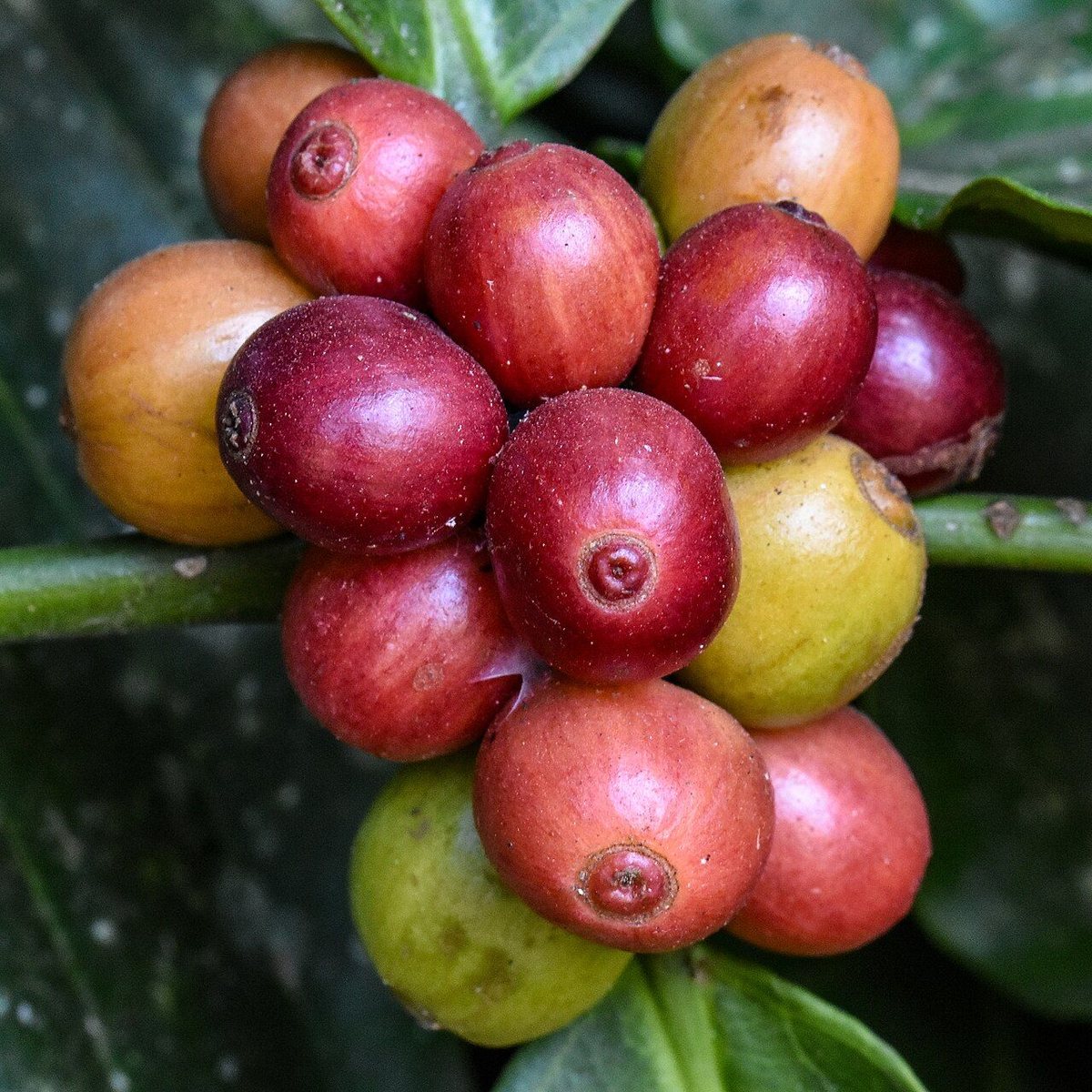
C. canephora is a robust, woody shrub or small tree reaching up to approximately 10 metres (30 feet) in height, with a notably shallow root system. It flowers irregularly, and berries require 10–11 months to ripen after flowering — longer than most arabica cultivars. The ripe fruits yield oval-shaped beans, slightly more rounded than the more elongated arabica bean.
Key morphological and physiological traits include:
- Diploid genome (2n = 22): Unlike the allotetraploid C. arabica, robusta carries only two sets of chromosomes. This diploid structure, combined with obligate cross-pollination (it is largely self-incompatible), drives the species' remarkable genetic and morphological diversity across both cultivated and wild populations.
- Shallow root system: Makes the plant more vulnerable to drought stress but also facilitates efficient uptake of surface-applied nutrients.
- Disease and pest resistance: Robusta's name is apt — the species is substantially less susceptible to common coffee diseases and pests, including Hemileia vastatrix (coffee leaf rust), reducing the need for herbicide and pesticide inputs relative to arabica.
- Adaptation: The species demonstrates high adaptability to diverse environmental conditions, partly through changes in behaviour and morphology, enabling cultivation across a broad range of lowland tropical environments.
For deeper context on the physiology of the coffee plant, see The Coffee Plant.
Chemical Composition
The biochemical profile of C. canephora differs from Arabica Coffee in several commercially significant ways:
Caffeine
Robusta beans contain approximately 2.7% caffeine (dry weight), compared to roughly 1.5% in arabica — nearly double. This elevated caffeine content is not merely a physiological stimulant: caffeine serves as a natural insecticide, likely contributing to the plant's greater pest resistance.
Sugars
Robusta beans carry 3–7% sugars, compared to 6–9% in arabica. Lower sugar content means less caramelisation during roasting and a less sweet, less fruity cup profile.
Chlorogenic Acids and Bitterness
Robusta is notably higher in chlorogenic acids (a class of polyphenols), which contribute to its characteristic bitterness and astringency. Bitterness is further amplified by pyrazines, nitrogen-containing aromatic compounds that form during roasting and give robusta its distinctive earthy, woody notes.
Antioxidants
The elevated polyphenol content — including chlorogenic acids — means robusta beans carry more antioxidant compounds than arabica, though this advantage is largely discussed in nutritional contexts rather than sensory ones.
Cup Profile Summary
| Attribute | C. canephora (Robusta) | C. arabica (Arabica) |
|---|---|---|
| Caffeine (approx.) | ~2.7% | ~1.5% |
| Sugar content | 3–7% | 6–9% |
| Acidity | Lower | Higher |
| Bitterness | Higher | Lower |
| Flavour notes | Earthy, woody, full-bodied | Fruity, floral, complex |
Origin, Distribution, and Major Growing Regions
C. canephora is indigenous to Western and Central Africa, with a native range stretching from Liberia in the west to Tanzania in the east, and south to Angola. It has since been introduced — and in some cases naturalized — across Borneo, French Polynesia, Costa Rica, Nicaragua, Jamaica, and the Lesser Antilles.
Modern Production Geography
Today's robusta supply chain is dominated by a handful of countries:
- Vietnam — The world's largest robusta exporter, accounting for over 40% of total robusta production. French colonists introduced the species in the late 19th century; it is now central to Vietnam's agricultural economy.
- Brazil — Produces approximately 25% of global robusta (largely as the conilon variety, C. canephora var. robusta, grown primarily in Espírito Santo and Rondônia). Brazil remains the world's largest overall coffee producer, though roughly 69% of its output is arabica.
- Indonesia — Around 13% of global robusta, predominantly from Sumatra, Java, and Flores.
- India — Approximately 5%, grown largely in the states of Karnataka and Kerala alongside arabica.
- Uganda — Approximately 5%, with significant production from the Lake Victoria basin, including wild-collected and semi-wild robusta.
Overall, C. canephora represents approximately 45–46% of world coffee production, with the remainder split between C. arabica and the minor species C. liberica.
For agronomic considerations — altitude, shade, and soil — see Growing Coffee: Altitude, Shade & Soil.
Genetics, Breeding, and Disease Resistance
Because robusta is diploid and largely obligate-outcrossing, its populations harbour far greater allelic diversity than the genetically narrow allotetraploid arabica. This diversity is both an agronomic resource and a breeding challenge.
A notable milestone: in 1927, a natural hybrid between robusta and arabica was discovered in Timor. Known subsequently as the Timor Hybrid (or Hibrido de Timor), it carries robusta's resistance to coffee leaf rust (H. vastatrix) in an arabica genetic background. This strain has been extensively used to breed rust-resistant arabica cultivars worldwide, underpinning many modern disease-resistant varieties.
The species' inherent resistance to leaf rust and other pathogens — relative to most arabica varieties — stems in part from its elevated caffeine content and distinct secondary metabolite profile, as well as its genetic diversity.
For more on coffee breeding programmes and genetic resources, see Coffee Genetics & Breeding and Coffee Varieties & Cultivars.
Role in Instant Coffee and Espresso Blends
Instant Coffee
The majority of robusta production feeds the instant coffee industry. The bean's high soluble-solids yield, strong body, and relatively low cost make it well suited to spray-dried and freeze-dried manufacturing processes. Its robust flavour — which can withstand the aggressive heat treatments involved in instant production — ensures a recognisable coffee character in the final product.
Espresso Blending
In Italian espresso tradition, robusta occupies a valued position that contradicts its reputation as a lower-quality filler. Good-quality robusta beans contribute two highly prized qualities to espresso blends:
- Crema: Robusta's higher content of certain lipids and its protein-carbohydrate profile produce a thicker, more persistent crema (the reddish-brown foam that tops a well-extracted espresso) compared with 100% arabica shots.
- Body and finish: The earthy, full-bodied character and elevated bitterness give blended espressos a perceived "strength" and lingering finish that many Italian-style consumers actively seek.
In lower-grade commercial blends, robusta is often used as a cost-reducing filler. The distinction between commodity robusta used as filler and high-grade robusta selected for its crema and body contributions is an important one in the trade.
Fine Robusta and the Specialty Coffee Movement
For much of the 20th century, C. canephora was essentially absent from specialty coffee discourse, regarded as categorically inferior to arabica. That consensus is eroding.
Several developments are driving fine robusta's emergence:
- Ugandan and Vietnamese fine robusta: Producers in Uganda (where wild robusta populations offer unique flavour diversity) and Vietnam are increasingly applying selective harvesting, careful post-harvest processing, and cupping evaluation protocols to robusta lots.
- Sensory re-evaluation: When grown at appropriate elevations, harvested ripe, and processed with care, C. canephora can yield cups with chocolate, dark fruit, and earthy-spice notes that are genuinely complex rather than merely harsh.
- Climate resilience argument: As climate change threatens arabica cultivation at traditional altitudes, robusta's lowland tolerance and disease resistance position it as a strategic crop. This has prompted renewed investment in genetic selection and agronomic improvement.
- SCA dialogue: The Specialty Coffee Association and allied organisations have begun tentative discussions around cupping protocols and quality frameworks appropriate to C. canephora, acknowledging that the existing arabica-centred Q-grader system does not adequately evaluate robusta's distinct sensory properties. A separate Q Robusta credentialling pathway now exists within the Coffee Quality Institute framework.
Fine robusta remains a small fraction of the overall C. canephora market, but the trajectory is upward, and its role in both blending and standalone specialty offerings is likely to expand.
Frequently asked questions
- What is the correct scientific name for robusta coffee?
- The accepted scientific name is Coffea canephora. The synonym Coffea robusta is widely used in trade but is scientifically superseded. The species has two main varieties: C. canephora var. robusta and C. canephora var. nganda.
- How much more caffeine does robusta have compared to arabica?
- Robusta beans contain approximately 2.7% caffeine compared to roughly 1.5% in arabica — nearly double. This elevated caffeine level also acts as a natural insecticide, contributing to the plant's pest resistance.
- Why is robusta used in espresso blends?
- Good-quality robusta beans contribute a thicker, more persistent crema and a full-bodied, powerful finish to espresso blends. This is a valued tradition particularly in Italian espresso culture, where robusta provides perceived strength and body alongside arabica's aromatic complexity.
- Why is robusta more resistant to coffee leaf rust than arabica?
- Robusta's elevated caffeine content, distinct secondary metabolite profile, and greater genetic diversity (being diploid and cross-pollinating) all contribute to its resistance. Notably, a natural robusta-arabica hybrid discovered in Timor in 1927 has been used extensively in breeding rust-resistant arabica varieties.
- Which country produces the most robusta coffee?
- Vietnam is the world's largest robusta exporter, accounting for over 40% of total robusta production. Brazil and Indonesia are the next largest producers, contributing approximately 25% and 13% respectively.
- Can robusta be considered a specialty coffee?
- Increasingly, yes. When selectively harvested, carefully processed, and evaluated on its own terms, high-grade robusta from origins like Uganda and Vietnam can exhibit genuine complexity. The Coffee Quality Institute now offers a Q Robusta grading pathway, reflecting the specialty sector's growing engagement with the species.
See also