Knowledge · industry
The Coffee Supply Chain
How coffee moves from farm to cup — and who adds value along the way
Key facts
- Global Production Region
- Over 90 percent occurs in Global South
- Production Timeline
- Cherry ripens roughly 8 months after flowering
- Harvesting Methods
- Strip picking or selective picking
- Key Processing Methods
- Washed, natural, or honey processing
- Specialty Grade Standard
- 80 points or above on SCA scale
- Major Traded Commodity
- Green coffee futures on exchanges worldwide
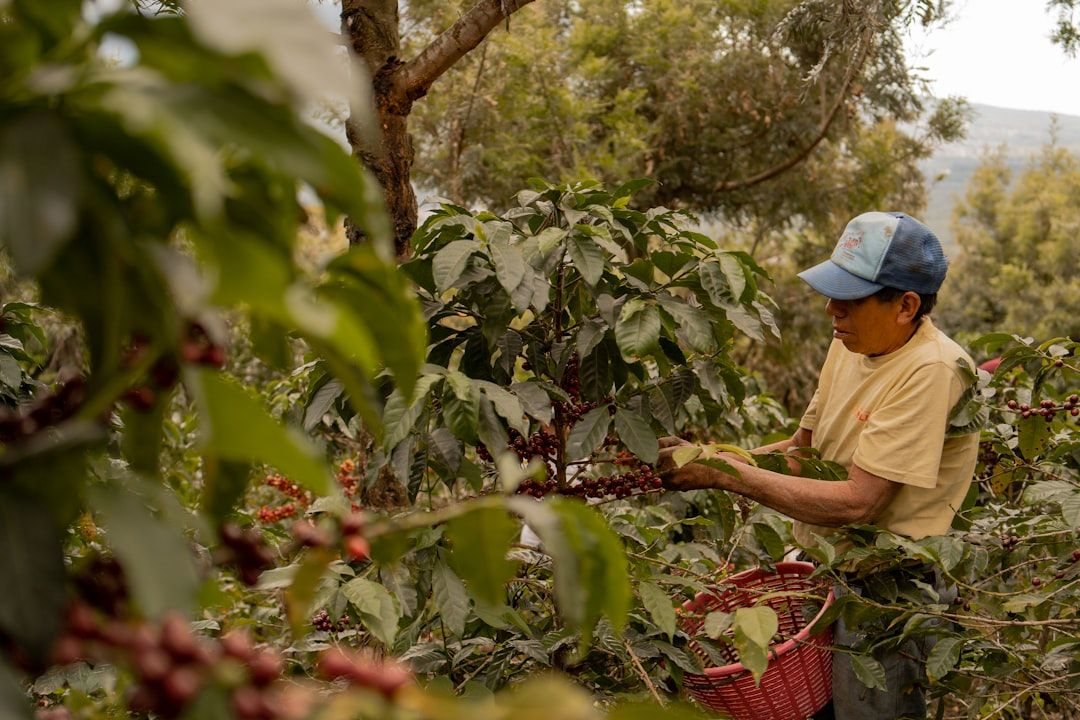
The Farm: Where Value Begins
Every cup of coffee originates on a farm, often a smallholding operated by a single family. Coffee production is a major source of income for millions of households — sources estimate between 12.5 million and 25 million farming families worldwide depend on it, the vast majority in developing countries. Over 90 percent of global production takes place in the Global South, while consumption is concentrated in industrialized economies, a structural asymmetry that underlies many of the supply chain's tensions.
The first critical value-adding decision happens at harvest. A coffee plant typically begins producing fruit three to four years after planting, with cherries ripening roughly eight months after flowering. Farmers choose between two harvesting methods:
- Strip picking — all fruit is removed from the branch at once, regardless of ripeness. It is faster and cheaper, and is used extensively in large, mechanized operations such as those found across Brazil's relatively flat growing regions.
- Selective picking — only ripe cherries are chosen, with pickers rotating through the same trees every eight to ten days. This labor-intensive approach is the standard for specialty coffee and higher-grade arabica, because ripe cherries have higher aromatic oil content and lower organic acid levels, producing a smoother, more fragrant cup.
The method chosen here cascades through every downstream step. Lots containing unripe fruit tend toward bitter, astringent flavors; selectively picked lots provide the raw material from which exceptional coffees are built. Pickers are typically paid by the basketful — a system that, historically, has placed farm labor at the lowest income tier of the entire chain.
Processing: The Washing Station and Wet Mill
Once harvested, the coffee cherry must be processed to extract the seed — the green bean — before it can be dried, stored, or shipped. Processing is the stage where flavor character is most dramatically shaped, and it is often carried out not on the farm itself but at a centralized washing station (also called a wet mill), particularly in East Africa and parts of Central America. Small farmers may deliver their cherries to a cooperative-run washing station, pooling their fruit for collective processing.
The two dominant methods are:
Washed (wet) processing: Cherries are sorted by flotation — ripe, dense fruit sinks while defective or unripe fruit floats. The skin and pulp are then removed mechanically, and the beans, still coated in mucilage, are fermented in tanks for between 8 and 36 hours depending on temperature, mucilage thickness, and enzyme concentration. Fermentation is monitored carefully by touch: the parchment surrounding the bean loses its slippery texture and becomes rough when fermentation is complete. The beans are then thoroughly washed with clean water. Washed processing tends to produce clean, bright, terroir-expressive cups.
Natural (dry) processing: Whole cherries are spread on raised beds or patios and dried in the sun before the fruit is stripped away. This method requires no water infrastructure but demands careful monitoring to prevent over-fermentation. It typically produces fruitier, heavier-bodied cup profiles.
A third approach — honey processing — leaves varying amounts of mucilage on the bean during drying, producing results that sit between washed and natural on the flavor spectrum.
The washing station or wet mill is a significant node of value addition. Cooperatives that control their own processing infrastructure can capture more of the price premium that clean, traceable lots command on the specialty market.
The Dry Mill and Grading
After drying, coffee is in parchment form — the dried bean still encased in a papery husk. Parchment coffee is transported to a dry mill (also called a hulling facility), where several mechanical and manual steps occur:
- Hulling — the parchment layer is stripped away to reveal the green bean.
- Polishing — an optional step that removes the silver skin.
- Grading and sorting — beans are sorted by size (using screens), density (using air jets), and color (using optical sorters that remove defects at high speed). This is where the SCA's defect standards are applied: a coffee must have no more than 0 to 5 defects per 350 g of milled beans to qualify as specialty grade.
- Cupping and quality assessment — samples are roasted, brewed, and evaluated on the SCA's 100-point scale. Coffees scoring 80 points or above are classified as specialty; those scoring 85–89.99 are graded Excellent, and scores of 90 or above are Outstanding.
The dry mill is also where lot separation is finalized. A single cooperative's parchment may be cupped, scored, and separated into commercial-grade and specialty-grade lots, with the latter commanding substantially higher prices. Exporters and traders often work closely with dry mills to identify and reserve high-scoring lots.
The Exporter and the Commodity Market
Green coffee is one of the most actively traded agricultural commodities in the world, with futures contracts traded on exchanges including the New York Intercontinental Exchange. Price discovery for commercial-grade coffee is dominated by the C price (arabica) and the Robusta contract, which are set by supply and demand across producing and consuming nations. Important processing and trading hubs in the consuming world include Hamburg and Trieste.
For the vast majority of production, exporters sell green coffee at or near these commodity benchmarks, adding a differential (positive or negative) based on origin, grade, and market conditions. The commodity price system has historically been volatile: the ICO Composite Index reached lows in September 2001 and remained suppressed for years, at times falling below the cost of production for farmers in many origins. The collapse of the International Coffee Agreement (1962–1989), combined with Brazil's plantation expansion and Vietnam's rapid emergence as a major producer after 1994, contributed to these price collapses.
For specialty coffee, the dynamic is different. Specialty lots are typically sold through private contracts negotiated between exporters, importers, and roasters — often at significant premiums above the commodity price. This decoupling from commodity markets is one of the defining economic features of the specialty tier.
The Importer and Green Coffee Trader
In consuming countries, importers (also called green coffee traders) receive, warehouse, and re-sell green coffee to roasters. They perform several functions that smaller roasters cannot do economically on their own:
- Consolidating container shipments from multiple origins
- Managing quality control and re-cupping on arrival
- Providing financing and credit terms
- Offering spot availability for roasters who cannot commit to forward contracts
- Connecting roasters with specific producing partners or cooperatives
Traditionally, the importer sits between the exporting country and the roaster, adding a margin for these logistics and risk-management services. In a conventional commodity chain, this step (along with the exporter's margin) represents value capture that remains invisible to both the farmer and the consumer.
The rise of direct trade — pioneered by specialty roasters including Intelligentsia Coffee, Stumptown Coffee Roasters, and Counter Culture Coffee — challenged this model by having roasters travel directly to origin, build relationships with specific farms or cooperatives, negotiate prices independently, and in some cases bypass traditional importers altogether. This shortening of the chain is discussed further below.
The Roaster: Transforming Green into Sellable Coffee
The roaster is the first actor in the chain typically visible to the consumer. Green coffee has no culinary appeal on its own — roasting is the transformation that develops aroma compounds, reduces moisture, caramelizes sugars, and produces the brown, fragrant bean recognizable as coffee. It is also where origin character can be preserved (lighter roasts) or masked (darker roasts).
Roasters add value through:
- Sourcing and curation — selecting origins and lots that fit their quality and flavor profile goals
- Roast development — tailoring profiles to express or balance a bean's inherent characteristics
- Blending — combining origins for consistency or complexity
- Packaging and branding — creating a consumer-facing product with traceability information, tasting notes, and provenance storytelling
- Education and training — particularly in the specialty segment, roasters often train wholesale café clients
The third wave of coffee reframed the roaster's role from manufacturer to curator and interpreter of origin. Where first-wave and second-wave roasters emphasized consistency and dark-roast house styles, third-wave roasters position the roast as a means of transparency — connecting the consumer to a named farm, a specific harvest, and a documented processing method.
Specialty coffee is frequently sold through multi-year private contracts rather than spot commodity markets. The result is that roasters in the specialty tier often pay prices that are meaningfully higher than the commodity benchmark — providing, in principle, better returns to producers, though the extent to which premiums flow back to the farm level depends heavily on supply chain structure.
The Café and the Consumer: The Final Markup
The café is where the largest single price jump in the supply chain occurs, and where the smallest fraction of that markup returns to the producer. A café's cost structure includes rent, labor, equipment, utilities, and consumables — the green coffee itself typically represents a modest share of the price of a finished beverage.
Nonetheless, the café plays a critical role in communicating value and building demand for quality. Specialty cafés, which proliferated rapidly from the 1990s onward, created the consumer-facing market that made it economically viable to pay premiums for high-scoring lots. According to figures from the Specialty Coffee Association of America, by 2004 approximately 16 percent of American adults drank specialty coffee daily, with around 17,400 specialty retail locations generating nearly $9 billion in sales in 2003 alone. By 2013, an SCAA report estimated approximately 29,300 specialty coffee shops in the United States, up from 2,850 in 1993.
The café is also the point at which provenance storytelling reaches — or fails to reach — the consumer. A menu that lists only "house espresso" collapses the entire upstream chain into anonymity; one that names the farm, cooperative, origin country, variety, and processing method does the opposite, making supply chain transparency legible to the person paying for the cup.
Price Transparency and Value Distribution
One of the most persistent critiques of the conventional coffee supply chain is the opacity of value distribution. Because green coffee is traded as a commodity with prices set on exchanges far from producing regions, individual farmers have limited visibility into what their coffee ultimately sells for at retail. The gap between what a picker earns per basket and what a café charges per cup can span several orders of magnitude.
Several mechanisms have emerged to address this:
- Fair Trade certification — sets minimum price floors and social premiums for certified cooperatives
- Rainforest Alliance and organic certifications — add environmental and social standards, sometimes with price premiums
- Direct trade — roasters negotiate directly with producers, often publishing the prices they pay
- Traceable lot trading — green coffee traded with documented farm-level origin, allowing premiums to be tied to specific producers
- Producer transparency reports — some roasters publish annual reports disclosing prices paid at origin
None of these systems is without criticism or limitation, but collectively they represent a shift toward greater accountability within the chain.
How Specialty Coffee Shortens the Chain
Perhaps the most structurally significant development in the coffee industry over the past three decades is the compression of the supply chain in the specialty segment. The conventional chain — farm → cooperative → dry mill → exporter → importer → roaster → café — can involve six or more transactions, each adding a margin and often obscuring origin information.
Specialty coffee has shortened this in several ways:
- Direct trade relationships allow roasters to source from specific farms or cooperatives, reducing or eliminating the role of the traditional importer and exporter intermediary
- Farmer-exporters — farms that have invested in their own dry-milling and export infrastructure — can sell directly to roasters abroad
- Online green coffee platforms connect small roasters with importers or producers in ways that were previously inaccessible
- Cooperative empowerment — cooperatives that control washing stations, dry mills, and even export licenses capture more value internally before the coffee leaves the country of origin
The history of coffee shows that the supply chain has always been shaped by power asymmetries between producing and consuming nations. The specialty movement represents a partial, market-driven rebalancing — one that remains incomplete but that has meaningfully altered how premium coffee is sourced, priced, and communicated across the full arc from farm to cup.
Frequently asked questions
- How many steps are in a typical coffee supply chain?
- A conventional coffee supply chain typically involves six or more distinct steps: the farm, a cooperative or washing station, a dry mill, an exporter, an importer or green coffee trader, a roaster, and finally a café or retail outlet. Each step adds cost and, ideally, value — but also introduces a margin that affects what the producer ultimately receives.
- What is the difference between a wet mill and a dry mill?
- A wet mill (or washing station) is where freshly harvested cherries are sorted, pulped, fermented, and washed to remove fruit layers before drying. A dry mill is a separate facility that receives already-dried parchment coffee and hulls it to extract the green bean, then grades and sorts it by size, density, and color before export.
- How does specialty coffee change the economics for farmers?
- Specialty coffee is typically sold through private contracts rather than commodity exchanges, often at prices above the standard market benchmark. Because specialty lots are traceable to specific farms or cooperatives and are valued for measurable quality (scoring 80 or above on the SCA's 100-point scale), they can command premiums. Whether those premiums reach the farm depends heavily on how many intermediaries are in the chain.
- What does 'direct trade' mean in the coffee supply chain?
- Direct trade refers to sourcing arrangements in which roasters establish relationships directly with farms or cooperatives, negotiate prices independently, and often bypass traditional importers or exporters. Pioneered by specialty roasters such as Intelligentsia, Stumptown, and Counter Culture Coffee, direct trade aims to increase price transparency and quality feedback between roasters and producers.
- Why is the commodity price system a problem for coffee farmers?
- The commodity price for arabica coffee is set on international exchanges and can be highly volatile. Historically it has at times fallen below the cost of production — as occurred through much of the late 1990s and early 2000s — forcing farmers in many countries to operate at a loss. Because individual smallholders have little leverage over global market prices, price crashes translate directly into income crises at the farm level.
- What qualifies as specialty coffee?
- The widely accepted definition, used by the Specialty Coffee Association, is coffee that scores 80 points or above on the SCA's 100-point cupping form. Additionally, a specialty-grade lot must have no more than 0 to 5 defects per 350 g of milled beans. The term was first used in 1974 by Erna Knutsen to describe beans of the best flavor produced in special microclimates.
See also