Knowledge · industry
Direct Trade
How roasters buy directly from farmers, what it promises, what it lacks, and how it compares to fair trade certification
Key facts
- Also called
- Direct sourcing relationship model
- Key practice
- Roasters buy directly from farmers without intermediaries
- Founded by
- Intelligentsia Coffee, Stumptown, Counter Culture
- Main advantage
- Higher premiums tied to coffee quality scores
- Key difference from Fair Tra
- No third-party certification or fixed floor price
- Notable standard
- Annual transparency reports with independent audits
What Is Direct Trade?
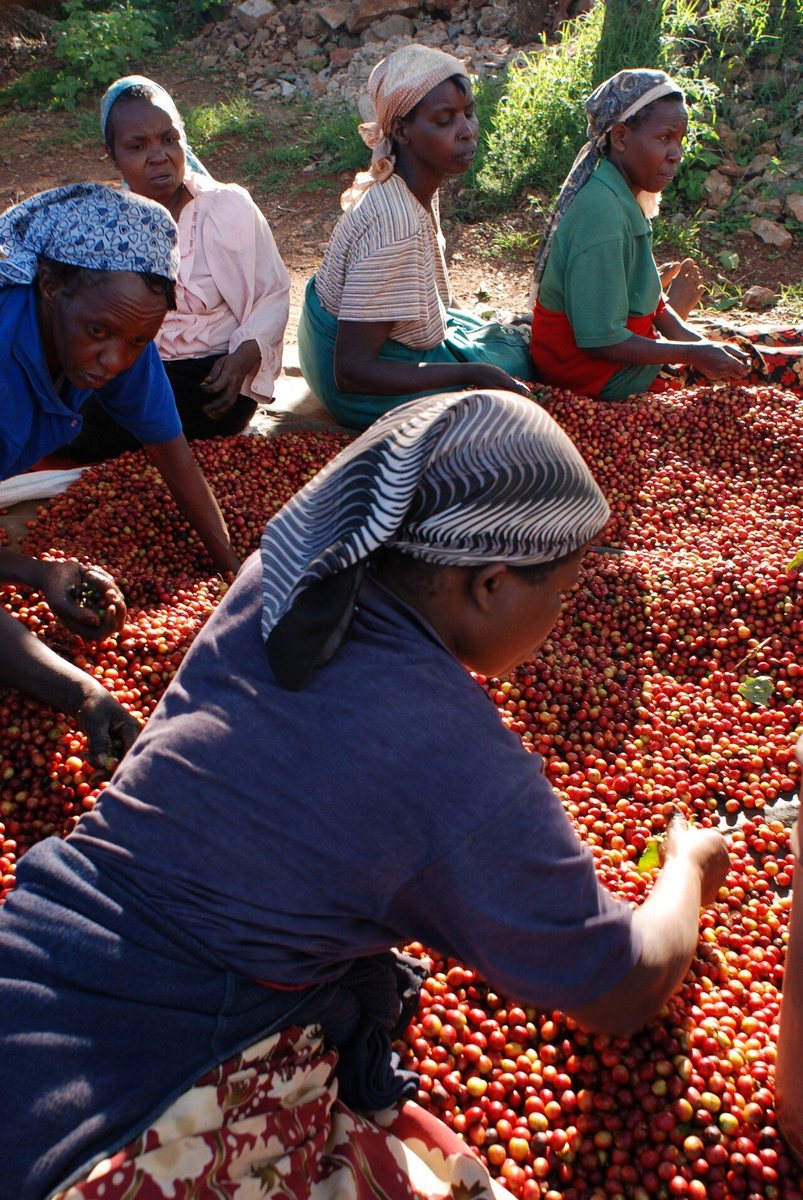
Direct trade is a form of sourcing practiced by certain coffee roasters, chocolate makers, tea sellers, and others who build direct relationships with the farmers, artisanal miners, and processors who produce the raw material they buy. Unlike certifications governed by third-party standards bodies, there is no single set of direct trade rules, and specific practices vary widely as a reflection of each company's business priorities and ethical commitments.
At its broadest, direct trade is defined by the roaster or buyer — not by an external auditor. A roaster may visit a farm once and call it direct trade; another may spend years co-investing in processing infrastructure, paying well above the market price, and publishing detailed price disclosures. Both can legitimately use the label. This ambiguity is one of the model's most contested features.
Direct trade emerged as a meaningful practice within the third wave coffee movement, which emphasizes single-origin sourcing, transparency about provenance, and a pursuit of quality that extends all the way back to the farm. Understanding direct trade in context requires some familiarity with the broader coffee supply chain, where the distance between producer and consumer has historically been measured in layers of intermediaries, exporters, and commodity exchanges.
The Promise: What Direct Trade Advocates Claim
Proponents of direct trade identify several advantages over conventional commodity purchasing and even over fair trade certification:
- Higher premiums paid directly to producers. Direct trade advocates argue that by eliminating middlemen and co-operative overhead, a larger share of the retail price reaches the farmer. Premiums are typically tied to cup quality rather than a fixed floor price, creating an economic incentive for producers to invest in fermentation, drying, and careful picking.
- Quality-linked pricing. Because premiums are negotiated against specific quality benchmarks — often scored using the Specialty Coffee Association's 100-point cupping scale — producers have a clear commercial reason to pursue excellence. A coffee scoring 86 points earns a different price than one scoring 82.
- Access for all farm sizes. Unlike fair trade co-operative membership, direct trade can, in principle, include individual smallholders, family farms, and estates of any size, without requiring membership fees or co-operative affiliation.
- Financial support beyond price. Many direct trade practitioners offer microloans, equipment financing, agronomic training, or shared information about processing methods — forms of support that compound the value of the relationship beyond a single transaction.
- Elimination of certification fees. Fair trade certification carries fees, dues, and surcharges that reduce net income for producers. Direct trade has no equivalent mandatory cost structure, though this also means no guaranteed minimum standard.
- Transparency and trust through personal relationships. Regular farm visits, open price negotiation, and long-term commitments are held up as generating supply chain trust that paper-based certification cannot replicate.
A 2011 study cited in the academic literature found that while fair trade strategies showed a greater impact on overall infrastructure development at coffee farms, direct trade models showed a greater impact on increased wages and an improved quality of life as reported by participating farmers — a distinction that matters when evaluating what each model is actually optimized to deliver.
Key Pioneers and the Transparency Report
The roasters most closely identified with establishing direct trade as a credible practice are the so-called "Big Three" of third-wave coffee in the United States: Intelligentsia Coffee & Tea (Chicago), Stumptown Coffee Roasters (Portland, Oregon), and Counter Culture Coffee (Durham, North Carolina). All three built their identities in part around direct sourcing relationships and are frequently cited as original direct traders.
Of these, Counter Culture Coffee and craft chocolate maker Taza Chocolate pioneered a practice that has become a benchmark for accountability in the industry: the annual Transparency Report. These documents disclose — publicly and in detail — the prices paid per origin, the relationships maintained, and the quality standards applied. Crucially, Counter Culture and Taza have their direct trade practices audited annually by an independent third party, bringing a degree of external accountability that most self-identified direct trade programs lack.
Whether these efforts will succeed in setting a durable standard for the industry, or whether they will remain the exception rather than the rule, remains an open question and the subject of ongoing debate among sourcing professionals and advocates.
The emergence of direct trade is inseparable from the history of specialty coffee and the broader arc from commodity-grade purchasing in the first wave and second wave eras toward the farm-level focus that defines contemporary specialty sourcing.
Direct Trade vs. Fair Trade: A Structural Comparison
The relationship between direct trade and fair trade is complicated — they share some goals but differ fundamentally in structure, accountability, and scope.
Fair trade (as certified by Fairtrade International and similar bodies) is a structured certification system designed to promote ethical trading standards for the benefit of producers in developing countries. It establishes minimum floor prices, regulates labor standards, provides access to credit and micro-financing, and funds infrastructural investment through co-operative premiums. Many studies have found that fair trade has contributed to stabilization in the world coffee market and improvements across certified farms.
Direct trade, by contrast, is not a certification at all — it is a sourcing philosophy with no universal floor price, no mandated labor standards, and no required external audit (though some practitioners voluntarily pursue these).
The table below summarizes the structural differences:
| Dimension | Fair Trade | Direct Trade |
|---|---|---|
| Governing body | Third-party certifier (e.g. Fairtrade International) | None — defined by each buyer |
| Price floor | Yes — mandated minimum | No — negotiated case by case |
| Certification fees | Yes — paid by producers and buyers | None |
| Co-operative requirement | Typically yes | No — individual farms eligible |
| Quality linkage | Not required | Common among rigorous practitioners |
| Transparency | Standardized reporting | Voluntary; varies widely |
| Third-party audit | Required for certification | Optional; rare |
Both models attract criticism. Fair trade has faced challenges ranging from claims of limited effectiveness to arguments that its structure benefits larger, better-organized co-operatives at the expense of the smallest producers, and broader concerns about the disbursement of co-operative premiums. Direct trade, meanwhile, faces the criticism that its lack of regulation makes it easy to misuse as a marketing term without substance.
Criticism and the Accountability Gap
The most persistent criticism of direct trade is that the label is unregulated and therefore unverifiable. Critics — including former advocates who helped build the model — have pointed to a trend of larger, marketing-savvy roasters using the term without offering any clear definition of what their direct trade program entails, any evidence of an actual direct sourcing scheme, or any meaningful transparency about their pricing and relationships.
This is not merely a theoretical concern. Because "direct trade" can be applied to anything from a single farm visit to a decade-long partnership with published price disclosures and third-party audits, a consumer or wholesale buyer has no way of comparing two companies that both use the label. The term carries reputational weight without carrying legal or structural obligations.
The lack of third-party accountability is the specific failure mode that critics identify most often. Without external verification, there is no mechanism to distinguish a roaster that pays 40% above the commodity price and publishes itemized farm-level payments from one that pays standard export prices and visited the farm once for a photo opportunity.
Some practitioners have responded to this critique by:
- Publishing annual transparency reports with farm-level pricing (Counter Culture Coffee and Taza Chocolate are the most cited examples).
- Submitting their sourcing practices to independent annual audits.
- Developing internal standards — minimum farm visit frequencies, price thresholds, multi-year contract commitments — and communicating these clearly to customers.
But these remain voluntary measures, and industry-wide adoption is limited. The debate over whether direct trade can or should develop into a formalized standard — or whether formalization would recreate the very bureaucratic costs it was designed to eliminate — is unresolved.
Pricing, Premiums, and Transparency Reports
One of the most concrete expressions of direct trade's values is the practice of price disclosure. A transparency report typically covers:
- The name and location of each farm or co-operative from which coffee was purchased
- The FOB (free on board) or farmgate price paid per pound or kilogram
- How that price compares to the commodity market price or the fair trade floor price
- The quality scores and relationship history associated with each lot
This level of disclosure is still rare in the broader industry. Most roasters — including many who use the phrase "direct trade" — do not publish the prices they pay producers. The specialty coffee world has no equivalent of a securities disclosure regime; price transparency is entirely voluntary.
Where transparency reports exist, they serve several functions simultaneously: they hold the roaster accountable to its own stated commitments, they allow producers to understand whether the prices they receive are competitive, and they give consumers and wholesale buyers the information needed to evaluate claims.
The SCA's emphasis on traceability and its cupping standards provide a quality framework within which direct trade pricing can be anchored — coffee scoring 80 or above on the SCA's 100-point scale qualifies as specialty grade, and direct trade premiums are often calibrated against scores within that range.
Direct Trade in the Broader Industry Context
Direct trade is neither a universal solution to the structural inequities of the coffee industry nor a mere marketing affectation. It exists on a spectrum: at its best, it represents a model of transparent, quality-linked, relationship-based commerce that demonstrably improves farmer income; at its worst, it is an unverifiable label attached to conventional purchasing.
Several dynamics shape its future:
- Consolidation pressure. Both Intelligentsia and Stumptown — two of direct trade's founding practitioners — were acquired by Peet's Coffee & Tea (itself part of JAB Holding Company) in 2015. Whether large corporate structures can sustain the intensive, relationship-based sourcing that direct trade requires at scale is a genuine operational question.
- Consumer demand for proof. As specialty coffee consumers become more sophisticated, the bar for what counts as meaningful transparency is rising. Vague claims are increasingly challenged by journalists, competing roasters, and producer advocates.
- Producer-side agency. Increasingly, farmers and co-operatives are developing their own quality assessment capabilities, attending international trade events, and negotiating directly with multiple buyers — shifting some of the informational power that has historically resided with the roaster back toward the origin.
- Hybrid models. Some roasters combine fair trade certification with direct trade practices, using the certification as a baseline guarantee while layering additional premiums and transparency on top.
The conversation about what direct trade should mean — and what it should require — is ongoing. For now, the most reliable signal of a genuine direct trade program remains the combination of published farm-level pricing, documented multi-year relationships, verifiable quality linkage, and independent audit. Everything else is, as the critics note, a claim waiting for evidence.
Frequently asked questions
- Is direct trade certified or regulated?
- No. Unlike fair trade, direct trade is not governed by any single certifying body and has no universal standards. Each roaster or buyer defines what their direct trade program entails, which means the term can mean very different things from company to company.
- Does direct trade guarantee farmers are paid more?
- Not automatically. Rigorous direct trade programs tie premiums to quality scores and publish the prices paid, often significantly above commodity or fair trade floor prices. However, because the label is unregulated, a roaster can use it without demonstrating that producers receive any premium at all.
- What is a transparency report in the context of direct trade?
- A transparency report is a voluntary public document in which a roaster discloses the prices paid to each farm or co-operative, the quality scores associated with each lot, and the history of those relationships. Counter Culture Coffee and Taza Chocolate pioneered this practice and have their direct trade practices audited annually by independent third parties.
- How does direct trade differ from fair trade?
- Fair trade is a certification system with mandated price floors, required co-operative membership, certified labor standards, and third-party audits. Direct trade is an unregulated sourcing philosophy with no floor price, no co-operative requirement, and no mandatory audit. Direct trade can, in principle, allow individual farmers of any size to participate and can pay higher premiums tied to quality — but it provides no structural guarantee of doing so.
- Which roasters are most associated with founding direct trade?
- Intelligentsia Coffee & Tea, Stumptown Coffee Roasters, and Counter Culture Coffee in the United States are most often cited as the original direct trade coffee roasters. Counter Culture Coffee is particularly noted for pioneering annual transparency reports and submitting its practices to independent audit.
- Can a roaster practice both direct trade and fair trade?
- Yes. Some roasters use fair trade certification as a baseline ethical floor and layer additional direct trade premiums and transparency practices on top, creating a hybrid model that combines third-party accountability with deeper sourcing relationships.
See also