Discover · For You
For the Coffee Professional: Tools & References
Standards, competitions, scoring systems, and the gear that serious coffee professionals actually rely on.
Key facts
- Founded
- January 2017 from SCAA and SCAE merger
- Members
- Over 10,000 across 40+ countries
- Specialty Threshold
- 80 points on SCA 100-point scale
- WBC Format
- 15-minute routine with espresso, milk, signature drinks
- Key Grinder
- Niche Zero for reference-grade single-dose grinding
The SCA: The Standards Body Behind Specialty Coffee
If you work in specialty coffee professionally, you operate — knowingly or not — within a framework largely set by the Specialty Coffee Association. The SCA was formed in January 2017 when the Specialty Coffee Association of America (founded 1982) and the Specialty Coffee Association of Europe merged into a single global organization. Today it counts more than 10,000 active members across more than 40 countries, spanning producers, importers, roasters, and retailers.
For a working professional, the SCA matters in practical terms: it maintains the cupping protocols, the green and roast grading standards, the barista and brewing curriculum (the Coffee Skills Program), and the rulebooks that govern world-level competition. Whether you're dialing in a filter roast for a cupping table or preparing a routine for a regional barista competition, you're working within SCA-derived conventions.
The SCA has not been without controversy. In 2026, its World Coffee Championships faced criticism after the nationality designation of Taiwanese competitor Bala — winner of the 2026 World Latte Art Championship — was changed from "Taiwan" to "Chinese Taipei" in official records, reportedly without public explanation. The Taiwan Coffee Association objected publicly, and the SCA later described the change as an "administrative decision" citing naming conventions used by bodies such as the IOC and FIFA. The episode is a reminder that the organization governing the sport is itself subject to political and institutional pressures.
Cupping: The Universal Language of Coffee Evaluation
Cupping is the foundational sensory protocol every Q Grader, green buyer, and serious roaster learns early and never stops using. The SCA's standardized method — water temperature, grind size, coffee-to-water ratio, steeping time, and evaluation sequence — exists to make scores comparable across tables, continents, and seasons. If you haven't worked through the methodology in detail, Cupping: The SCA Protocol is the place to start.
At its most professional level, cupping feeds directly into the SCA 100-Point Scale, the scoring system that separates commodity coffee from specialty (the threshold is generally 80 points) and stratifies quality within specialty itself. The ten attributes — Fragrance/Aroma, Flavor, Aftertaste, Acidity, Body, Balance, Uniformity, Clean Cup, Sweetness, and Overall — each carry weighted point values. Scoring consistently and accurately across those attributes is the core skill of a Q Grader, a credential administered by the Coffee Quality Institute.
For roasters, cupping is also a production tool: roast-to-roast consistency checks, blend development, and green coffee selection all run through the cupping table. Getting your cupping environment right — consistent water, controlled room temperature, calibrated grinders, identical brewing vessels — matters as much as the protocol itself.
Competition Formats: What They Test and Why They Matter
Barista competition formats are not just spectacle. They codify what the industry currently values and create a shared vocabulary for excellence. Understanding the major formats is useful even if you never compete. For a full breakdown, see Coffee Competitions.
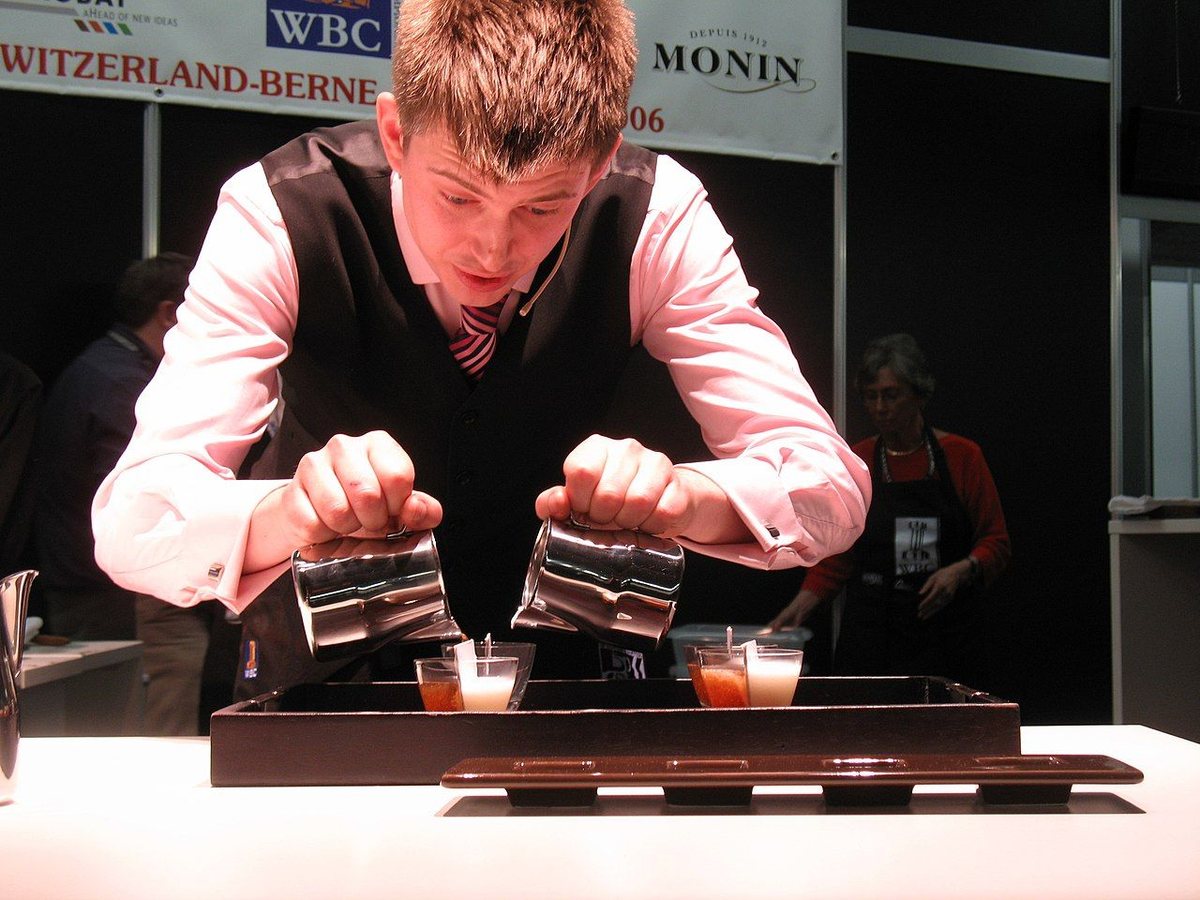
World Barista Championship (WBC) is the flagship event, held annually at a rotating international location. Competitors present a 15-minute routine: four espressos, four milk drinks, and four signature drinks, judged on taste, technique, and the competitor's ability to articulate their coffee. The WBC is credited, among other things, with spreading the espresso-and-tonic format across North America — a concrete example of how competition influences café menus globally. Formal barista competition itself originated in Norway, and the WBC has grown into a genuinely international event since.
World Brewers Cup (WBrC) focuses on filter coffee prepared by hand, without espresso equipment, evaluating the brewer's command of a single method and their sensory acuity in service of a specific coffee's best qualities.
World Cup Tasters Championship tests blind discrimination — identifying the odd cup in a triangle test under time pressure. For Q Graders and buyers, it's the most directly applicable format to daily work.
World Latte Art Championship judges technical precision and aesthetic creativity in milk texturing and free-pour design — a distinct skill set that overlaps with, but doesn't duplicate, the WBC's milk-drink component.
Each format publishes its rulebook openly, and reading them is one of the more underrated forms of professional development available to baristas and roasters alike.
The Grinder: Your Most Important Investment
Every serious coffee professional will tell you the same thing: the grinder is the single piece of equipment that most determines cup quality, and it's where skimping costs you most in the long run. For a professional working in a home lab, a small training café, or a competition prep environment, the Niche Zero has become a reference-grade single-dose grinder. Its zero-retention design means you're grinding exactly what you weigh in — critical when you're dialing in small batches or switching between coffees on a cupping table. Single-dosing eliminates stale grind buildup, which matters enormously when you're evaluating coffee at a professional level.
The trade-off to know: the Niche Zero is a home and light-professional grinder, not a high-volume workhorse. For a commercial bar doing volume, your needs differ. But for the roaster running QC cuppings, the competition-prep barista, or the Q Grader building a home evaluation setup, it's a considered and honest choice.
Scales: Where Precision Becomes Reproducible
In a professional context, a scale isn't a luxury — it's how you make any result repeatable. The Acaia Pearl S is a purpose-built coffee scale with the response time and resolution that competition and calibration work demands. Its real-time flow-rate display is genuinely useful when you're learning to read and control an espresso shot rather than just hitting a target weight.
For filter work and cupping — where you're weighing grounds, water, and yield across multiple vessels — the Pearl S's connectivity and logging features mean you can track variables across sessions rather than relying on memory or hand-written notes. That kind of session-to-session record-keeping is part of what separates professional practice from enthusiast experimentation.
The honest note: Acaia scales sit at a premium price point. If your work is primarily manual-brew bar rather than competition or R&D, a well-calibrated lower-cost scale will serve you. The Pearl S earns its price when the data it captures is actually being used.
Kettles: Temperature Control as a Variable, Not an Afterthought
Water temperature is a fundamental brew variable, and professionals who work across multiple brewing methods — pour-over, Chemex, AeroPress, cupping — need a kettle that holds the temperature they set, not one they have to guess at. The Fellow Stagg EKG Pro offers degree-level temperature precision and a hold function, which matters in a cupping or training context where you may be pouring over 15 or 20 minutes.
The gooseneck spout is also a real professional concern, not aesthetic: pour rate and aim affect agitation, which affects extraction. For competition baristas working on pour-over or filter signatures, and for roasters training staff on extraction fundamentals, having a kettle that removes temperature variability from the equation is the point.
References Worth Building Into Your Practice
Beyond the gear and the certifications, a professional coffee practice runs on reference knowledge that accumulates over time. A few categories worth investing in:
Sensory calibration is ongoing, not one-time. Regular cupping — both solo and with peers — and periodic participation in calibration sessions with other trained cuppers is how you keep your palate honest. The SCA's sensory curriculum and the CQI's Q Grader program both structure this formally, but informal peer cupping works too.
Competition rulebooks are free, publicly available, and densely informative. Even if you never compete, reading the current WBC rules tells you what the judging panel weights, which is itself a useful lens on professional standards.
Green coffee knowledge — understanding processing methods, variety, and origin — is increasingly expected at the professional level, not just the buyer level. Roasters who can articulate why a washed Ethiopian expresses differently from a natural one of the same variety on the cupping table are more valuable collaborators to the cafés they supply.
The SCA's published research and white papers, available to members, cover water chemistry, extraction yield, sensory science, and more. If you haven't mined that archive, it's worth the time.
Building a Professional Setup: Summary Checklist
For a roaster, Q Grader, or competition-prep barista assembling a serious evaluation and practice environment:
- Grinder: Single-dose, zero-retention — the Niche Zero is a strong reference point
- Scale: High-resolution with real-time flow rate — Acaia Pearl S
- Kettle: Degree-precise temperature control — Fellow Stagg EKG Pro
- Protocol: SCA cupping methodology — see Cupping: The SCA Protocol
- Scoring literacy: Internalize the SCA 100-Point Scale
- Competition context: Understand the formats at Coffee Competitions
- Community: SCA membership, CQI programs, peer cupping groups
None of these elements work in isolation. The gear serves the protocol; the protocol serves the palate; the palate, calibrated against peers and standards, is ultimately what a coffee professional is developing and protecting.
Gear for this
Frequently asked questions
- What is the SCA and why does it matter to working coffee professionals?
- The Specialty Coffee Association (SCA) is a global non-profit trade organization formed in 2017 from the merger of the SCAA (founded 1982) and the SCAE. With more than 10,000 members across 40+ countries, it maintains the cupping protocols, grading standards, barista curricula, and competition rulebooks that define professional practice in specialty coffee.
- What score does a coffee need to qualify as 'specialty' on the SCA scale?
- The SCA 100-point scoring system generally sets the specialty threshold at 80 points. Coffees scoring below that are considered commodity grade. Within specialty, scores above 90 are considered exceptional.
- How does the World Barista Championship format work?
- Competitors have 15 minutes to present four espressos, four milk-based drinks, and four signature drinks to a panel of sensory and technical judges. They are scored on taste, technique, and their ability to communicate the story and qualities of their coffee.
- Is the Niche Zero suitable for commercial bar use?
- The Niche Zero is best suited to home, competition-prep, and QC cupping environments — it excels as a zero-retention single-dose grinder for precision work. It is not designed for high-volume commercial throughput, where a dedicated commercial grinder would be the appropriate choice.
- What is a Q Grader and how does the certification work?
- A Q Grader is a licensed coffee quality evaluator certified by the Coffee Quality Institute (CQI). The certification involves a rigorous battery of sensory and cupping exams that test a candidate's ability to score coffees accurately on the SCA 100-point scale and identify sensory attributes and defects. Recertification is required periodically to keep the credential current.
- Why do competition formats matter to baristas who don't plan to compete?
- Competition rulebooks codify what the industry currently values — extraction parameters, sensory standards, presentation expectations — and reading them is a form of professional development. Formats like the WBC have directly influenced café menus and industry vocabulary, making them relevant context even for non-competitors.
See also