Mosto Fermented Washed
Bolivia: Gregorio & Nancy Palli, Mosto Fermented Washed
Roasted by Ozone Coffee
Bolivian Caturra and Catuai with bright lime, blackcurrant, and cocoa from mosto fermented washed processing.
From the roaster
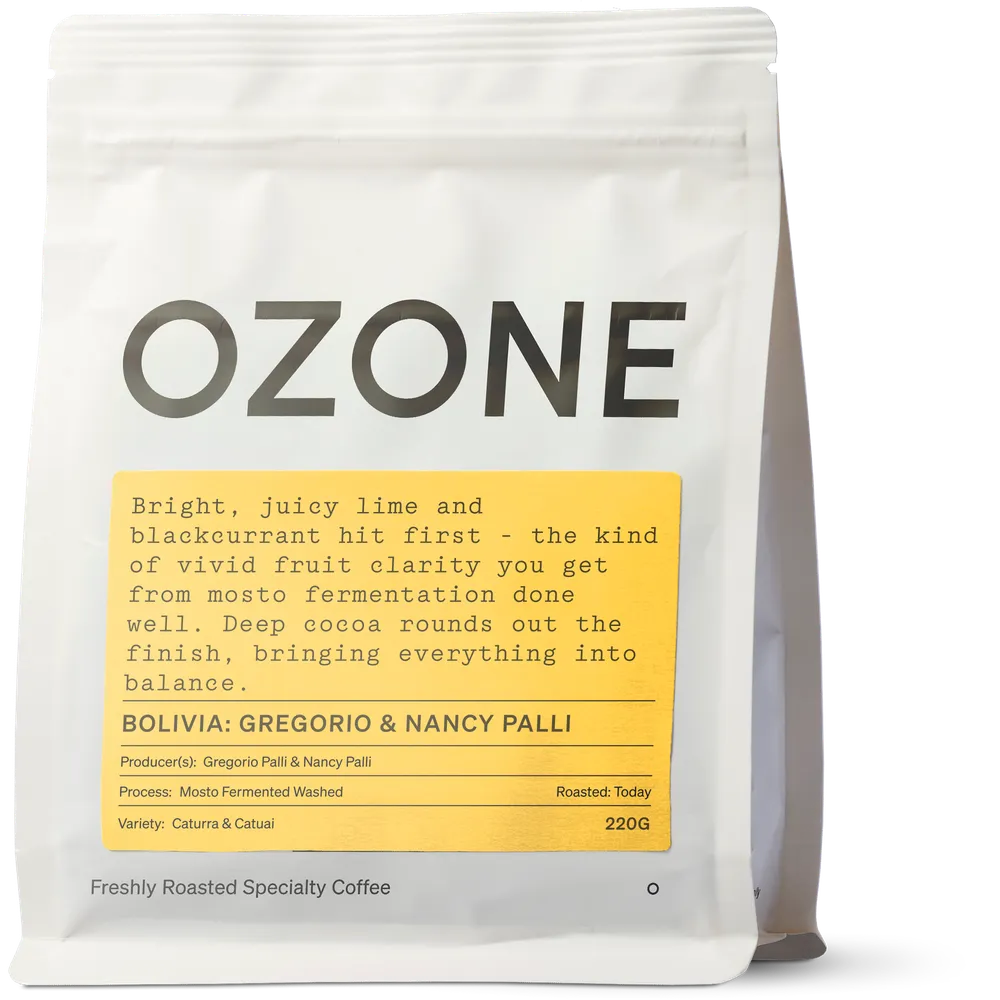
Bolivia: Gregorio & Nancy Palli, Mosto Fermented Washed
Bright, juicy lime and blackcurrant hit first - the kind of vivid fruit clarity you get from mosto fermentation done well. Deep cocoa rounds out the finish, bringing everything into balance.
This Bolivian Caturra and Catuai coffee is a combination of lots harvested from two neighbouring farms. It was grown by Gregorio Palli and his daughter Nancy, on their farms facing each other over a hillside, before heading to the Agricafe Buena Vista mill to be processed using their Mosto Fermented Washed technique.
A Family Story
When Gregorio was a young boy, his parents decided to move from their home in the Muñecas province of Bolivia (just north of Lake Titicaca) and travelled to the Caranavi area to provide him a better education. There was no school in their town, the roughly 100km relocation was worth it to give Gregorio a good start in life.
Gregorio is now a full-time coffee producer, living on his 12-hectare farm with his wife Daisy and his two youngest children. In his free time, Gregorio enjoys going on walks around town with his kids, swimming in the river, and playing football. He has owned his coffee farm for 35 years now and the little ones love to help their dad out when they can. His brother Julio also runs his own coffee farm nearby. As does his daughter Nancy (one of his two grown-up children from his first marriage) who has graduated from playing on the farm to running her own, and whose coffee we’ve also got here. Clearly the move to Caranavi was a felicitous decision for Abuela y Abuelo Palli!
The Best Bolivian Coffee
The Caranavi province sits towards the western edge of Bolivia, on the eastern slopes of the Andes mountain range. Caranavi means "high place" in the Aymara language, one of the indigenous languages spoken in Bolivia. Caranavi province is in a transitional zone between the high Andes and the Amazon basin, it’s known for its lush vegetation and has been dubbed the "Coffee Capital of Bolivia" for its ideal growing conditions and over 13,000 hectares of plantations. Caranavi is the hub for amazing Bolivian specialty coffee. Caranavi town (the capital of the province) itself is too low altitude to grow coffee so the farms are all situated in the surrounding hills. The Palli family’s farms are dotted around the Copacabana colonia (the Bolivian term for small agricultural villages), as are some other Ozone favourites such as Vincent Palli and Martin Chirino. It’s safe to say the region produces some truly delicious coffees.
Tigers and Gold
Gregorio’s farm covers 12 hectares in total but only 2 hectares are currently used to grow coffee. It is named Volcán del Tigré, which translates to “Tiger’s Volcano” in English, although “tigré” is used locally to mean jaguars. Prior to becoming the well-tended specialty coffee farm it is today, the land used to be very overgrown with wild vegetation. Local people used to say that they saw smoke rising from one of the hills in the jungle, they thought it must be a volcano. Legend has it that when smoke comes from the hills, there's gold to be found there! Around the same time, nearby residents also noticed what appeared to be a footpath running through the land – this turned out to be a tiger's path, worn into the landscape by prowling big cats. To this day, Gregorio doesn't keep animals on the farm as they might become el tigrés next meal. He is looking to expand his coffee-growing area over more of the ten other hectares on his farm and is really excited about what the future at Volcán del Tigre holds.
Nancy’s farm is a little smaller than her father’s, situated just across the valley on the opposite hillside. As is more common for Bolivian coffee farmers, her land doesn’t have a set name. That tends to only be the case with larger or more established farms, such as Gregorio’s, and Nancy has not been in the business as long as her dad. She hasn’t quite got to the naming level yet, but with cof
— Ozone Coffee
Context
This Bolivian microlot from the Palli family combines Caturra and Catuai varietals through an innovative mosto fermented washed process—a technique that introduces additional fermentation complexity during wet processing. Sourced from Caranavi, a region known for its elevation and rich soil, this coffee balances bright acidity with depth, expressing characteristics typical of fermented preparations while maintaining the clarity that defines washed coffees. Ozone Coffee's tasting profile emphasizes the juicy, fruit-forward character the process encourages, with lime and blackcurrant notes complemented by cocoa undertones. Natural-process coffees tend to showcase heavier fruit expression; this hybrid method offers a middle ground—structured brightness with fermented complexity.
In the Encyclopedia
Frequently asked questions
What does Bolivia: Gregorio & Nancy Palli, Mosto Fermented Washed taste like?
Expect tasting notes of bright, juicy, lime, blackcurrant, and cocoa.
How is Bolivia: Gregorio & Nancy Palli, Mosto Fermented Washed processed?
Bolivia: Gregorio & Nancy Palli, Mosto Fermented Washed uses the Mosto Fermented Washed process.
More from Ozone Coffee
View all →Mosto Washed
Bolivia: Don Carlos, Mosto Washed
Soft and sweet Bolivian coffee with sultanas, apricot, and golden sugar notes.
Dry Fermented Washed
Bolivia: Pedro Flores, Dry Fermented Washed
Crisp Bolivian Catuai with red apple, redcurrant, and balanced biscuity sweetness.
Honey
Bolivia: Jeivert Panuni
Honey-processed Bolivian coffee with bright berry and sweet apple notes.
Anaerobic Natural
Thailand: Aoy & Nui
Anaerobic natural Typica from Thailand with red cherry, banana and vanilla notes.
More Mosto Fermented Washed coffees
Last verified: June 27, 2026 · Browse all beans.