Knowledge · brewing
Moka Pot
Steam-pressure percolation, Bialetti history, and the technique for a clean, bitter-free cup
Key facts
- Named after
- Mokha, Yemeni port city
- Invented by
- Alfonso Bialetti in 1933
- Operating pressure
- 1 to 2 bar, not espresso
- Typical TDS
- 3 to 4 percent dissolved solids
- Grind size
- Fine-to-medium, finer than drip
- Most common regions
- Europe, Latin America, Australia
- Avoid bitterness by
- Use hot water, avoid tight packing
History and Origins
The moka pot takes its name from Mokha, the Yemeni port city long associated with fine coffee. The principle behind it — using steam pressure to push heated water up through a bed of ground coffee — dates to at least 1818, when a patent by Elard Römershausen described a large machine operating on the same basis. More portable versions followed, including a design by Louis Bernard Rabaut submitted to the French Academy of Sciences in 1822.
The device that became a household icon was created by Alfonso Bialetti, an Italian aluminium merchant, who introduced the Moka Express in 1933. His son Renato Bialetti subsequently popularized the design across Italy and beyond, and Bialetti Industries continues to manufacture the original model under the Moka Express trade name to this day. The pot became so thoroughly embedded in Italian domestic culture that it is difficult to overstate its cultural significance — examples now reside in the permanent collections of institutions including the Museum of Modern Art (MoMA), the Cooper–Hewitt National Design Museum, the Smithsonian, and the London Science Museum.
Today the moka pot is most commonly used in Europe, Latin America, and Australia, and is produced in sizes ranging from one to eighteen 50 ml servings.
How It Works: The Physics of Percolation
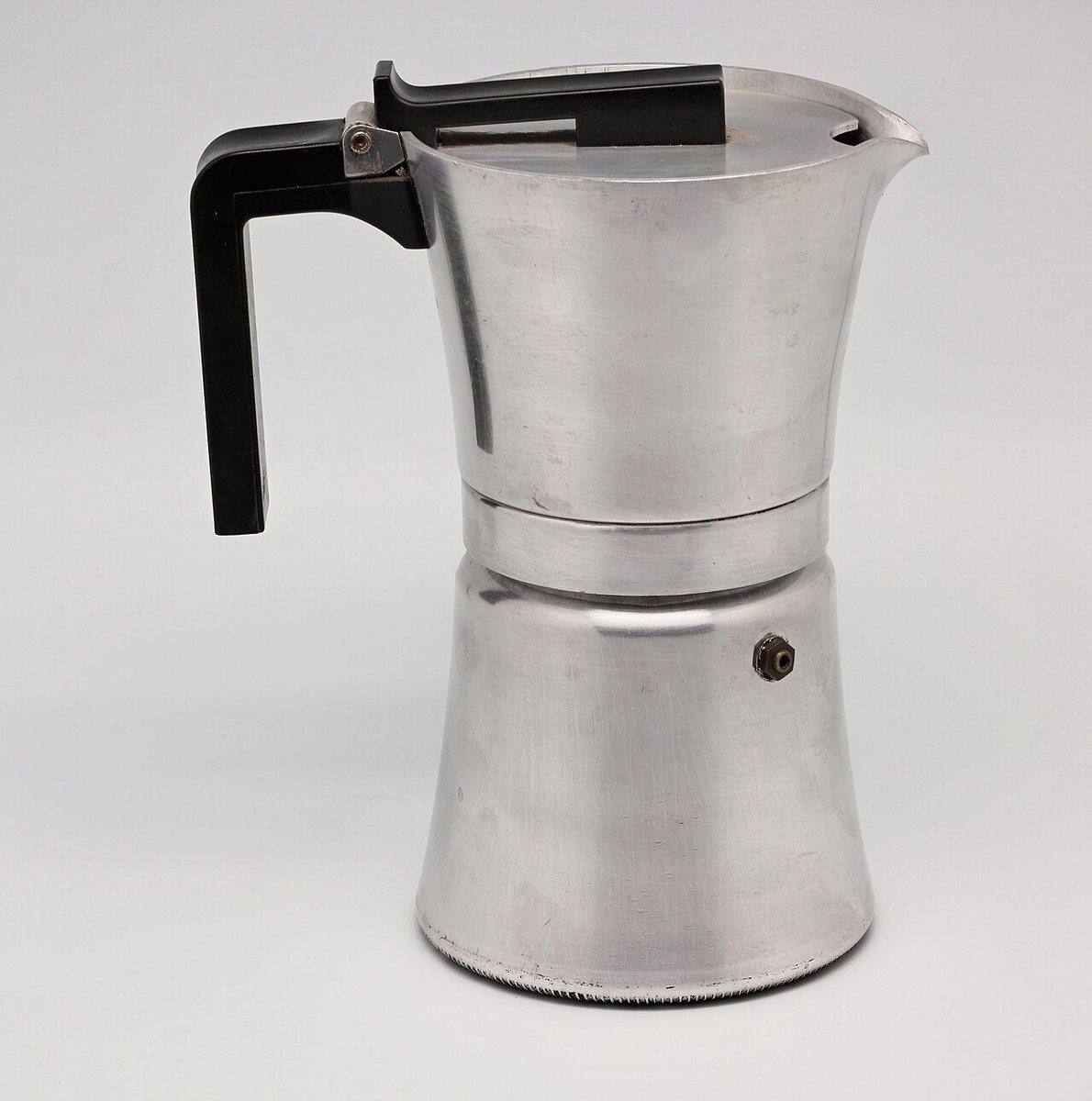
A standard moka pot consists of three components:
- The lower chamber (boiler): Holds water and is fitted with a safety valve to prevent dangerous over-pressurization.
- The filter funnel (basket): Holds the ground coffee and, when the pot is assembled, compresses a rubber gasket to form an airtight seal.
- The upper chamber (collector): Receives the brewed coffee as it rises through the central spout.
When heat is applied, pressure inside the sealed boiler rises due to two simultaneous effects: the expansion of enclosed air and the increasing vapour pressure of the heating water. Once pressure is sufficient, water is forced upward through the coffee bed and emerges as brewed coffee into the upper chamber.
The operating pressure is typically 1 to 2 bar (100–200 kPa) — a figure that is critical to understanding what moka coffee is and is not. This is far below the 9 bar required by espresso standards, which is why, despite the "stove-top espresso" nickname commonly applied to the device, moka coffee is technically not espresso. See Extraction: Yield & Strength for a deeper comparison of pressure, dissolved solids, and brew strength.
A number of physics papers published between 2001 and 2009 modelled the moka pot's brewing process using the ideal gas law, Darcy's law, and the temperature-dependent vapour pressure of water.
Brew Characteristics: Strength, TDS, and Caffeine
Moka coffee occupies a distinct position on the concentration spectrum. The device typically uses a coffee-to-water ratio of approximately 1:10 by mass, yielding a brew with roughly 3–4% dissolved solids (TDS). For context:
| Method | Approx. TDS |
|---|---|
| Drip / filter coffee | ~2% |
| Moka pot | ~3–4% |
| Espresso | ~9–10% |
This places moka coffee well above filter brews in strength, but considerably below a true espresso shot. The result is a dense, full-bodied cup with a pronounced roast character — well suited to drinking straight or with milk, but not capable of producing the emulsified crema associated with high-pressure espresso extraction.
Caffeine content has been measured across a wide range of 128–539.9 mg per 100 mL, a spread that reflects the significant influence of variables such as grind fineness, heat level, roast, and how long the brewer is left on the heat. See Brew Ratio for more on how the coffee-to-water ratio shapes strength and extraction.
Grind Size and Packing
Grinding & Particle Size is one of the most consequential variables in moka pot brewing. The conventional guidance is to use a fine-to-medium grind — finer than drip filter, but not quite as fine as espresso. Because the water passes through the grounds under pressure rather than gravity, a finer grind produces efficient extraction; however, a grind that is too fine will slow the flow of water through the bed, raise brewing pressure unevenly, and risk over-extraction and bitterness.
As a general principle, beans that are too finely ground expose too much surface area to heated water and produce a bitter, harsh, over-extracted result — a risk that is heightened in the moka pot because the water temperature and contact time are difficult to control precisely once the pot is sealed and on the heat.
Key grind considerations:
- Use a burr grinder for a uniform particle size; blade grinders produce inconsistent fragments that extract unevenly.
- Aim for a consistency roughly between table salt and granulated sugar.
- Do not tamp the coffee firmly into the basket. Light, even filling allows water to pass through evenly. Tight packing can elevate pressure and concentrate heat in the coffee bed.
- Fill the basket to the brim but level, without pressing down.
Technique: Avoiding Bitterness
The most common complaint about moka pot coffee — harsh bitterness — is largely a product of avoidable technique errors rather than an inherent flaw of the method. Research on moka brewing identifies a critical late stage called the "strombolian" phase: as the lower chamber empties, bubbles of steam begin mixing with the remaining water, and this superheated mixture passes through the coffee at high temperature, causing rapid over-extraction and the introduction of undesirable bitter compounds.
Practical steps to a cleaner cup:
- Use pre-boiled or hot water in the boiler. Starting with water that is already near boiling temperature reduces the time the grounds spend exposed to rising heat before extraction begins, minimising the risk of scorching the coffee bed and shortening contact time overall. Cold water means the grounds sit in a heating chamber for longer before pressure builds.
- Use low to medium heat. A gentle flame or low electric setting produces a slower, more controlled rise in pressure. Rapid, high heat forces the strombolian phase to arrive sooner and more violently.
- Remove from heat at the gurgle. The characteristic gurgling sound signals that steam is entering the spout. This is the cue to immediately remove the pot from the heat source — or run cold water over the base — to stop the strombolian phase before it over-extracts.
- Do not pack the grounds tightly. As noted above, even filling supports even extraction.
- Keep the pot clean. Residual coffee oils in the basket and upper chamber go rancid and introduce stale, bitter notes. Hand-wash all components with water only; aluminium moka pots are not dishwasher safe, and detergent use is discouraged.
Flavour is also shaped by Water for Coffee — mineral content and pH influence extraction rate and perceived acidity — and by Brew Temperature dynamics in the boiler.
Materials and Maintenance
The original Moka Express and most current models are made from aluminium with Bakelite handles. Stainless steel versions are also widely available and, unlike aluminium models, are compatible with induction hobs. Some contemporary designs feature an upper chamber made from heat-resistant glass.
Concerns about aluminium migration into acidic beverages have been scientifically investigated. Studies found that migration falls below 1% of the recommended total weekly intake once a new pot has been used a few times. Migration rose to a maximum observed level of just under 4% of weekly intake after dishwasher cleaning — the primary reason dishwasher use is strongly discouraged.
Routine maintenance includes:
- Periodic replacement of the rubber gasket, which degrades with heat cycling.
- Regular cleaning of the filter disc, which can accumulate compacted grounds.
- Checking that the safety valve is unobstructed, as a blocked valve is a safety hazard.
- Scrubbing all parts by hand with water, without detergent.
The Moka Pot in Context
The moka pot occupies a unique niche in the landscape of Brewing Coffee: it is more concentrated and body-forward than filter methods such as Chemex or Kalita Wave, but it lacks the crema-producing pressure of an espresso machine. Its low cost, simplicity, and the absence of paper filters make it a practical and sustainable daily brewer, particularly for those who prefer a robust, milk-friendly cup without the investment of an espresso setup.
For brewers seeking a similarly hands-on, pressure-assisted method at low cost, the AeroPress Original provides a complementary approach — it can brew under manual pressure and offers far more adjustability in variables such as temperature, steep time, and grind, making it a useful companion or alternative to the moka pot for experimentally minded home baristas.
Dial it in
Live recipe for this method — tweak the dose and ratio, then brew along with the timer. Open the full calculator.
18g coffee · 288ml water (1:16)
Pour schedule
- 0:00Bloom: pour to 45g, swirl, wait
- 0:45Pour to 126g
- 1:20Pour to 207g
- 1:55Pour to 288g
- 2:45Drawdown complete — serve
Gear for this
Frequently asked questions
- Is moka pot coffee the same as espresso?
- No. Despite being commonly called "stove-top espresso," moka pot coffee is brewed at approximately 1–2 bar of pressure, far below the 9 bar required by espresso standards. The resulting brew has around 3–4% dissolved solids, compared to 9–10% for espresso, and does not produce the emulsified crema associated with high-pressure extraction.
- What grind size should I use for a moka pot?
- A fine-to-medium grind — finer than drip filter coffee, but not as fine as espresso — is generally recommended. A uniform grind from a burr grinder is strongly preferred. Grinding too fine risks over-extraction and bitterness; too coarse produces a weak, under-extracted result.
- How do I stop my moka pot coffee from tasting bitter?
- The most effective steps are: start with pre-boiled or hot water in the boiler; use low to medium heat; remove the pot from the heat immediately when you hear gurgling (the 'strombolian' phase); do not tamp the grounds tightly; and clean the pot regularly by hand with water only, without detergent.
- Can I use a moka pot on an induction hob?
- Only stainless steel moka pots are compatible with induction cooking. Standard aluminium models, including the original Bialetti Moka Express, cannot be used on induction hobs.
- How much caffeine does moka pot coffee contain?
- Caffeine content has been measured at a wide range of 128–539.9 mg per 100 mL, reflecting the significant variation introduced by grind size, heat level, roast, and how long the pot remains on the heat after brewing begins.
- Is aluminium safe to brew coffee in?
- Scientific investigation has found aluminium migration from moka pots to be negligible — below 1% of the recommended total weekly intake under normal use. However, washing aluminium moka pots in a dishwasher was found to raise migration to just under 4% of weekly intake, which is why hand washing without detergent is strongly recommended.
See also