Knowledge · brewing
Brew Temperature
How water temperature shapes extraction kinetics, flavour balance, and equipment design—from the 90–96 °C window to PID-controlled espresso machines.
Key facts
- Optimal Range
- 90–96 °C (195–205 °F)
- Key Variables
- Temperature, grind size, brew time, brew ratio
- Over-extraction Risk
- Above roughly 96 °C, bitter compounds extract rapidly
- Cold Brew Time
- 12–24 hours or longer at ambient or refrigerated
- Boiling Point Effect
- Decreases with altitude; drops to 93 °C at 2,000 metres
- Sub-optimal Zone
- 80–89 °C produces flat, underdeveloped cups
The 90–96 °C Window
Coffee is almost universally brewed hot, at temperatures close to the boiling point of water, and the range commonly cited across professional and hobbyist communities is 90–96 °C (195–205 °F). This window did not emerge arbitrarily: it represents a practical equilibrium between extraction efficiency on one end and flavour integrity on the other.
Within this band, water dissolves the full spectrum of desirable soluble compounds—organic acids, sugars, melanoidins, and aromatic oils—at a rate and in a balance that most tasters find pleasant. Brew just above this range and the risk of over-extraction climbs sharply; brew well below it and the cup risks being sour, thin, and under-developed.
As the sources note, water temperature is one of the key variables in coffee preparation, alongside grind size, brew time, and brew ratio—all of which interact with one another. Changing temperature without adjusting the others often shifts the cup in unexpected directions.
Why Higher Temperatures Extract Faster
The relationship between temperature and extraction rate is governed by basic thermodynamic and chemical kinetic principles. At higher temperatures, water molecules carry more kinetic energy, which accelerates the diffusion of soluble compounds out of the coffee particle matrix and into solution.
Practically, this means:
- Higher temperature → faster extraction of a wider range of compounds.
- Lower temperature → slower, more selective extraction, with lighter-molecular-weight acids and aromatics dissolving before heavier, more bitter compounds have time to follow.
This kinetic relationship is why grind size and brew time must be calibrated alongside temperature. Brewing methods that expose grounds to water for longer periods—French press, percolation drip—generally rely on coarser grinds to compensate for extended contact time. Temperature amplifies this effect: a finer grind at higher temperature can accelerate extraction so dramatically that the brew tips into harshness before the intended brew time has elapsed.
The Bitterness Risk at High Temperatures
Over-extraction—drawing too many compounds from the grounds—produces a cup characterized by harsh, dry bitterness and astringency. As one source describes, grounds exposed to too much surface area and heated water will produce a "bitter, harsh, 'over-extracted' taste."
Temperature is one of the levers that pushes extraction toward this zone. Above roughly 96 °C, several classes of compounds that are typically slow to solubilize begin to extract more readily:
- High-molecular-weight chlorogenic acid lactones and their degradation products contribute a dry, medicinal bitterness.
- Phenolic compounds associated with astringency become more mobile in very hot water.
- Delicate floral and citrus aromatic notes are volatile and can be driven off or masked when brewing temperatures are too aggressive.
The practical implication is that darker roasts—which are already higher in bitter-tasting compounds and lower in bright acids—are often brewed at the lower end of the recommended range, while lighter roasts, whose desirable compounds require more energy to extract, are sometimes pushed toward or slightly above the upper boundary. This is not a universal rule, but a useful starting heuristic when dialling in an unfamiliar coffee.
Lower Temperatures: Clarity, Selectivity, and Cold Brew
When temperature drops below the conventional window, extraction slows and becomes increasingly selective. Lighter, more soluble acids and some aromatics extract preferentially, while heavier bitter compounds are left largely undissolved. The result, when done well, is a cup with heightened clarity, brighter acidity, and a cleaner finish—though achieving sufficient extraction yield requires compensating with a finer grind, a longer brew time, or both.
This principle reaches its logical extreme in cold brew, where coffee is steeped in ambient-temperature or refrigerated water for many hours (commonly 12–24 hours or longer). As the sources observe, cold-brewed coffee is less sensitive to contact time than hot-brewed coffee, and it maintains its character well when stored cold—making it suited to preparation well in advance. The resulting beverage is typically lower in perceived acidity and bitterness, with a heavy, smooth body, because the thermal energy required to mobilize the sharpest bitter compounds is simply absent.
Between the cold-brew extreme and the conventional hot window lies a zone of sub-optimal temperatures—roughly 80–89 °C—that is often more problematic than either approach. At these temperatures, extraction is fast enough to pull sour acids but not always complete enough to balance them with sweetness and body, producing flat, underdeveloped cups.
For a deeper dive into how soluble yield relates to cup strength, see Extraction: Yield & Strength.
Altitude and the Boiling Point Effect
A practical complication for brewers at elevation is that water boils at a lower temperature as altitude increases. At sea level, water boils at 100 °C (212 °F). At approximately 2,000 metres above sea level, the boiling point drops to roughly 93 °C (199 °F); at 3,000 metres, it falls to around 90 °C (194 °F).
This has direct consequences:
- At moderate elevations, boiling water may fall within or just at the edge of the recommended brew temperature window without any additional temperature management.
- At high elevations—common in major coffee-producing and coffee-consuming regions across Ethiopia, Colombia, and parts of Asia—boiling water may already sit at or below the lower boundary of the optimal range.
- Brewers who habitually rely on "just-off-the-boil" as a proxy for 93–96 °C will find that proxy increasingly unreliable as altitude rises.
The practical takeaway is that altitude-aware brewers should use a thermometer or variable-temperature kettle rather than relying on the boiling event as a temperature signal. This is especially relevant in high-altitude cities where specialty coffee culture is prominent.
Temperature Stability and Espresso: The Role of PID Controllers
For filter brewing methods, temperature precision is important but some drift is tolerable—the relatively large water volume and longer brew time allow for a degree of averaging. Espresso is categorically different. In espresso, a small volume of water (roughly 36–42 g for a double shot) passes through a compact puck of finely ground coffee in 25–35 seconds under pressure. Minor fluctuations in water temperature—even ±2–3 °C—can meaningfully shift extraction balance and cup character.
The industry response to this challenge was the widespread adoption of PID (Proportional-Integral-Derivative) controllers in espresso machines. A PID controller monitors the boiler or group head temperature continuously via a sensor and adjusts the heating element in real time to maintain the target setpoint with minimal overshoot or oscillation.
Key advantages of PID control in espresso:
- Repeatable shot-to-shot temperature: the machine can be set to a specific degree and held there consistently across a service period.
- Adjustability: baristas can dial the temperature up or down by single-degree increments to compensate for roast level, origin characteristics, or blend composition.
- Thermal stability during back-to-back shots: traditional thermosiphon boiler designs without PID are prone to temperature drift when pulled in rapid succession; PID mitigates this.
Modern single-boiler, heat-exchanger (HX), and dual-boiler machines all implement PID differently, but the underlying principle—closed-loop feedback control—is consistent. For high-volume commercial settings, dual-boiler machines with independent PID loops for the brew boiler and the steam boiler represent the current standard of temperature management.
Temperature and the Other Brewing Variables
Brewers sometimes treat temperature as an isolated dial, but it is deeply entangled with the other key variables of coffee preparation. The sources are clear that extraction character depends simultaneously on grind particle size, water temperature, contact time, water quality, freshness of the roast and grind, and the brew ratio.
Some practical interaction effects worth understanding:
- Temperature and grind size: A coarser grind at higher temperature may extract similarly to a finer grind at lower temperature, offering a route to compensation when equipment has a fixed temperature.
- Temperature and brew time: Reducing temperature while extending brew time is a common strategy in pour-over brewing to enhance clarity and emphasize delicate aromatics—especially floral and citrus notes—without sacrificing overall extraction yield.
- Temperature and water chemistry: Water composition—particularly mineral content and buffering capacity—affects how temperature interacts with acidic and bitter compounds. Soft water at high temperatures can accelerate extraction of sharp acids; harder water may buffer against some of these effects.
- Temperature and roast level: As a general orientation, lighter roasts benefit from the upper portion of the recommended window (93–96 °C) because their desirable compounds are denser and harder to solubilize; darker roasts, already carrying more developed bitter compounds, often express better at 90–93 °C.
For a full treatment of how these variables combine across different brewing methods, see the dedicated methodology articles.
Practical Guidance for Brewers
The following principles synthesize the above into actionable guidance:
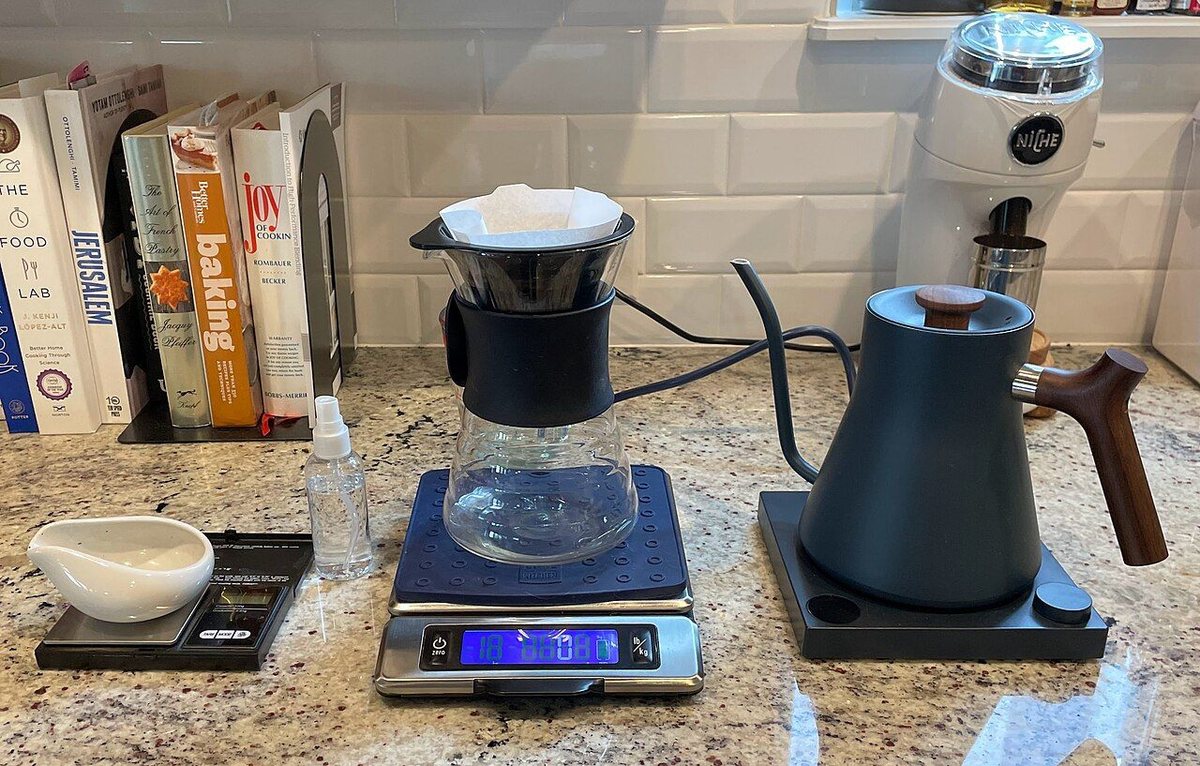
- Use a thermometer or variable-temperature kettle. Estimating temperature by watching a kettle is unreliable, especially at altitude. Most variable-temperature kettles allow setting in 1 °C increments and hold temperature for several minutes.
- Start in the middle of the window. 93 °C (199 °F) is a widely used default for filter brewing and a reasonable starting point before adjusting based on the cup.
- Adjust for roast. Lighter roasts: move toward the higher end. Darker roasts: move toward the lower end. If the cup tastes sour or thin, consider raising temperature before changing other variables.
- Account for your altitude. If you are at significant elevation, your boiling water is already cooler than it would be at sea level—this may mean it falls within or below your target range without any waiting.
- For espresso, invest in PID. Machines without PID make temperature reproducibility difficult. If cup consistency is a priority, stable temperature management is not optional.
- Remember that temperature is one variable among several. Over-reliance on temperature adjustment to fix cup problems can mask underlying issues with grind size, brew ratio, water quality, or coffee freshness. Approach it as part of a system.
For foundational context on all these interacting variables, see Brewing Coffee.
Frequently asked questions
- What is the recommended water temperature for brewing coffee?
- The range most commonly cited across professional and hobbyist communities is 90–96 °C (195–205 °F). This window balances extraction efficiency against the risk of over-extracting harsh, bitter compounds. The precise point within the range depends on roast level, grind size, and brew method.
- Does using hotter water always make coffee more bitter?
- Not automatically, but it increases the risk. Higher temperatures accelerate the extraction of all soluble compounds, including those associated with harsh bitterness and astringency. Brewing above roughly 96 °C makes it easier to over-extract before the intended brew time has elapsed, particularly with finer grinds or darker roasts.
- Why does water temperature matter differently for espresso than for filter coffee?
- In espresso, a very small volume of water contacts a tightly packed coffee puck for only 25–35 seconds under high pressure. Even small temperature fluctuations—a few degrees—can noticeably shift extraction balance and cup character. PID controllers are used in modern espresso machines to maintain a precise, stable temperature throughout each shot and across back-to-back pulls.
- How does altitude affect brew temperature?
- Water boils at a lower temperature as altitude increases. At approximately 2,000 metres above sea level, the boiling point drops to around 93 °C (199 °F), and at 3,000 metres it falls to approximately 90 °C (194 °F). Brewers at altitude who rely on 'just-off-the-boil' water may already be at or near the lower limit of the recommended range—or below it—without realising it.
- Can you brew good coffee at lower temperatures?
- Yes, with appropriate adjustments. Brewing at sub-optimal hot temperatures (around 80–89 °C) tends to produce sour, under-developed cups because extraction is selective and incomplete. However, cold brew—steeped at ambient or refrigerated temperatures for 12–24 hours or more—produces a distinct beverage with lower perceived acidity and bitterness and good keeping quality when stored cold.
- Should lighter and darker roasts be brewed at different temperatures?
- As a practical heuristic, yes. Lighter roasts contain denser cell structures and less-developed soluble compounds that benefit from the energy of higher temperatures (toward 93–96 °C) to extract fully. Darker roasts, which already carry more bitter compounds, often express more cleanly at the lower end of the window (90–93 °C). These are starting points, not fixed rules.
See also