Knowledge · brewing
Immersion Brewing
A complete reference to full-immersion brewing: how it works, how it differs from percolation, and how to dial in French press, switch drippers, and cupping bowls.
Key facts
- Definition
- Ground coffee fully submerged in static water for extraction
- Common methods
- French press, Clever Dripper, Hario Switch, cupping bowl
- Key advantage
- Forgiving method with self-limiting extraction
- Grind size
- Coarser than percolation, roughly coarse cooking salt
- Standard ratio
- 15–18:1 water-to-coffee by mass
- Water temperature
- 93–96 °C for French press, close to boiling
- Flavor character
- Heavier mouthfeel, rounder, less acidic than percolation
What Is Immersion Brewing?
Immersion brewing is any method in which ground coffee is fully submerged in—and remains in contact with—a static body of water for the duration of the steep. The grounds are not continuously fed with fresh water; instead, they sit in the same volume of water until extraction is deemed complete and separation occurs. Common immersion brewers include the French press (cafetière), Clever Dripper, Hario Switch, and the cupping bowl used in professional sensory evaluation.
The category stands in contrast to percolation brewing, in which fresh water flows continuously through a bed of grounds, flushing extracted compounds away and replacing them with a lower-concentration liquid. In immersion, as extraction proceeds, the concentration of dissolved solids in the surrounding water rises until it approaches equilibrium with the coffee particles, at which point extraction slows significantly. This self-limiting dynamic is one of the key reasons immersion is considered a more forgiving method.
Immersion vs. Percolation
Understanding the distinction between immersion and percolation clarifies why the two methods produce different cups:
- Driving force of extraction. In percolation, fresh water constantly dilutes the liquid around the grounds, maintaining a steep concentration gradient and driving continued extraction. In immersion, the gradient collapses as the water approaches saturation, naturally capping extraction.
- Grind sensitivity. Because percolation relies on water flowing through a particle bed, grind uniformity and size directly affect flow rate and contact time—channeling is a real risk. Immersion is less sensitive: as the sources note, brewing methods that expose coffee grounds to heated water for longer require a coarser grind, but the self-limiting nature of immersion means modest grind variation has a smaller impact on the final cup.
- Flavor profile. Percolation methods (pour-over, drip) tend to emphasize clarity, brightness, and delicate aromatic notes. Immersion methods, particularly those using metal mesh filters, allow coffee oils and fine particles to pass into the cup, producing a heavier mouthfeel and a rounder, less acidic character.
- Repeatability. Once steep time and brew ratio are fixed, immersion results are highly repeatable because there is no variable pour technique to control.
Even Extraction and the Role of Grind Size
One of the most-cited advantages of full immersion is extraction evenness. Because every particle is in contact with water simultaneously, there is no "fast lane" through the bed the way channeling can create in percolation. That said, grind particle size still matters:
- A coarser grind is recommended for immersion. For example, the French press works best with coffee ground to roughly the consistency of coarse cooking salt. Finer grounds have lower permeability, require excessive force to plunge, and are more likely to pass through or around the mesh filter into the cup.
- Beans ground too finely will expose too much surface area to the water and produce a bitter, over-extracted result. Conversely, an overly coarse grind will yield a weak brew unless the dose is increased.
- A uniform grind is highly desirable regardless of method. Burr mills, which crush beans between two abrasive elements with little frictional heating, release the coffee's oils and produce a more consistent particle distribution than blade grinders—leading to a richer, smoother extraction.
Because the contact time is adjustable in immersion, a shorter steep can be used to compensate for a finer grind, and vice versa—giving the brewer a second lever to dial in extraction yield and strength.
Key Brewing Variables
The same variables that govern all coffee preparation apply to immersion, though their relative importance shifts:
| Variable | Role in Immersion Brewing |
|---|---|
| Grind size | Coarser than percolation; affects body and filter passage |
| Water temperature | Typically close to boiling; the French press calls for 93–96 °C (199–205 °F) |
| Steep time | The primary dial; commonly around four minutes for a French press |
| Brew ratio | Commonly cited range of 15–18:1 water-to-coffee by mass; differences within this range are easily perceived |
| Water quality | Mineral content affects extraction and flavor—see Water for Coffee |
Brew temperature deserves particular attention: coffee is usually brewed hot, at close to the boiling point of water, immediately before drinking. The 93–96 °C window specified for the French press is broadly representative of immersion practice, though cupping protocols use water at a similarly elevated temperature poured directly over grounds.
The French Press
The French press—also called cafetière (UK/Ireland), coffee plunger (Australia, New Zealand, South Africa), or press pot—is the archetype of immersion brewing. Its design history stretches back to an 1852 French patent by Henri-Otto Mayer and Jacques-Victor Delforge, though the spring-sealed filter mechanism familiar today was patented in 1928–1929 by Milanese designers Giulio Moneta and Attilio Calimani. The version most widely sold today descends from Faliero Bondanini's 1958 patent and was popularized across Europe under the Melior and later Bodum Chambord brand names.
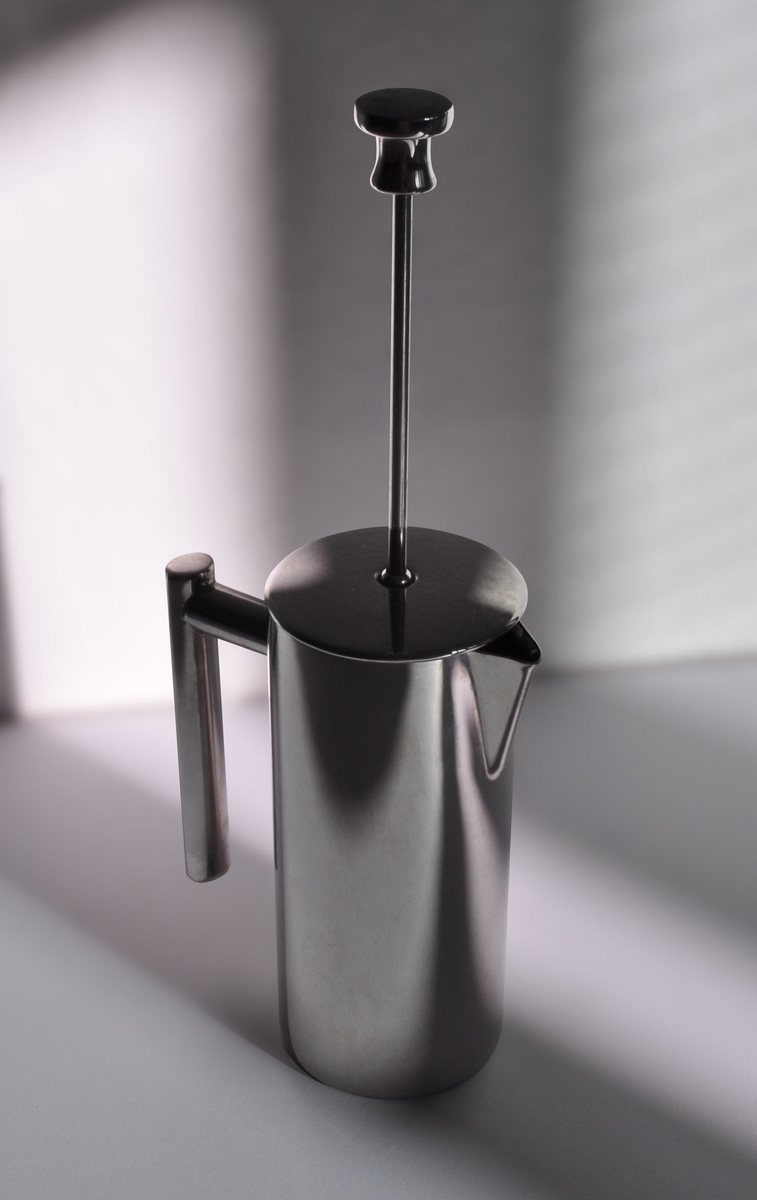
The modern French press consists of a narrow cylindrical beaker—usually glass or clear plastic—with a metal or plastic lid and a plunger fitted with a fine stainless steel wire or nylon mesh filter.
Standard procedure:
- Add coarsely ground coffee to the dry beaker (approximately 30 g per 500 ml of water, adjusted to taste).
- Pour hot water at 93–96 °C evenly over the grounds.
- Steep for approximately four minutes, though this is adjustable based on grind and preference.
- Press the plunger slowly to hold the grounds at the bottom.
- Serve immediately. Leaving brewed coffee on the grounds can cause the cup to become astringent and bitter over time.
Filter and body: The metal mesh allows coffee oils and a small quantity of fines to pass into the cup. This is the principal reason French press coffee is associated with a heavier, richer mouthfeel compared to paper-filtered methods. Brewers who prefer a cleaner cup sometimes add a paper filter above the mesh plunger, though this is a departure from classic practice.
Variations include insulated stainless steel presses (which maintain temperature the way a vacuum flask does), travel mug versions, and the "reverse French press" or "French pull," in which a mesh basket is pulled into the lid after steeping to isolate the grounds. The American press variant inverts this logic: water is added first, and a basket of grounds is slowly pushed down through the water column.
Switch and Hybrid Drippers
A newer category of immersion device combines the even extraction of steeping with the clarity of paper filtration: switch drippers and hybrid immersion drippers.
The Hario Switch is a widely used example. A valve at the base of the dripper stays closed during steeping, holding the water and grounds in full immersion. When the brewer opens the switch, gravity draws the liquid through the paper filter into a server below, stripping oils and fines in the process. The result blends the extraction evenness of immersion with the clarity and brightness more commonly associated with pour-over.
The Clever Dripper operates on the same principle. Because the contact time is controlled by the brewer (not by flow rate), both devices are more forgiving of grind variation than conventional pour-overs like the Kalita Wave 185 or Chemex 6-Cup.
Key differences from a pure immersion brewer like the French press:
- Paper filtration removes oils and fines, producing a cleaner, lower-body cup.
- Decanting is built in: once the switch opens, separation is complete, ending extraction immediately and preventing the bitterness that can develop when coffee sits on its grounds.
Cupping: Immersion as Quality Standard
In professional sensory evaluation, cupping is an immersion protocol used by roasters, buyers, and the Specialty Coffee Association (SCA) to assess coffee quality and compare lots on a level playing field. The procedure is deliberately simple:
- Coarsely ground coffee is placed in an open bowl.
- Hot water is poured directly over the grounds.
- After a set steep period, a crust of floating grounds is broken and the aromatics are assessed.
- Grounds are skimmed from the surface, and the liquid is evaluated by slurping with a spoon.
There is no filter; oils and fines are present in the cup. Cupping's reliance on immersion is not accidental—it eliminates the variables introduced by filtration equipment, pour technique, and flow rate, producing a baseline that reflects the coffee itself. Because immersion is the most method-neutral way to brew, it became the industry's sensory standard.
Practical Guidance: Dialing In Immersion
- Start with the ratio. Commonly cited brew ratios fall in the 15–18:1 range (water to coffee by mass). Differences within this range are easily perceived by an experienced drinker, so weigh both water and coffee for consistency.
- Control temperature. Brew close to boiling; 93–96 °C is a practical target for hot immersion methods.
- Adjust steep time first. Because grind affects body and filtration rather than extraction rate as dramatically as in percolation, steep time is often the most effective dial. Longer steep → more extraction; shorter steep → brighter, lighter cup.
- Grind coarse, grind uniformly. A burr grinder set to a coarse setting will minimize fines that cloud the cup or clog mesh filters.
- Decant promptly. If using a French press or cupping bowl, pour off or serve the coffee as soon as the steep is complete. Extended contact with grounds pushes extraction toward astringency and bitterness.
- Freshness matters. Ground coffee deteriorates faster than whole beans due to the greater surface area exposed to oxygen. Grinding immediately before brewing preserves aroma and flavor.
For guidance on how extraction yield and total dissolved solids (TDS) relate to immersion results, see Extraction: Yield & Strength.
Dial it in
Live recipe for this method — tweak the dose and ratio, then brew along with the timer. Open the full calculator.
18g coffee · 288ml water (1:16)
Pour schedule
- 0:00Add 18g coffee, pour ~58g, stir to bloom
- 0:30Top up to 288g
- 3:30Break crust, then plunge
- 4:00Serve immediately
Watch a brew guide
James Hoffmann covers the Immersion Brewing in a 12-minute video. Watch the review below, then see the details and where to buy — all without leaving the page.
James Hoffmann takes a hands-on look at the AeroPress Original. We link it for its specs walkthrough and real-world impressions — form your own view by watching.
More videos
Gear for this
Frequently asked questions
- What makes immersion brewing more forgiving than pour-over?
- In immersion, all grounds are submerged in the same body of water simultaneously, so there is no uneven channeling caused by an inconsistent pour. As extraction proceeds, the concentration of dissolved solids in the water rises and the extraction rate naturally slows, creating a self-limiting effect. This means modest variations in grind size or timing have a smaller impact on the final cup than they would in a percolation method.
- Why does French press coffee taste heavier and oilier than filtered coffee?
- The French press uses a metal mesh filter, which allows coffee oils and a small quantity of fine particles to pass into the cup. These oils and fines are responsible for the heavier mouthfeel and fuller body associated with the method. Paper-filtered methods trap these compounds, producing a cleaner, brighter result.
- How long should I steep coffee in a French press?
- Some writers give the optimal steep time as around four minutes, though this is adjustable. A shorter steep suits a slightly finer grind; a longer steep works with coarser coffee. If the brewed coffee is left on the grounds after steeping, it can become astringent and bitter, so it is best to serve or decant promptly.
- What brew ratio should I use for immersion brewing?
- Preferred brew ratios commonly fall in the range of 15–18:1 water to coffee by mass. Even within this fairly narrow range, differences are easily perceived by an experienced drinker, so weighing both coffee and water with a scale is recommended for consistency. The French press is often cited with approximately 30 g of grounds per 500 ml of water as a starting point.
- What is the difference between a Hario Switch and a French press?
- Both are immersion brewers that steep grounds in a static body of water, but they differ in filtration. The French press uses a metal mesh plunger, which passes oils and fines into the cup for a heavier body. The Hario Switch holds water in the dripper via a valve and then releases it through a paper filter when opened, removing oils and fines for a cleaner, brighter cup while retaining the extraction evenness of full immersion.
- Why is cupping done as an immersion method?
- Cupping eliminates the variables introduced by filtration equipment, pour technique, and flow rate, making it the most method-neutral way to evaluate coffee. Because immersion places all grounds in contact with water simultaneously and does not involve any filter medium, the resulting cup reflects the coffee's intrinsic character more directly than percolation methods would.
See also