Guides · Comparisons
AeroPress vs French Press: Which Immersion Brewer?
Two immersion classics compared across cup quality, body, cleanliness, ease of use, and portability — so you can pick the right brewer for your kitchen, camp, or carry-on.
Key facts
- Brewing method
- Immersion brewing with filtered separation
- Key difference
- AeroPress uses paper microfilter; French press uses mesh
- AeroPress inventor
- Alan Adler, retired Stanford engineering lecturer
- French press origins
- Patent filed 1852 by Mayer and Delforge
- AeroPress brew time
- Approximately 30-40 seconds total contact time
- French press brew time
- Around four minutes for hot brew
- Cup character
- AeroPress clean and bright; French press rich and textured
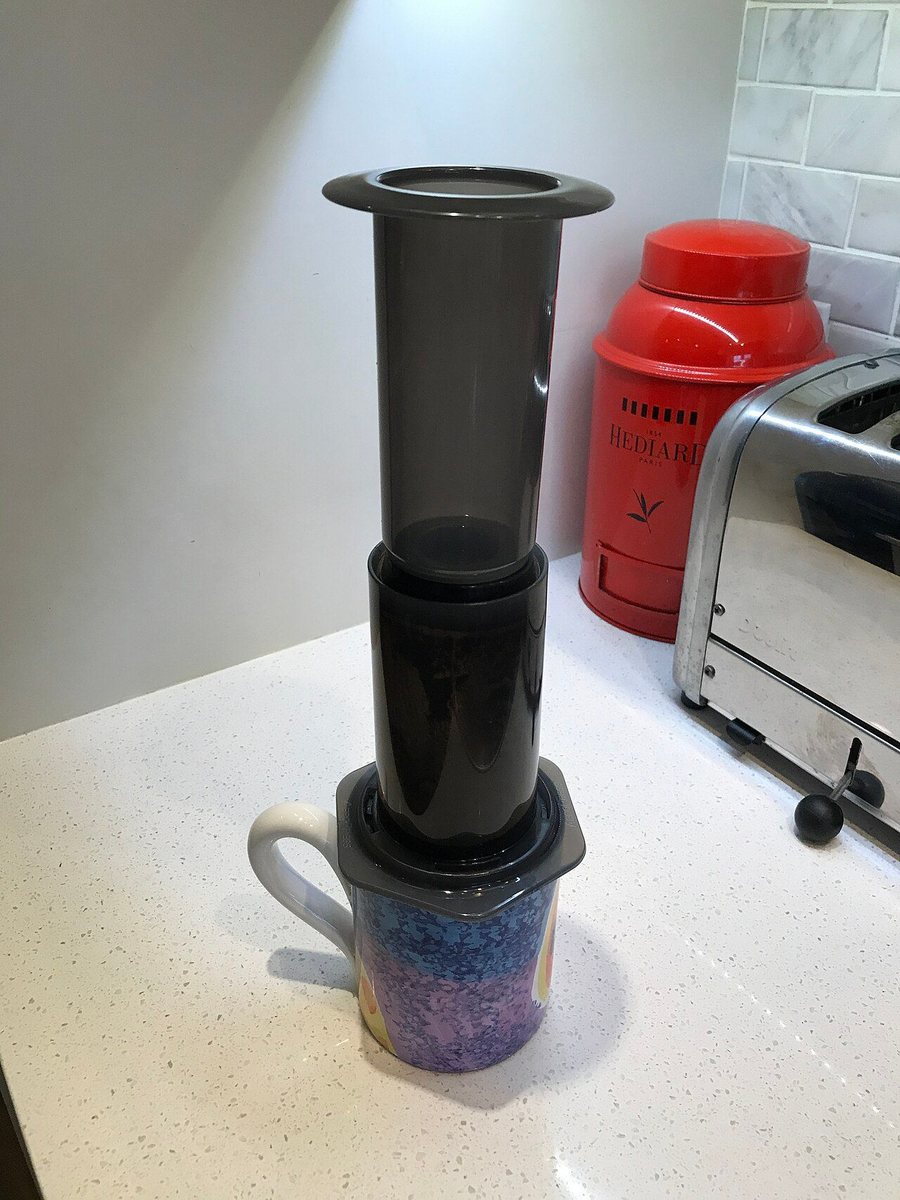
AeroPress and French Press are both immersion brewers, but differ sharply in filtration, flavor, and versatility.
| Which Immersion Brewer? | AeroPress | French Press |
|---|---|---|
| Best for | Travel, single cup, experimentation | Full-bodied coffee, beginners, batch brewing |
| Filter type | Paper microfilter (or metal option) | Stainless-steel or nylon mesh, no paper |
| Cup cleanliness | Bright, sediment-free, oil-filtered | Heavy, oily, some sediment in cup |
| Flavor profile | Clean, nuanced, tunable acidity | Bold, viscous, earthy, muted acidity |
| Brew time | ~30–40 seconds total contact time | ~4 minutes for hot brew |
| Water temperature | 176–185°F depending on roast level | 199–205°F, hotter than AeroPress |
| Grind size | Flexible; fine to medium works well | Coarse required; finer risks over-extraction |
| Price | Budget-friendly | Budget-friendly |
| Where to buy | Check price | Check price |
What Makes a Brewer "Immersion"?
Immersion brewing is the oldest and most forgiving category in coffee: grounds sit fully submerged in water for a fixed period, extracting steadily until you separate liquid from solids. Both the AeroPress and the French press belong to this family, which is why they share certain virtues — consistency, minimal equipment, no need for a gooseneck kettle — and why comparing them is genuinely useful rather than arbitrary.
The critical fork in the road is filtration. The AeroPress forces coffee through a paper (or metal) microfilter using hand pressure, while the French press relies on a stainless-steel or nylon mesh that the grounds simply press against. That single difference cascades into almost every other distinction between the two brewers.
The AeroPress: Syringe Logic
The AeroPress Original was invented by Alan Adler, a retired Stanford engineering lecturer who had previously patented the Aerobie flying ring. Adler began prototyping in his garage in 2004 with a specific, personal goal: reduce acidity and bitterness in his daily cup. He was dissatisfied with espresso machines, pour-over, and — notably — the French press, and wanted greater control over brew time, water temperature, and grind size.
The device he arrived at is essentially a large syringe: a cylindrical brewing chamber, a plunger with an airtight silicone seal, and a screw-on cap that holds a small circular filter. Coffee steeps inside, then you press the plunger down, forcing the brew through the filter and into your cup. The pressure this generates makes the AeroPress capable of producing a highly concentrated shot comparable to espresso, though it can equally brew filter-strength coffee or even cold brew.
Key AeroPress specs and notes
- Filter type: Ships with 350 paper microfilters; AeroPress now sells its own stainless-steel mesh filter (as of 2024), and a wide third-party accessory ecosystem includes reusable metal filters, flow-control caps, and cold-drip adapters.
- Materials: Early models used polycarbonate; switched to BPA-free copolyester in 2009, then polypropylene in 2014. In 2023, new Tritan clear models were added. The company states lab tests found the original model did not leach BPA into brewed coffee.
- Variants: The AeroPress Go (travel-sized, launched 2019), the AeroPress XL (double-capacity with carafe), the AeroPress Premium and Steel (glass and metal chambers), and the AeroPress Go Plus (insulated travel mug) all followed.
- Temperature: The manufacturer recommends approximately 176 °F (80 °C) for dark roast and 185 °F (85 °C) for lighter roasts.
- Brew time: Around 10 seconds of stirring after adding water, then a press of roughly 20–30 seconds in standard technique — total contact time is brief and user-controlled.
- Championship scene: The World AeroPress Championship, first held in Oslo in 2008 with just three competitors, grew to attract 3,157 competitors from 61 countries by 2018, reflecting the brewer's outsized cultural footprint.
The French Press: Gravity and Oil
The French press has a far longer and more contested history. A patent forerunner was filed by two Frenchmen, Henri-Otto Mayer and Jacques-Victor Delforge, in 1852 — though that early version did not create a seal around the filter. The design was further refined through Faliero Bondanini's 1958 patent, manufactured in a French clarinet factory under the brand name Melior, and eventually popularized across Europe by companies including Bodum, whose Chambord model remains one of the most recognizable coffee brewers in the world.
The modern French press consists of a narrow cylindrical beaker — typically glass or clear plastic — fitted with a metal or plastic lid and a plunger bearing a fine stainless-steel wire or nylon mesh filter. Grounds steep in the full volume of water, you depress the plunger to pin them to the bottom, and you pour. Gravity does nearly all the work.
The Bodum Chambord French Press is the canonical entry point: classic proportions, a borosilicate glass carafe, and the chrome frame that has appeared on kitchen counters since the 1970s.
Key French press specs and notes
- Filter type: Stainless-steel wire or nylon mesh — no paper. Oils and fine particles pass freely into the cup.
- Grind: Coarse, roughly the consistency of cooking salt. Finer grinds increase resistance on the plunger, risk seeping through or around the mesh, and will over-extract toward bitterness.
- Temperature: Hot water at 93–96 °C (199–205 °F) — hotter than the standard AeroPress recommendation.
- Brew time: Most sources cite around four minutes for hot brew; cold brew requires several hours of contact.
- Post-brew caution: If brewed coffee is left sitting on the grounds after plunging, it can become astringent and bitter. Decanting promptly is best practice.
- Portability variants: Travel-mug versions in tough plastic and insulated stainless-steel models exist; some are marketed specifically to hikers and backpackers.
Head-to-Head: Five Key Dimensions
1. Cup Cleanliness
This is the starkest divide. The AeroPress's paper microfilter traps oils and virtually all fine particles, producing a cup that is bright, clean, and sediment-free — closer in texture to a well-made pour-over than to espresso. Metal filters for the AeroPress (now available directly from the manufacturer) allow more oils through, shifting the result toward the richer, fuller side.
The French press's mesh filter is intentionally porous. Oils, flavor compounds, and inevitably some fine sediment pass into the cup. The result is a heavier, more textured mouthfeel that many drinkers love — but if you are sensitive to coffee oils for digestive reasons, or simply prefer a pristine cup, the French press will consistently disappoint on this axis.
Winner for cleanliness: AeroPress (with paper filter, decisively; with metal filter, roughly equivalent to French press).
2. Body and Flavor Character
Body is where the French press earns its devoted following. Because nothing strips the oils away, the cup is viscous, bold, and deeply aromatic. Chocolate and earthy notes tend to read loudly; bright, floral, or acidic characteristics can feel muted by comparison — which is either a feature or a bug depending on what you are drinking.
The AeroPress with paper filters produces a cleaner cup in which acidity and delicate aromatics are more present — exactly what Adler was engineering away from bitterness, not brightness. The ability to adjust water temperature, steep time, and pressure means the AeroPress can be tuned across a wide flavor spectrum. At lower water temperatures with a short steep, it can highlight floral notes in a light-roasted natural; at higher concentrations it mimics espresso body.
Winner for body: French press (with standard metal filter). Winner for versatility and clarity: AeroPress.
3. Ease of Use and Cleanup
Both brewers are genuinely simple, but they fail differently. The French press has almost no technique barrier: add coarse grounds, pour hot water, wait roughly four minutes, press slowly, pour. The main mistakes are grinding too fine (causes a gritty, bitter cup and a plunger that fights back), leaving coffee on the grounds too long, or plunging too fast.
Cleanup is where the French press earns its reputation for tedium. Spent grounds need to be scooped or rinsed out of the beaker — pouring them directly down a drain is inadvisable for most plumbing — and the mesh filter assembly tends to trap fine particles in ways that require disassembly to clean properly.
The AeroPress cleanup is among the fastest in coffee: press the spent puck into the compost bin, rinse the rubber seal, done. Paper filters capture the grounds in a neat disc. The main consumable cost is filters, though the price per filter is low given 350 ship with the device.
Winner for ease of use: Roughly equal. Winner for cleanup: AeroPress, clearly.
4. Portability
The AeroPress was designed with portability in mind from early on, and the 2019 launch of the AeroPress Go — a reduced-capacity travel model whose small accessories nest inside a plastic mug with a lid — formalized what many travelers were already doing with the original. The plastic construction is durable and lightweight; the entire kit packs into a small footprint.
The French press is portable in theory — travel-mug versions in tough plastic and insulated stainless-steel models exist and are marketed to hikers and backpackers — but glass-bodied models like the Chambord are fragile and awkward to pack. The insulated stainless versions solve the fragility issue but add weight and bulk.
Winner for portability: AeroPress, especially the Go variant.
5. Capacity
The standard AeroPress brews one to two cups at a time. The AeroPress XL extends this to a double-capacity brew with an included plastic carafe, but it remains a single-serve-to-small-batch brewer. The French press scales more naturally: Bodum's Chambord alone comes in multiple sizes, and a large press can brew enough for four or more people in one go with no extra hardware.
If you are regularly brewing for a household or hosting guests, the French press is simply more practical. For solo brewers or two-person households, both are adequate.
Winner for batch brewing: French press.
Which Grind, Which Roast?
Because the French press's mesh is prone to letting fines through and over-extraction is a real risk, it performs best with a coarse, even grind and tends to suit medium to dark roasts whose bolder characteristics shine through the oily, full-bodied brew. Very light roasts with delicate acidity and florality can get muddied.
The AeroPress is far more grind-tolerant — its paper filter handles a wider range of particle sizes — and its temperature and pressure variables mean it can be optimized for light, medium, or dark roasts. The competitive AeroPress community (the World AeroPress Championship, active since 2008) has generated thousands of published recipes exploring this versatility, from cool-water blooms to near-espresso concentrates.
Who Should Buy Which?
Choose the AeroPress if you:
- Prefer a clean, sediment-free cup
- Drink primarily light or medium roasts where clarity matters
- Want to experiment with recipes and techniques
- Travel frequently or commute with your brewer
- Value fast cleanup above all else
- Brew for one or two people
Choose the French press if you:
- Love full-bodied, oily, rich coffee
- Drink medium to dark roasts
- Regularly brew for three or more people
- Prefer a brewer with no consumable filters (with caveats — metal filters still need thorough cleaning)
- Appreciate a classic, analog aesthetic on the counter
- Are comfortable with slightly more involved cleanup
Consider both if you want to cover all bases: the AeroPress for weekday mornings and travel, the French press for weekend brunches or when company arrives.
Our Picks
For the AeroPress, the AeroPress Original remains the benchmark — affordable, durable, backed by an enormous recipe community, and compatible with the full range of third-party accessories. It suits most people who are new to the brewer and want maximum flexibility.
For the French press, the Bodum Chambord French Press is the honest recommendation at its price point: the borosilicate glass, chrome frame, and consistent mesh design have made it the default reference model for good reason. If you need insulation or plan to travel with it, look at stainless-steel variants — but for counter use, the Chambord is hard to argue against.
Neither brewer requires a significant financial commitment, which makes the real question not "which one can I afford" but "which cup do I want to drink every morning." Answer that honestly and the choice makes itself.
Gear for this
Frequently asked questions
- Can I use the AeroPress without paper filters?
- Yes. AeroPress now sells its own stainless-steel mesh filter (as of 2024), and a large third-party ecosystem of reusable metal filters has existed for years. Switching to metal allows more oils into the cup, producing a fuller body similar to a French press — though cleanup is slightly more involved than simply discarding a paper disc.
- Why does my French press coffee taste bitter or gritty?
- The two most common culprits are grind size and steep time. The French press works best with a coarse grind, roughly the consistency of cooking salt. Finer grounds increase resistance on the plunger, seep through or around the mesh, and over-extract toward bitterness. Leaving brewed coffee to sit on the grounds after plunging also causes bitterness and astringency — decanting promptly helps.
- What water temperature should I use for each brewer?
- The AeroPress manufacturer recommends approximately 176 °F (80 °C) for dark roast and 185 °F (85 °C) for lighter roasts — lower than most other brewing methods. The French press is typically brewed with hotter water, 93–96 °C (199–205 °F). These are starting points; both brewers reward experimentation.
- Is the AeroPress good for travel?
- It is one of the best travel brewers available. The original packs compactly and is made of durable plastic. The AeroPress Go, launched in 2019, is a purpose-built travel version whose smaller accessories nest inside a lidded plastic mug, making it even more packable.
- Can a French press make espresso?
- No. The French press produces a full-bodied, immersion-brewed coffee, but it does not generate the pressure required for true espresso extraction. The AeroPress, by contrast, produces a concentrated shot using hand pressure that is often described as espresso-like, though it is technically a different beverage.
- Which brewer is better for beginners?
- Both have shallow learning curves. The French press is arguably simpler in concept — add coarse grounds, hot water, wait four minutes, press — but cleanup and grind consistency matter more than they appear. The AeroPress has more variables to play with but is more forgiving of grind inconsistencies thanks to its paper filter, and cleanup is faster. Either is a sound first serious brewer.
See also