Guides · Brewing
How to Brew with an AeroPress
Master the standard, inverted, and championship approaches — with grind settings, ratios, temperatures, and troubleshooting for every common problem.
Key facts
- Invented
- Alan Adler in 2004, unveiled 2005
- Brewing method
- Immersion and gentle manual pressure combined
- Water temperature
- 176–185 °F (80–85 °C) per manufacturer
- Brew ratio
- Approximately 1:13 to 1:15 by mass
- Brew time
- 1:30–2:30 minutes depending on method
- Grind size
- Medium-fine, slightly coarser than espresso
What Makes the AeroPress Different {#what-makes-the-aeropress-different}
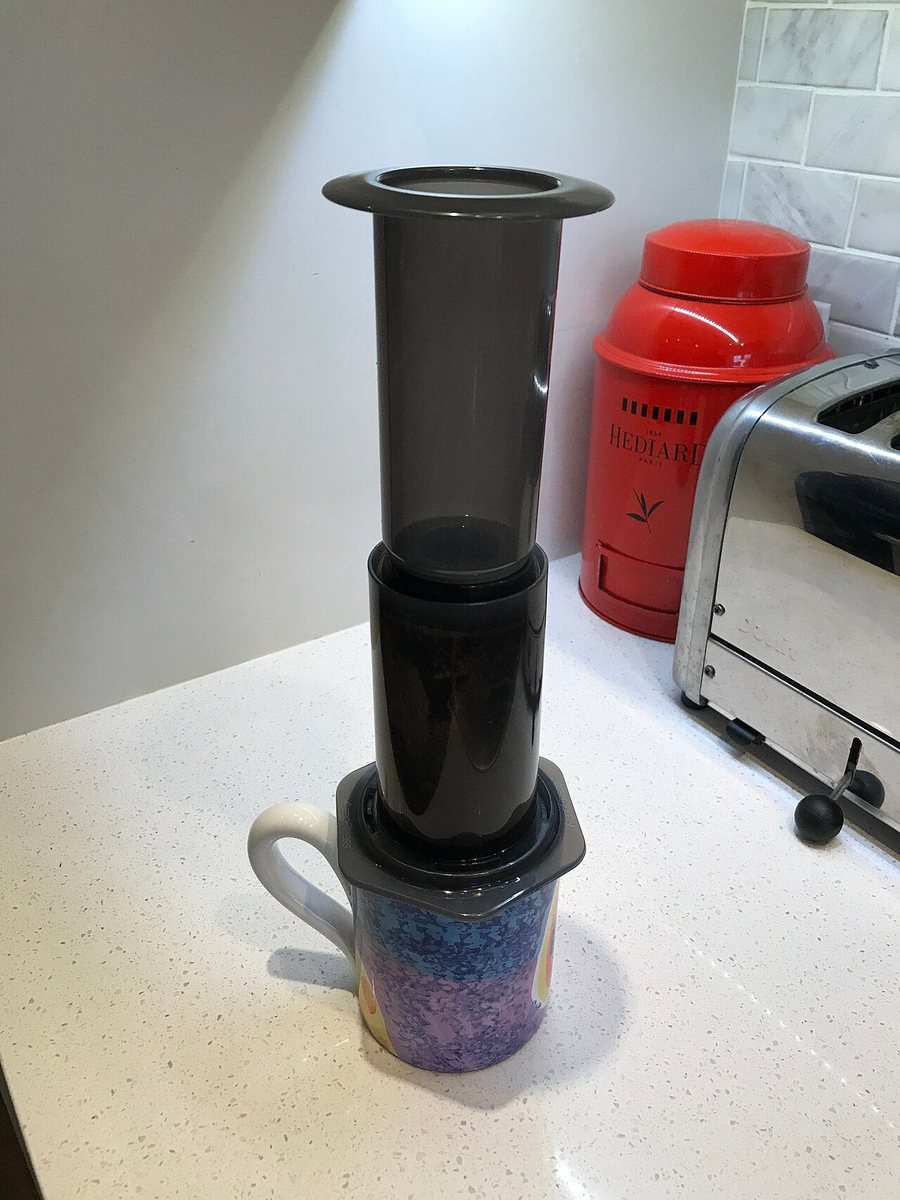
Invented by Alan Adler — a retired Stanford engineering lecturer better known for the Aerobie flying ring — the AeroPress began as a garage project in 2004. Adler's stated goal was simple: reduce the acidity and bitterness in his daily cup by gaining real control over brew time, water temperature, and grind size. What he produced was a cylindrical brewing chamber paired with a syringe-style plunger and an airtight silicone seal, officially unveiled at the CoffeeFest trade show in Seattle in November 2005.
Unlike a pour-over, which relies on gravity alone, the AeroPress uses gentle manual pressure to push brewed coffee through a filter — paper or metal — at the end of a short immersion. That combination of immersion brewing and pressure is what makes it unique: the immersion builds extraction evenly, while the press shortens contact time and can produce a noticeably fuller body than drip methods. Per Wikipedia's summary, the device is "capable of brewing highly concentrated coffee, comparable to espresso, but it can also be used to brew filter-strength coffee and cold brew."
Since its cult following began growing in the mid-2000s, the AeroPress has spawned a global competition circuit (more on that below), dozens of third-party accessories, and an entire sub-genre of recipe development. It remains one of the most forgiving, travel-friendly, and genuinely fun brewers available.
Equipment and Gear {#equipment-and-gear}
Which AeroPress Should You Buy?
AeroPress Original — the classic full-size brewer, suited to one to three cups. It ships with a scoop, stirring paddle, and 350 micro-paper filters. The current version is made from polypropylene (the company moved away from polycarbonate in 2009 and shifted to polypropylene in 2014); clear Tritan models were added in 2023. This is the right choice for home use or anyone who wants the full range of recipes.
AeroPress Go — the travel-sized model released in 2019, with a reduced brewing capacity. Its smaller accessories nest inside a plastic mug with a lid, making it genuinely compact for bags and backpacks. Brew volume is slightly limited compared to the Original, but the method is identical.
Both models come with paper filters. AeroPress also now sells their own stainless-steel mesh filter (as of 2024), and a wide ecosystem of third-party metal filters and flow-control caps exists if you want to experiment with body and texture.
Grinder
Grind consistency matters more here than almost any other variable. The 1Zpresso J-Max is an excellent hand grinder for AeroPress work — its stepped adjustment system makes it easy to dial in and repeat a setting session to session, which is exactly what you need when you're tweaking recipes. For AeroPress, a uniform grind prevents both channeling (where water finds a path of least resistance through coarser clumps) and over-extraction from fines.
Water Temperature
The AeroPress instructions specify approximately 176 °F / 80 °C for dark roasts and 185 °F / 85 °C for lighter roasts. These are lower than typical pour-over temperatures, which is part of why Adler designed the brewer: lower temperatures reduce the extraction of harsh, bitter compounds while preserving sweetness. In practice, many specialty-coffee recipes push slightly higher — up to around 90–93 °C — especially for light, high-grown washed coffees. Start with the manufacturer's guidelines and adjust from there.
The Standard (Traditional) Method {#the-standard-method}
The standard orientation places the AeroPress upright on your cup from the start — filter cap screwed on, paper filter rinsed, brewer resting directly over your vessel.
Standard Recipe (Starting Point)
- Coffee: 15–17 g, ground medium-fine (slightly coarser than espresso, finer than pour-over)
- Water: 200–230 ml at 82–85 °C
- Brew ratio: approximately 1:13 to 1:15 by mass
- Total brew time: 1:30–2:00
Step-by-step:
- Place a paper filter in the filter cap and rinse with hot water to remove any papery taste. Discard the rinse water.
- Lock the filter cap onto the chamber and set the AeroPress on a stable mug or carafe.
- Add your ground coffee to the chamber.
- Start your timer and pour water in a steady spiral to saturate all the grounds — aim to reach your full water volume within 30 seconds.
- Stir for approximately 10 seconds with the paddle (as per the original instructions), ensuring even saturation.
- Insert the plunger just enough to create a seal and slow or stop drip-through.
- At around 1:00–1:15, begin pressing with steady, even pressure. The press should take 20–30 seconds. Stop when you hear a faint hiss of air — don't force past this point, as the last fraction can introduce bitterness.
- Remove, twist off the cap, and eject the puck directly into a compost bin.
The standard method is fast, consistent, and hard to mess up. It suits medium to dark roasts particularly well.
The Inverted Method {#the-inverted-method}
The inverted technique flips the AeroPress upside-down during brewing — plunger inserted first, chamber on top, filter cap added only before the flip. This prevents any liquid from dripping through before you're ready, giving you complete control over immersion time.
Inverted Recipe (Starting Point)
- Coffee: 15–18 g, ground medium-fine
- Water: 200–240 ml at 85–90 °C
- Brew ratio: approximately 1:13 to 1:15
- Total brew time: 1:45–2:30
Step-by-step:
- Place the plunger in the chamber about 1–2 cm deep and flip the AeroPress so the open chamber faces up (plunger pointing down).
- Add your ground coffee.
- Pour all your water in, stir for 10–15 seconds, and let steep.
- At around 1:30, screw on the rinsed filter cap firmly.
- Place your mug over the filter cap, hold both firmly, and flip the whole assembly in one smooth movement.
- Begin pressing at around 1:45–2:00. Apply steady downward pressure for 20–30 seconds.
- Stop at the first hiss and serve.
Trade-offs: The inverted method offers longer, more controlled immersion and tends to produce a slightly fuller body. The flip step introduces a small but real risk of spills — particularly with a full chamber or a narrow mug. Use a wide, stable vessel and make sure the filter cap is locked tight before flipping. Many championship competitors use inverted as their preferred starting point precisely because it removes the variable of early drip-through.
The Championship-Style Approach {#the-championship-style-approach}
The World AeroPress Championship is a fan-led elimination tournament held since 2008 (first in Oslo, with just three competitors; by 2018, drawing 3,157 competitors from 61 countries). Competitors have five minutes to brew and serve their coffee. The event's global reach has turned recipe development into a genuine discipline.
Championship recipes diverge significantly from the manufacturer's baseline. Common patterns include:
- Much lower doses: some recipes use as little as 10–12 g of coffee
- High-temperature water: 90–96 °C, especially for light roasts
- Very short total brew times: 60–90 seconds total, using a fine-ish grind and fast press
- Multiple short pours rather than a single fill
- Long, slow presses: 45–60 seconds to increase body and sweetness
- Metal filters to allow more oils and a heavier mouthfeel
- Coarser grinds with longer steeps to emphasise clarity and fruit character in naturals
The key insight from championship-level brewing is that the AeroPress's variables interact in non-obvious ways. A finer grind with a shorter steep can produce equivalent extraction to a coarser grind with a longer steep — but with a different flavour profile. As the Wikipedia entry on coffee preparation notes, brew ratio, grind size, temperature, and contact time all independently affect extraction and flavour; within a brew ratio range of 15–18:1 by mass, "differences are easily perceived by an experienced coffee drinker."
A Simplified Championship-Inspired Recipe
- Coffee: 11 g, ground medium (slightly coarser than the standard recipe)
- Water: 200 ml at 92 °C
- Method: Inverted, 45-second bloom with 50 ml, then remaining 150 ml added; total steep 90 seconds; slow 45-second press
- Filter: metal mesh (more oils, heavier body)
This produces a transparent, aromatic cup that highlights fruit and floral notes in light-roasted washed coffees. It is not a universal recipe — it's a starting point for experimentation.
Grind Size Reference {#grind-size-reference}
Getting grind size right is the single highest-leverage adjustment you can make. Here's a practical reference:
| Style | Grind Size | Comparable To |
|---|---|---|
| Espresso-strength concentrate | Fine | Moka pot / fine espresso |
| Standard / inverted filter | Medium-fine | Slightly coarser than moka pot |
| Championship clarity recipes | Medium | Between AeroPress standard and pour-over |
| Cold brew AeroPress | Coarse | French press territory |
As a general rule from coffee-preparation science: finer grinds extract faster and more completely; coarser grinds require longer contact time to reach equivalent extraction. If your AeroPress coffee tastes bitter and harsh, your grind is likely too fine (or your temperature too high, or your steep too long). If it tastes watery and sour, go finer, brew hotter, or extend your steep.
A quality burr grinder — like the 1Zpresso J-Max — produces a far more uniform particle distribution than a blade grinder, which directly reduces both bitterness (from over-extracted fines) and sourness (from under-extracted boulders) in the same cup.
Troubleshooting {#troubleshooting}
Coffee tastes bitter or harsh
- Grind is too fine — coarsen by 1–2 steps
- Water temperature too high — drop by 3–5 °C
- Steep time too long — reduce by 15–20 seconds
- You pressed past the hiss — stop earlier next time
Coffee tastes sour, thin, or weak
- Grind is too coarse — fine down
- Water temperature too low — increase by 3–5 °C
- Not enough coffee — check your ratio (aim for at least 1:15 as a starting point)
- Steep too short — add 15–20 seconds before pressing
Plunger is very hard to press / slow drip
- Grind is too fine — coarsen slightly
- You're pressing too fast — slow down; 20–30 seconds is correct
- Metal filter with very fine grind — this combination creates significant resistance; go slightly coarser
Grounds in the cup
- Paper filter wasn't rinsed and seated properly — ensure it lies flat against the cap before brewing
- Filter cap wasn't screwed on fully
- Metal filter in use — some fine particles will pass through; this is normal and affects body rather than quality
Coffee dripping through before you're ready (standard method)
- Switch to the inverted method
- Alternatively, insert the plunger immediately after pouring to create a vacuum seal that slows drip-through
The inverted flip went wrong
- Use a wider, more stable mug
- Don't overfill the chamber — leave a few millimetres of headspace
- Check the filter cap is fully locked before attempting the flip
Quick-Reference Summary {#quick-reference-summary}
| Parameter | Standard | Inverted | Championship-Inspired |
|---|---|---|---|
| Dose | 15–17 g | 15–18 g | 10–12 g |
| Water | 200–230 ml | 200–240 ml | 180–220 ml |
| Temp | 82–85 °C | 85–90 °C | 90–96 °C |
| Grind | Medium-fine | Medium-fine | Medium to fine |
| Total time | 1:30–2:00 | 1:45–2:30 | 1:00–1:45 |
| Filter | Paper | Paper or metal | Metal preferred |
The AeroPress rewards experimentation. Once you have a recipe that works, changing one variable at a time — grind size first, then temperature, then dose — is the fastest route to a cup that genuinely excites you.
Gear for this
Frequently asked questions
- What grind size should I use for an AeroPress?
- Medium-fine is the safest starting point for both standard and inverted methods — slightly coarser than moka pot, finer than a typical pour-over. Championship recipes sometimes go coarser (medium) or finer depending on steep time and filter type. If your cup is bitter, coarsen the grind; if it's sour or weak, go finer.
- What water temperature is best for AeroPress?
- The AeroPress manufacturer recommends approximately 176 °F (80 °C) for dark roasts and 185 °F (85 °C) for lighter roasts. Many specialty-coffee recipes push higher — up to 90–93 °C — particularly for light, washed coffees. Start with the manufacturer's guidelines and adjust based on taste.
- What is the inverted AeroPress method and why use it?
- The inverted method flips the AeroPress upside down during brewing so no liquid drips through before you're ready. This gives you complete control over immersion time and tends to produce a slightly fuller body. The trade-off is a flip step that can spill if not done carefully — use a wide, stable mug and make sure the filter cap is locked before flipping.
- Can I use a metal filter with an AeroPress?
- Yes. AeroPress now sells their own stainless-steel mesh filter (as of 2024), and third-party metal filters have been available for years. Metal filters allow more coffee oils to pass through, producing a heavier body and more texture compared to paper filters. They are especially popular for championship-style recipes. Note that some fine particles will also pass through, which is normal.
- How long does an AeroPress brew take?
- Most standard and inverted recipes take between 1:30 and 2:30 in total, including the press. Championship-inspired recipes can be as short as 60–90 seconds. The press itself should take 20–30 seconds (or up to 45–60 seconds for a slow championship-style press) — stop when you hear a faint hiss of air.
- What is the World AeroPress Championship?
- The World AeroPress Championship is a fan-led international brewing competition first held in Oslo in 2008 with just three competitors. By 2018 it attracted 3,157 competitors from 61 countries. Competitors have five minutes to brew and serve their coffee in a multi-round elimination format. The competition has significantly influenced specialty-coffee recipe development and pushed the boundaries of what the AeroPress can produce.
- AeroPress Original vs. AeroPress Go — which should I buy?
- The AeroPress Original is the full-size brewer suited to home use and one to three cups; it offers the full range of recipes and accessories. The AeroPress Go is a travel-sized model with a reduced capacity whose accessories nest inside a mug with a lid — ideal for trips and smaller bags. The brewing method is identical on both; the Go just has a lower maximum brew volume.
See also