Natural co-fermented with orange
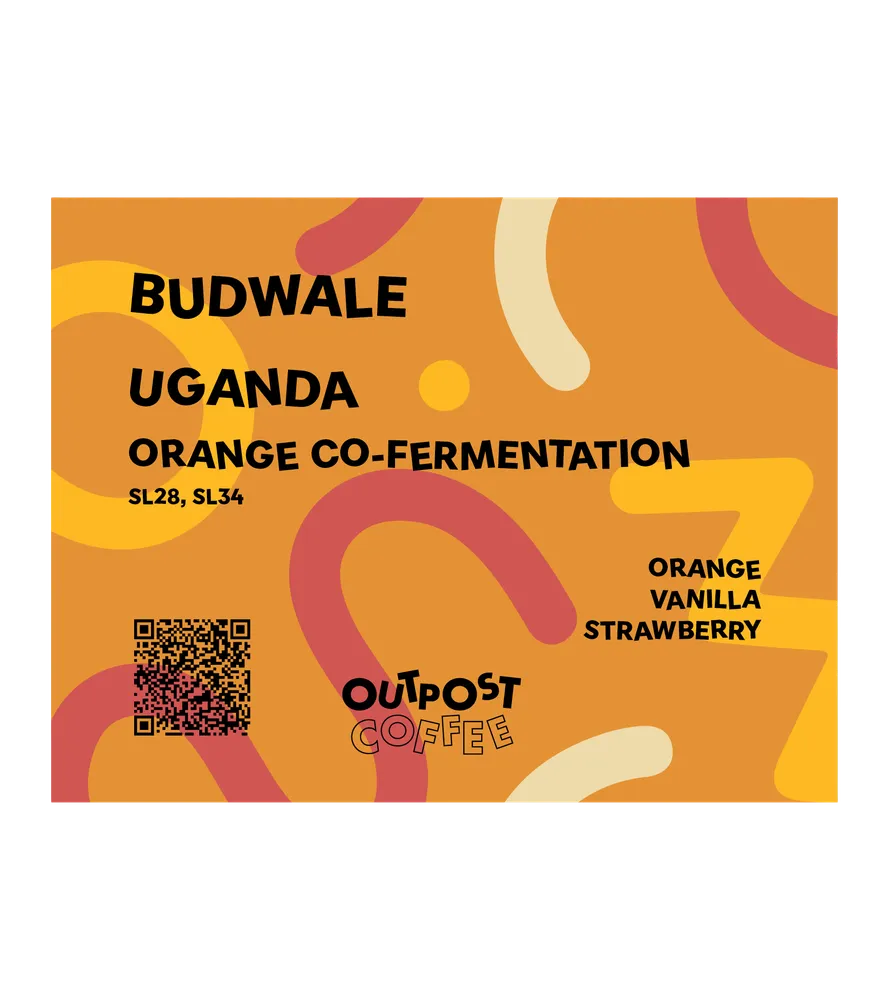
Budwale, Orange Co-Fermentation, Uganda
Roasted by Outpost Coffee
Uganda co-fermented natural with orange, SL28/SL34 from Mt Elgon Sipi Falls.
From the roaster
Orange, Vanilla, Strawberry
Producer: Smallholder Farmers Origin: Mt Elgon, Uganda Varietal: SL28, SL34 Elevation: 1900 -2100 masl
About This Coffee
This special co-fermented natural lot is processed using locally sourced orange in the fermentation vessel. The coffee is sourced from the Sipi Falls microregion on Mount Elgon, Eastern Uganda. These farmers supply our long time partners in the region Zukuka Bora Coffee Company. The purchase price of this coffee includes a dedicated premium used to fund social projects in the community.
The Budwale farmer group is one of the first groups which Zukuka Bora started working with on the Wanale Ridge and they are most loyal to the project. This season the group comprised 201 farmers, cultivating at altitudes ranging between 1,600 and 1,900masl.
The Zukuka Bora Coffee project was set up to support the people of Mt Elgon in many different ways. While coffee farmers are at the heart of the project, the profits from the project are also used to support their partner NGO: JENGA Community Development. JENGA have been working in the Mt Elgon area for almost 20 years, and had laid much of the groundwork for Zukuka Bora to build relationships with farmers and their communities. JENGA operate a range of projects - including education sponsorship, clean water schemes, savings groups, health promotion and training, and wider farming support.
The Region
Mt Elgon is an extinct volcano on the border with Kenya and is thought to be the oldest volcano on the African continent. The massive base and gentle slopes support thousands of smallholder farmers, with arabica coffee is cultivated across a broad band around the mountain between 1,200 and 2,200masl. Volcanic soils, plentiful rain, high altitude and abundant sunshine are all contributing factors to the excellent terroir of the Mt Elgon region.
The region is steeped in coffee tradition. In fact, Zukuka Bora’s Tangwen coffee comes from the very micro-region where Arabica coffee was first planted in around 1920, after being brought from farms in neighbouring Kenya. Despite the rich history, the story of specialty coffee is more mixed.
After independence in 1962, Uganda had a fine reputation for coffee, with strong cooperatives working across the mountain - most famously the Bugisu Cooperative Union. Quality cultivation and harvesting practices were employed and the industry boomed. However, over time, quality started to become compromised due to a variety of reasons and buyers started to become (rightly) suspicious of the quality coming out of the country. As a result, prices plummeted, and for many farmers growing coffee was simply not economically viable. There was very little differential local market for quality and so the quality-driven processes were largely abandoned.
In recent years however, as the specialty industry has grown producers have started to realise that there is demand and economic incentive for high quality coffee.
The Process
Ripe coffee cherries are selectively harvested and then delivered to the wetmill. The cherries are floated in a clean water tank to separate by density (lower quality cherries float and are removed).
These cherries, together with locally-sourced orange, were fermented in a cool anaerobic environment for 96 hours (4 days) before being put directly on to raised beds to dry. The drying takes up to 30 days.
After drying the coffee is rested for around 1 month before moving to a dry mill for secondary processing (hulling, sorting, grading, handpicking and bagging in Grainpro/Ecotact bags for export.
— Outpost Coffee
Context
From the slopes of Mt Elgon near Sipi Falls, this lot brings together Uganda's renowned SL28 and SL34 varietals with an inventive co-fermentation approach using orange. The Budwale farmer group cultivates these beans at 1900–2100 masl, where volcanic soils and cool mountain conditions support complex flavor development. The orange co-fermentation process—an experimental technique that introduces citrus elements directly into fermentation—yields an aromatic profile centering on orange and strawberry with creamy vanilla notes. Outpost Coffee has developed this microlot to showcase how fruit-forward processing can enhance the natural character of East African coffees. The result reflects both the producer's careful farm work and the roaster's commitment to exploring unconventional fermentation methods.
In the Encyclopedia
Frequently asked questions
What does Budwale, Orange Co-Fermentation, Uganda taste like?
Expect tasting notes of Orange, Vanilla, and Strawberry.
How is Budwale, Orange Co-Fermentation, Uganda processed?
Budwale, Orange Co-Fermentation, Uganda uses the Natural co-fermented with orange process.
More from Outpost Coffee
View all →Washed
Sholi, Washed, Rwanda
Fair Trade organic washed Bourbon from Rwandan women coffee farmers at 1800-2000m elevation.
Costa Rica · Washed
Santa Elena, Washed, Costa Rica
Washed microlot from Tarrazú with chocolate, sugar, and raisin notes.
Ethiopia · Washed
Banko Gotiti, Washed, Ethiopia
Grade 1 washed Ethiopian Heirloom from Banko Gotiti wetmill with apricot, lemon, and orange blossom notes.
Anaerobic Washed
Los Quispe, Anaerobic Washed Gesha, Peru
Anaerobic washed Geisha from Peru's Cajamarca region with vibrant floral and fruit notes.
Last verified: June 27, 2026 · Browse all beans.