Discover · Spotlights
Geisha Coffee: How One Variety Changed Specialty
The Ethiopian forest variety that shattered auction records, redefined flavor expectations, and turned a sleepy Panamanian mountain farm into a global phenomenon.
Key facts
- Origin
- Montane forests of southwestern Ethiopia
- Alternative name
- Gesha
- Arrived in Panama
- 1960s
- Breakthrough moment
- Won Best of Panama competition in 2005
- Record auction price
- $42,000 for seven pounds in 2022
- Flavor profile
- Jasmine, floral, bergamot, honey, stone fruit, black tea
The Forest Where It All Began
Long before it became the darling of specialty coffee competitions, Geisha — more precisely, Gesha — was simply a wild coffee tree growing in the montane forests of southwestern Ethiopia. The variety takes its name from the Gesha region, a transliteration of the Amharic ጌሻ, and those origins matter: Ethiopia is the world's primary storehouse of genetic diversity for Coffea arabica, and the complexity locked inside that biodiversity is precisely what makes Geisha taste the way it does.
The first documented outside encounter with the variety came in 1936, when a British consul collected seeds during a trip to what correspondence of the time called the "Geisha coffee area." That colonial-era phonetic spelling — Geisha — has stuck in most of Latin America and in competition circuits ever since, even as awareness has grown about the unintended link to Japanese geisha entertainers. Today, most Ethiopian producers use the Gesha spelling, while many Latin American farms retain Geisha, and some specifically use Gesha to signal cultivation from original Ethiopian stock. Both spellings refer to the same distinct genetic lineage.
A Slow Journey from Addis to Boquete
The path from Ethiopian forest to Panamanian auction was neither swift nor intentional. After the 1936 seed collection, plants were established at the Tengeru (now Lyamungu) Coffee Research Station in Tanzania. In 1953, successfully cultivated material — catalogued as accession VC-496 — was transferred to the Centro Agronómico Tropical de Investigación y Enseñanza (CATIE) in Costa Rica, where it was logged as T2722. CATIE then distributed the variety across Central America.
Geisha arrived in Panama in the 1960s, partly because Boquete's coffee farms were battling leaf rust fungus, and the variety showed promising resistance. But Geisha has a small root system and is not very productive compared with commercial workhorse cultivars, and without a specialty market willing to pay for quality over yield, farmers eventually set it aside for other varieties. For decades it sat largely forgotten on farms like Hacienda La Esmeralda — waiting.
The 2004–2005 Moment That Changed Everything
In 2005, the Peterson family of Boquete entered a Geisha from their Hacienda La Esmeralda into the Best of Panama competition. It won — decisively — and sold at auction for a then-record US $350 per pound (US $770 per kilogram). The coffee world stopped. Judges and buyers who had spent careers calibrating their palates to the best Yirgacheffes and Kenyas encountered something genuinely unfamiliar: a transparency of flavor, a soaring floral register, and a cup that didn't just score well but seemed to change what "well" could mean.
The records have not stopped falling. In 2017, a natural-process lot from Hacienda La Esmeralda set a new Best of Panama record at US $601 per pound (US $1,320 per kilogram). In September 2022, seven pounds of Geisha from Lamastus Family Estate sold for $42,000 at a private auction hosted by Sensible Coffee. These are not anomalies — they reflect consistent, compounding demand from buyers in Asia, Europe, and North America who treat top-tier Geisha as a fine-wine equivalent.
Why Geisha Tastes Like Nothing Else
Understanding Geisha's flavor means understanding its genetics and its terroir together. As a Coffea arabica variety, Geisha carries the same allotetraploid genome as every other arabica — the result of an ancient hybridization between C. canephora and C. eugenioides — but its particular expression of aromatic compounds sets it apart from commercial cultivars bred for yield and disease resistance.
The variety is widely described as exhibiting jasmine, floral sweetness, bergamot, honey, stone fruit, and black tea, with a delicate body and bright, well-defined acidity. Consult the Coffee Taster's Flavor Wheel and Geisha tends to cluster at the floral and fruit quadrants in a way most other arabica varieties don't sustain across multiple brew methods. These notes aren't a roaster's invention — they emerge from the bean's chemical composition, altitude-influenced sugar development in the cherry, and, critically, processing decisions made at the farm.
Processing has an outsized effect on how those underlying characteristics express:
- Washed Geisha amplifies the variety's clarity. Expect a lighter body, brighter and more precisely defined acidity, and the jasmine and bergamot notes in high relief — "cleaner" in the sensory language of the trade.
- Natural (dry-process) Geisha adds body and fermentation-driven fruit sweetness, making the stone fruit and honey notes more dominant, though sometimes at the cost of the floral delicacy that defines the variety's reputation.
Producers who want to preserve floral transparency typically favor the washed method and invest heavily in cherry selection — hand-picking only the ripest fruit, often with additional quality sorting, because the sweetness of the finished cup depends directly on ripeness at harvest.
The Name Question
It's worth addressing the spelling debate directly, because it matters for buyers navigating menus and auction listings. Gesha is the closer transliteration of the Ethiopian origin region; Geisha is the historical spelling introduced by British officials and remains common in Panama and across Latin America. Neither is incorrect in context, and the Specialty Coffee Association does not mandate one over the other. What matters for discerning buyers is provenance — ideally a documented lot number, farm name, and processing method — rather than the spelling alone. The Panamanian Geisha, in particular, has a verified genetic fingerprint that distinguishes it from coffees merely labeled as such.
Trade-offs Worth Knowing Before You Buy
Geisha is not for everyone in every context, and intellectual honesty requires acknowledging that.
Price: Even "entry-level" Geisha from reputable roasters commands a significant premium over excellent single-origin Ethiopia or Kenya lots. If you brew primarily in high-volume drip or rely on a French press, that premium may not translate the way it does in a slow pour-over or a precise espresso.
Brew method sensitivity: Geisha is unusually sensitive to water temperature, grind consistency, and extraction time. It rewards precision equipment and rewards the brewer who dials in carefully. Brewed sloppily, it can taste thin or under-extracted — the delicacy that makes it extraordinary also makes it less forgiving.
Low yield, high exclusivity: Because Geisha produces less per plant and requires careful hand-picking, supply is structurally constrained. Lots from top farms sell out fast. When you find a quality lot from a roaster you trust, it's worth acting on.
Geisha in Our Shop Right Now
We currently stock two Geisha offerings that represent the variety from different angles — one Colombian, one Honduran — both from roasters who have shown consistent care with the variety.
Colombia Doña Martha Gesha — Onyx Coffee Lab
Colombia Doña Martha Gesha by Onyx Coffee Lab represents Geisha grown in a Colombian terroir rather than Panama — a meaningful distinction. Colombia's high-altitude growing regions offer their own mineral-rich soils and temperature swings that can coax surprising clarity from the variety. Onyx Coffee Lab, based in Rogers, Arkansas, has built a reputation in specialty circles for disciplined sourcing and transparent roasting. This lot is a strong entry point for drinkers approaching Geisha for the first time who want the variety's signature florality in a slightly more accessible price tier than top Panamanian auction lots.
Best for: Pour-over and filter brewing; first-time Geisha drinkers; those who appreciate a producer-focused, traceable supply chain.
Arturo Paz — Itacayo Gesha — Black & White Coffee Roasters
Arturo Paz - Itacayo Gesha by Black & White Coffee Roasters takes the variety to Honduras, where producer Arturo Paz has developed Gesha cultivation at his Itacayo farm. Black & White Coffee Roasters, out of Charlotte, North Carolina, are known for a light-to-medium roast philosophy that prioritizes origin character — exactly what you want when the origin character is Geisha. Honduras as a Geisha origin remains less widely discussed than Panama or Colombia, which makes this lot an interesting choice for coffee drinkers who enjoy tracing the variety's geographic range.
Best for: Experienced specialty drinkers; those curious about Geisha outside the Panama canon; filter and pour-over; anyone who appreciates roasters that keep roast development subordinate to terroir expression.
Geisha arrived on the world stage through a combination of accident, persistence, and one very consequential competition. Its continued dominance in specialty auctions is not nostalgia — it's a reflection of a flavor profile that remains genuinely difficult to replicate in any other variety. Whether you approach it as a daily luxury or a periodic benchmark for your palate, understanding where it came from makes every cup more interesting.
Coffees demonstrating this
From our catalog of in-stock beans.
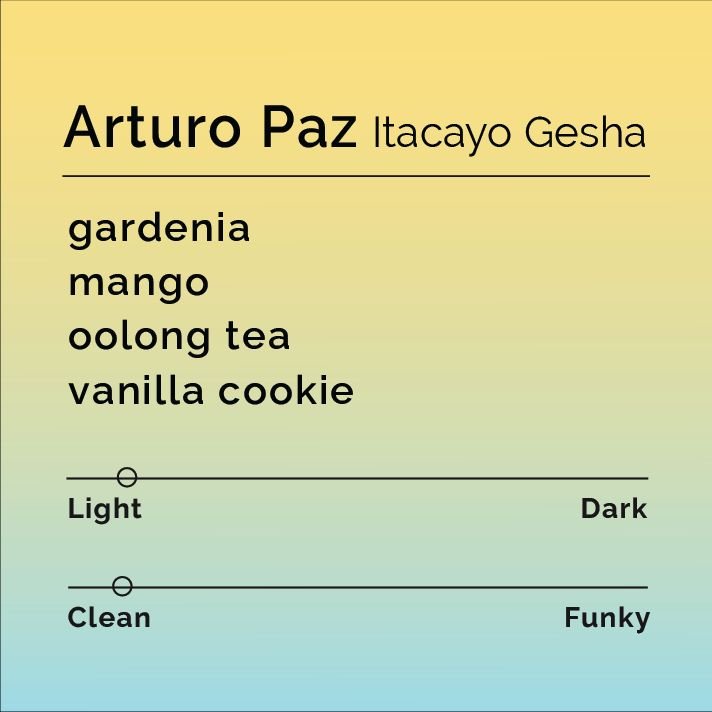
Honduras · Washed
Arturo Paz - Itacayo Gesha
Black & White Coffee Roasters · $28
Delicate washed Geisha from Honduras with floral, tropical, and tea-like characteristics.
Colombia · Anaerobic Washed
Colombia Doña Martha Gesha
Onyx Coffee Lab · $30
Modern Colombian Geisha with refined florals and elegant structure from El Diviso.
Frequently asked questions
- What is the difference between Geisha and Gesha coffee?
- They are the same variety — the difference is spelling. Gesha is the closer transliteration of the Ethiopian origin region (ጌሻ in Amharic), while Geisha is the historical spelling introduced by British officials in the 1930s and remains common in Panama and across Latin America. Some Latin American producers now use Gesha specifically to indicate plants grown from verified original Ethiopian stock.
- Why is Geisha coffee so expensive?
- Several structural factors drive the price. Geisha plants are low-yielding and have a small root system, limiting supply. The cherries require careful hand-picking to ensure ripeness. Demand — particularly from buyers in Asia, Europe, and North America — consistently outpaces what top farms can produce. Auction records reinforce perceived value: a Best of Panama lot sold for US $601 per pound in 2017, and a private auction lot reached $42,000 for seven pounds in 2022.
- What does Geisha coffee taste like?
- Geisha is widely described as having jasmine, floral sweetness, bergamot, honey, stone fruit, black tea, and bright, well-defined acidity. Washed lots tend to emphasize clarity and florality; natural-process lots tend toward fuller body and fruit-forward sweetness. The flavor profile is generally considered more delicate and transparently complex than most other arabica varieties.
- Is Geisha coffee from Ethiopia or Panama?
- It originated in the Gesha region of southwestern Ethiopia, where it was identified in the 1930s. It traveled through Tanzania and Costa Rica before reaching Panama in the 1960s. Panama — specifically Boquete and Hacienda La Esmeralda — is where it became internationally famous after the 2005 Best of Panama competition, but the variety is now grown in Colombia, Honduras, and other origins as well.
- How should I brew Geisha coffee?
- Pour-over and other filter methods are strongly recommended to highlight Geisha's delicate floral and fruit notes. The variety is sensitive to brew variables — water temperature, grind consistency, and extraction time all matter more than with sturdier cultivars. Sloppy technique can result in a thin, under-extracted cup. If you invest in a quality Geisha lot, pair it with precise brewing equipment and take time to dial in your recipe.
See also