
Grinder · Electric conical (single dose)
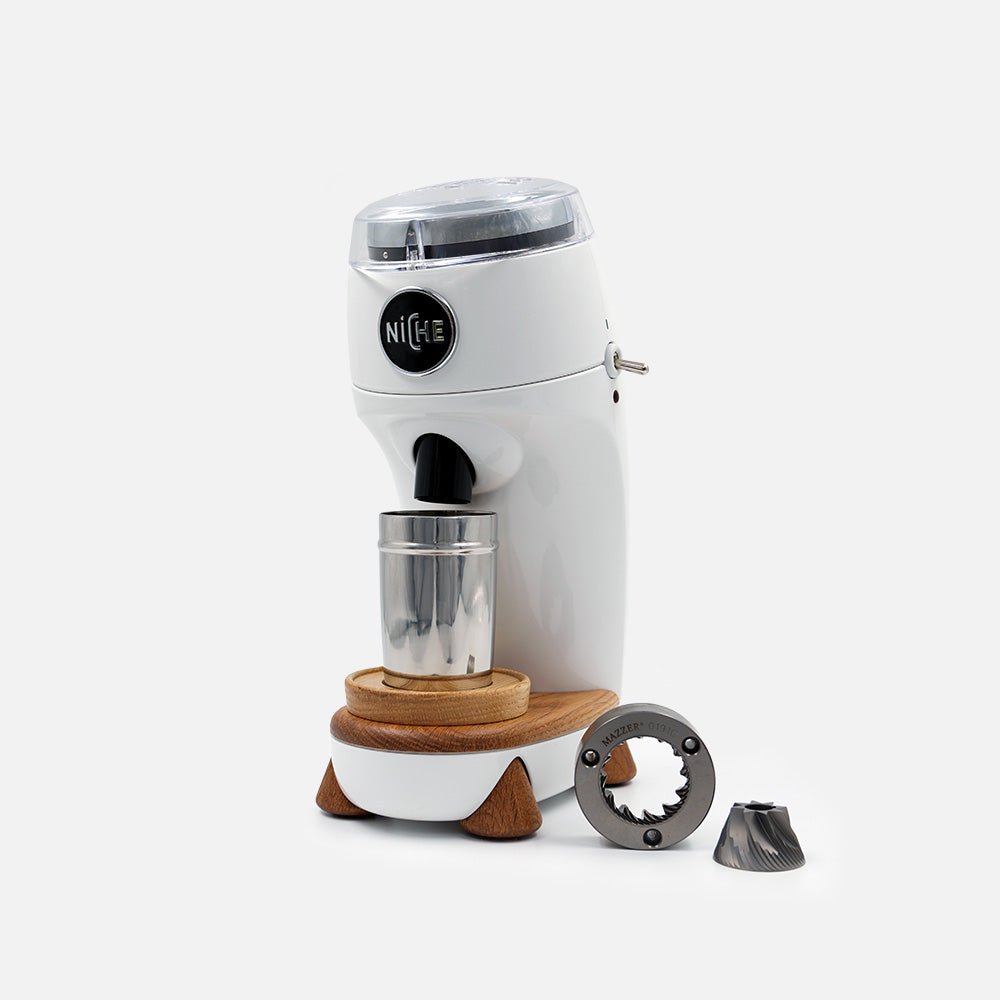
Niche Zero
Niche · $$$
The single-dose grinder that popularised low-retention conical grinding for home espresso.
Price range
$620 – $750
Niche Zero on video
James Hoffmann covers the Niche Zero in a 21-minute video. Watch the review below, then see the details and where to buy — all without leaving the page.
James Hoffmann takes a hands-on look at the Niche Zero. We link it for its specs walkthrough and real-world impressions — form your own view by watching.
We may earn a commission when you buy through links on this page, at no additional cost to you.
More videos
Why this matters
When the Niche Zero arrived on the market, single-dose grinding for home espresso was a niche (pun earned) discipline carried out by modifying commercial machines or tolerating the retention penalties of hopper-fed grinders. Niche Coffee, a small UK-based team of enthusiast engineers, designed the Zero from the ground up around near-zero retention: beans in, grounds out, almost nothing left behind. That promise, backed by 63 mm Mazzer-sourced conical steel burrs, gave home baristas a credible path to dialing in one dose at a time without cross-contamination between coffees. At $620–750 USD it sits firmly in the prosumer tier, above mass-market machines but below commercial workhorses. Its wood-and-metal construction means it reads as furniture rather than appliance on a kitchen counter. For the curious single-origin switcher, the small-household espresso drinker, or anyone who wants to run one grinder across both espresso and filter without a hopper full of stale beans waiting in between, the Niche Zero remains a compelling and widely respected answer.
At a glance
Best for
- Single dosing
- Espresso
- Home use
Look elsewhere if
- You need a fast workflow: the Zero's gravity-fed, near-zero-retention architecture means grind times per espresso dose are slower than hopper-fed or pressurized-feed grinders — a meaningful issue for households pulling multiple shots in quick succession.
- You want repeatable settings without note-taking: the stepless dial has no reference markings, so returning to a dialed-in setting after switching coffees requires your own documented notation system.
- You are primarily a filter brewer: dedicated filter-focused grinders at this price point may offer faster throughput, wider coarse ranges, or flat-burr geometry that some filter brewers prefer for flavor separation.
- You want dose-by-weight or timed grinding automation: the Zero is a manual single-dose grinder with no built-in scale integration or programmable dose controls, features available on competing machines in a similar or modestly higher price bracket.
Closest alternatives
The Niche Zero is a single-dose electric conical burr grinder built around a pair of 63 mm steel conical burrs sourced from Mazzer, one of the most established burr manufacturers in the espresso industry. Conical burrs operate by funneling beans between a stationary outer ring and a rotating inner cone; the grinding gap — and therefore the particle size — is determined by how close those two surfaces sit to each other. Because conical geometry relies on gravity to assist bean flow and produces a relatively narrow particle-size distribution, it suits both the fine end of the grind spectrum (espresso) and the medium-fine range used for filter brewing, which is exactly the dual-use promise Niche makes for the Zero.
The body pairs a wooden outer shell with a metal chassis. That combination is unusual in the grinder category, where most machines are all-plastic or all-metal, and it contributes to the Zero's reputation as one of the more visually considered grinders in its price range. Dimensions are compact by prosumer standards, a deliberate choice for a product aimed at home kitchens rather than café counters.
The grind adjustment is stepless — meaning the collar rotates continuously rather than clicking between fixed positions — which in principle gives the user an almost infinite range of settings between the finest espresso grind and the coarsest filter setting. In practice, stepless adjustment is a double-edged characteristic: the range is genuinely useful when chasing a precise extraction, but the dial carries no reference markings, so reproducing a setting after switching coffees depends entirely on the user's own notation system. This is a notable workflow friction point that prospective buyers should weigh honestly.
Retention — the ground coffee that sticks to the grinding chamber and burrs after a dose is complete — is where the Zero made its name. Near-zero retention means that what you put in is almost entirely what you get out, with negligible stale grounds from a previous session contaminating the next dose. This characteristic is what makes single dosing practical: you weigh beans before grinding, drop them into the top, and what lands in the catch cup is essentially your entire input. Burr mills in general produce more uniform particle sizes than blade grinders and generate less frictional heat, both of which are relevant to coffee quality, but the retention spec is the Zero's defining engineering achievement.
Workflow is slower than hopper-fed grinders. Without a pressurized hopper feeding beans continuously into the burrs, the Zero relies on gravity alone, and grind times for an espresso dose are longer than users accustomed to commercial or semi-commercial machines might expect. This is a deliberate trade-off: the architecture that enables near-zero retention also removes the hopper-pressure assist that speeds up grinding in conventional designs.
The catch cup is a dedicated vessel that fits snugly under the grinder's exit chute and is designed to sit directly on an espresso portafilter or be transferred manually. Niche Coffee provides setup guides, a user manual, a cleaning guide, and a calibration procedure through their website, reflecting the reality that a stepless grinder without markings requires some initial user investment to learn and document personal settings.
For espresso specifically, the 63 mm Mazzer conical burrs are well suited to the fine, consistent grind required for nine-bar extraction. For filter, the same burrs produce a grind that many users find clean and separation-friendly, though some filter-focused users at this price point prefer flat-burr grinders for a different flavor profile. The Zero is genuinely capable across both methods, but it is a grinder that rewards methodical users who keep notes rather than those who want a fire-and-forget experience.
The Niche Zero's most honest trade-off is speed versus precision. A single espresso dose takes longer to grind than on a hopper-fed machine, and the absence of dial markings means a new user will spend a session or two building their own reference system before they can return to a known setting reliably. Neither issue disqualifies the machine, but both are real friction points that the enthusiast press has noted consistently.
At $620–750 USD, the Zero competes in a tier where buyers are also considering flat-burr single-dose grinders, some of which offer grind speed advantages and more clearly marked adjustment rings. Flat-burr designs tend to produce a different particle-size distribution — often described as producing more fines alongside larger particles — and the choice between conical and flat burrs at this price point is genuinely a matter of preference and brewing style rather than an objective hierarchy. The Zero's conical geometry is particularly well regarded for espresso clarity and for the grinder's ability to handle lighter roasts without choking.
The wood-and-metal body is attractive, but wood requires more careful maintenance in humid environments than an all-metal chassis. This is a minor point for most home users but worth noting for anyone in a high-moisture kitchen.
For filter brewing, the Zero is competent but not the first choice of dedicated filter enthusiasts who want maximum clarity and who might prefer a grinder with a wider coarse range or faster throughput. Its sweet spot is the espresso-primary user who also wants to make the occasional pour-over without buying a second grinder.
Where the Zero genuinely leads is in its combination of build quality, burr pedigree, and near-zero retention at a price that, while not cheap, is well below the entry point for commercial single-dose grinders with comparable burr sets. For a home user who rotates through multiple single-origin coffees, values keeping each dose isolated, and is willing to invest time in dialing in and documenting settings, it remains one of the most sensible purchases in its category. For a buyer who wants speed, preset programs, or a dose-by-weight function, there are better options at similar or higher price points.
Pros
- Very low retention single dosing
- Espresso and filter capable
- Attractive, compact
Cons
- Slower workflow
- Stepless dial lacks reference markings
Who reviewed it
We synthesized this page from independent reviews and the manufacturer's own materials. Conclusions below are paraphrased, not quoted.
Niche Coffee (Manufacturer)
Niche positions the Zero as a dual-use espresso and filter grinder engineered specifically around near-zero retention for single-dose workflows at home.
Source ↗James Hoffmann
Hoffmann broadly praised the Niche Zero as a well-engineered single-dose grinder that delivered on its low-retention promise, while noting the stepless dial requires the user to develop their own reference system.
Source ↗Prima Coffee
Prima Coffee concluded that the Niche Zero is one of the strongest prosumer single-dose options available, highlighting its near-zero retention and dual espresso-and-filter capability as its key differentiators.
Source ↗Whole Latte Love
Whole Latte Love found the Zero to be a premium but justified investment for home espresso enthusiasts who prioritize coffee freshness and the ability to switch beans without residue carry-over.
Source ↗Home-Barista.com
The Home-Barista community has extensively documented the Zero's performance, with the general consensus being that its Mazzer-sourced burrs and near-zero retention make it a benchmark single-dose espresso grinder despite the slower grind speed.
Source ↗Clive Coffee
Clive Coffee highlighted the Niche Zero's compact footprint and aesthetic design alongside its technical credentials, recommending it for home setups where counter space and visual presentation matter alongside performance.
Source ↗
Frequently asked questions
What burrs does the Niche Zero use?
The Niche Zero uses 63 mm steel conical burrs sourced from Mazzer, a well-established commercial burr manufacturer. The conical geometry assists with even particle distribution and low heat generation during grinding.
What does 'near-zero retention' mean in practice?
Retention refers to ground coffee that remains trapped inside the grinder after a dose is complete. Near-zero retention means almost all of the coffee you put in comes out in the current grind cycle, with negligible stale grounds left behind to contaminate the next dose — which is the core requirement for effective single dosing.
Can the Niche Zero grind for both espresso and filter?
Yes. The stepless adjustment dial covers a range that includes fine espresso grinds at one end and medium-to-coarse filter grinds at the other. It is a genuine dual-use grinder, though its single-dose workflow is most beneficial for espresso, where dose precision is most critical.
How much does the Niche Zero cost?
The Niche Zero is priced in the $620–750 USD range, placing it in the prosumer tier — above entry-level home grinders but below most commercial single-dose machines.
Is the grind adjustment stepped or stepless?
The adjustment is stepless, meaning the collar rotates continuously with no fixed click stops. This gives a wide range of fine-tuning options but the dial has no printed reference markings, so users need to build their own notation system to return to a setting reliably.
How do I record my grind settings if there are no markings on the dial?
Most users mark their preferred settings with a permanent marker, a small piece of tape, or a written log noting the number of turns from the zero-calibration point. Niche Coffee provides a calibration guide on their website to help users establish a consistent reference starting point.
Is the Niche Zero slow compared to other grinders?
Yes, grind speed is one of its acknowledged trade-offs. Because it uses a gravity-fed single-dose architecture rather than a pressurized hopper, each dose takes longer to grind than on conventional hopper-fed machines. For single-shot home use this is typically acceptable; for households pulling many shots in a row it can become a bottleneck.
What materials is the Niche Zero body made from?
The body combines wood and metal. The wooden shell contributes to its distinctive aesthetic and compact profile, while the metal chassis provides structural rigidity. Users in very high-humidity environments should be aware that wood requires more care than an all-metal housing.
Does the Niche Zero have a built-in scale or dose-by-weight function?
No. The Zero is a manual single-dose grinder without integrated scale, timer, or dose-by-weight automation. Users weigh beans on a separate scale before loading them into the grinder.
What is the difference between the Niche Zero and the Niche Duo?
Niche Coffee makes both the Zero and the Duo. The Zero is the original single-dose model reviewed here. The Duo is a separate product in the Niche lineup; for specific Duo specifications and differences, refer to the Niche Coffee website directly.
Who is the Niche Zero best suited for?
It is best suited for home espresso enthusiasts who single dose, rotate through multiple coffees, and prioritize minimal cross-contamination between doses. It also suits those who want one grinder to cover both espresso and occasional filter brewing without buying two dedicated machines.
How do I clean the Niche Zero?
Niche Coffee provides a dedicated cleaning guide on their website. General burr grinder maintenance involves periodic disassembly to clear coffee oils and fine particles from the burrs and grinding chamber. Because the Zero is a low-retention design, routine cleaning is still necessary to maintain burr performance and flavor clarity over time.
Compare with
DF / Turin
DF64 Single Dose Grinder
An affordable 64mm flat-burr single-dose grinder with a vast modding community.
Niche
Niche Duo
Niche's larger, faster follow-up to the Zero, aimed at broader espresso-to-filter versatility.
More grinders
Baratza
Baratza Sette 270Wi
A fast, low-retention espresso grinder with built-in grind-by-weight dosing.
DF / Turin
DF64 Single Dose Grinder
An affordable 64mm flat-burr single-dose grinder with a vast modding community.
1Zpresso
1Zpresso K-Ultra
A fast, versatile 48mm hand grinder with an intuitive external adjustment dial.
Fellow
Fellow Opus
An affordable all-purpose conical grinder spanning espresso to French press.
We may earn a commission when you buy through links on this page, at no additional cost to you.
Last updated: June 13, 2026