Brewer · French press (immersion)
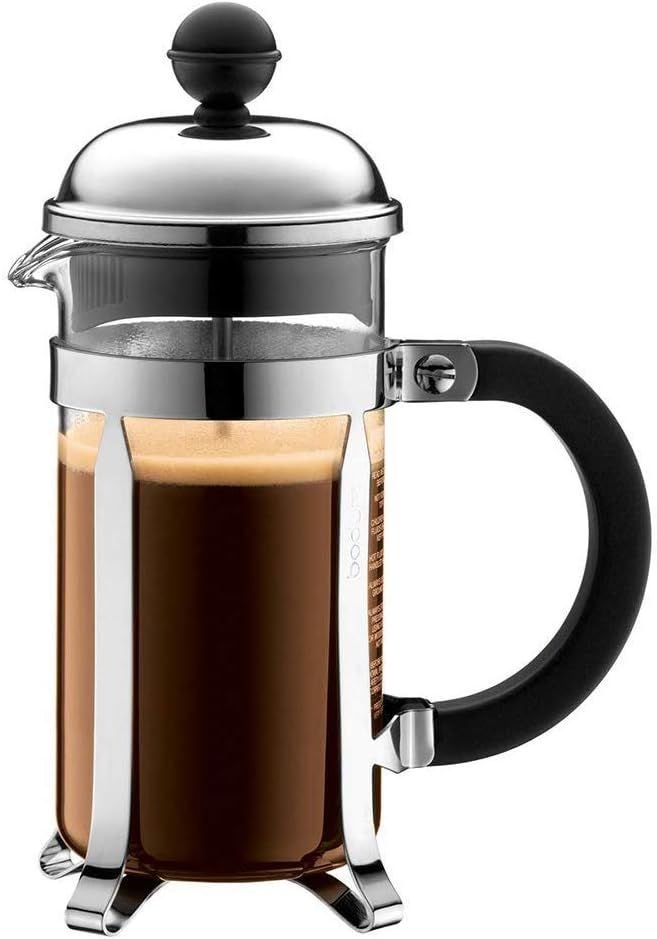
Bodum Chambord French Press
Bodum · $
The classic chrome-and-glass French press for full-bodied immersion coffee.
Price range
$28 – $50
We may earn a commission when you buy through links on this page, at no additional cost to you.
Why this matters
The Bodum Chambord is arguably the single most recognizable French press on the planet, and its ubiquity is not accidental. Since Bodum's chrome-and-glass Chambord design became the global shorthand for plunger coffee, it has served as the entry point for millions of home brewers discovering full-immersion extraction — a method that keeps coffee oils in the cup and delivers a body no paper-filtered brewer can replicate. At $28–$50 depending on size, it sits at a price point where the cost-to-cup-quality ratio is genuinely difficult to beat. The Chambord is best suited to beginners who want a low-barrier introduction to specialty-coffee brewing, to households that batch-brew for multiple people, and to anyone who values a thick, rich, textured cup over absolute clarity. It is not a precision instrument and does not pretend to be one — it is a durable, elegant, and time-tested tool that rewards attention to grind size and brew time without demanding technical obsession. Its global spare-parts ecosystem, wide size range, and decades of design continuity make it an unusually safe long-term buy.
At a glance
Best for
- Full-bodied coffee
- Beginners
- Batch brewing
Look elsewhere if
- You prioritize a sediment-free, clarified cup — the stainless steel mesh filter passes fine particles freely, and no workaround fully eliminates the silt layer at the bottom of every pour.
- You want extended thermal retention — the single-wall borosilicate carafe loses heat steadily during and after brewing; a vacuum-insulated press like the Frieling is a better fit if you pour slowly over 30+ minutes.
- Your kitchen is high-traffic or accident-prone — borosilicate glass handles thermal shock but not physical impact, and replacing the carafe, while cheap, is an ongoing maintenance reality.
- You are chasing light-roast clarity and terroir-driven fruit notes — full immersion retains oils and solids that obscure delicate flavor nuance better explored through a paper-filtered V60 or Chemex.
Closest alternatives
Featured in
The Bodum Chambord French Press is a full-immersion plunger brewer built around a borosilicate glass carafe held inside a chrome-plated stainless steel frame. That combination of materials is not decorative — borosilicate glass is formulated to withstand rapid thermal changes, so pouring water close to boiling (93–96°C / 199–205°F) directly into the carafe does not risk cracking from thermal shock the way ordinary soda-lime glass would. The chrome frame cradles the carafe on all sides and terminates in a distinctive C-shaped handle and a domed lid that doubles as a plunger guide. The overall silhouette — short cylindrical body, flared lid dome, polished metal — has remained essentially unchanged across decades of production, which means replacement carafes, lids, and filter assemblies purchased today fit presses purchased years ago.
Bodum produces the Chambord in four practical sizes: 3-cup (0.35 L), 4-cup (0.5 L), 8-cup (1.0 L), and 12-cup (1.5 L). The cup designation follows Bodum's 120 ml 'coffee cup' standard, so an '8-cup' brewer yields roughly 1 litre of finished coffee — enough for two generous 500 ml servings or four standard 250 ml cups. For solo drinkers, the 3-cup model is appropriately compact; households or office settings benefit from the 8-cup or 12-cup. Weight across the range runs from approximately 0.45 kg for the 3-cup to just over 1 kg for the 12-cup, all light enough to pour single-handed once you are used to the balance.
The filter assembly is a three-part stainless steel stack: a fine mesh screen sandwiched between a cross plate and a spiral plate, all threaded onto the plunger rod. The spiral plate presses against the inner wall of the carafe during the plunge, sweeping grounds downward rather than letting them escape around the edges. This geometry works well, but it is worth noting that the mesh is woven stainless steel rather than sintered metal — meaning very fine particles and coffee oils pass through freely, contributing to the Chambord's characteristically full body and sediment-forward cup. Grind consistency matters here more than on any other brewer: a coarse, uniform grind (typically in the 800–1000 micron range on most hand grinders or electric burr grinders set to their coarsest third) produces the clearest cup with the least muddy sediment at the bottom. Bladed grinder output, with its inconsistent particle sizes, produces noticeably more sludge and bitterness.
Brewing workflow is straightforward. Preheat the carafe with hot water and discard it — this step closes the gap between your brew-water temperature and the glass surface temperature and measurably extends brew-temperature stability during extraction. Add ground coffee at a ratio of roughly 60–75 g per litre (a 1:15 to 1:13 coffee-to-water ratio by weight is a reasonable starting point), pour water between 93–96°C, stir briefly to ensure full saturation, place the lid on without plunging, and steep for four minutes. Press slowly and evenly, applying just enough downward force to move the plunger without forcing grounds around the filter seal. Pour immediately after plunging — leaving brewed coffee in contact with the grounds past the four-minute mark continues extraction and drives bitterness upward. Total active time is under two minutes; the brewer does the rest.
Cleaning requires disassembling the three-part filter stack by unscrewing the plunger rod nut, rinsing each component, and tapping spent grounds from the carafe into a bin or compost (do not pour grounds down a drain in quantity — they accumulate). The borosilicate carafe is top-rack dishwasher safe. The chrome frame is best hand-washed and dried promptly to avoid water spots. Over months of use, the mesh screen can accumulate coffee oils that eventually produce off-flavors; periodic soaking in a dilute cafiza or baking-soda solution restores it. Replacement filter assemblies cost roughly $8–$12 from Bodum directly, and replacement carafes for the 8-cup model are widely available for $15–$20, making the frame effectively indefinitely repairable.
The Chambord produces a cup defined by its body. Full-immersion extraction keeps chlorogenic acids, diterpenes (cafestol and kahweol), and aromatic oils in the liquid rather than stripping them through a paper filter. The result is a heavier mouthfeel, a more pronounced roast character, and a texture that espresso drinkers and those who prefer bold, opaque coffee find deeply satisfying. That same openness to oils is why the Chambord is not a precision extraction tool — it does not isolate subtle floral or delicate fruit notes the way a Chemex or V60 paper filter can. It is optimized for richness over clarity, and understanding that trade-off upfront prevents disappointment.
For batch brewing, the Chambord punches above its price class. An 8-cup press filled to capacity can serve four people simultaneously with no additional equipment, no filters to stock, and a total cost of ownership that approaches zero beyond the initial purchase. Office kitchens, weekend hosting, and camping setups all fall within its practical range — the chrome frame travels better than it looks, and the borosilicate glass is more resilient than standard glass, though it will still break if dropped on a hard floor.
The Bodum Chambord's core trade-off is not subtle: you gain body, you sacrifice clarity. Every reviewer who engages seriously with French press methodology eventually reaches the same conclusion — the Chambord delivers on its promise of rich, full-bodied immersion coffee reliably and repeatably, but it will always leave fine sediment in the cup, and no technique fully eliminates it. Users who find sediment texturally unpleasant, or who are chasing the transparent fruit-forward cup that a light roast can produce in a pour-over, are in the wrong category of brewer entirely. The Chambord is not a flawed pour-over; it is an excellent French press, and those are different instruments.
The glass breakage concern is real and worth weighing honestly. Borosilicate resists thermal shock well but is not impact-proof, and the chrome frame, while structurally protective from the sides, leaves the base and top of the carafe relatively exposed. Households with children, small kitchens, or marble countertops where the press gets moved frequently will likely break a carafe within a few years. The saving grace is cost: a replacement carafe runs $15–$20, and since Bodum maintains size and design continuity, a frame purchased now will accept replacement carafes for the foreseeable future.
Head-to-head against the Espro Press P7 (currently around $80–$100), the Chambord loses on sediment but wins on value and simplicity. The Espro's double micro-filter assembly catches significantly more fine particles and produces a cleaner cup approaching paper-filter clarity — a genuine technical advancement. But the Espro filter is complex, requires more careful cleaning, and costs nearly twice the price. For most drinkers, the Chambord's sediment level is entirely acceptable once grind coarseness is dialed in, making the Espro's premium hard to justify unless sediment is a specific dealbreaker.
Against the Frieling Double Wall Stainless Steel French Press (around $60–$80), the Chambord trades thermal retention for lower cost and visual elegance. The Frieling's vacuum-insulated stainless steel body holds brew temperature for thirty to forty minutes after steeping — meaningful if you pour over a long period or leave coffee sitting. The Chambord loses roughly 2–3°C during a standard four-minute steep, which is acceptable for a single pour but does become a factor if you are serving multiple people slowly. Users who batch brew and pour immediately over ten minutes or less will not notice a meaningful difference; users who want the press to function as a thermos will find the Frieling more practical.
Compared to the Fellow Clara French Press (around $65–$80), the Chambord is simpler and cheaper but loses the Clara's integrated coarser-filter design that reduces sediment and the Clara's more refined aesthetic. The Fellow product targets a design-conscious specialty-coffee audience willing to pay a premium for reduced sediment and a modern silhouette; the Chambord targets everyone else, and the numbers suggest that audience is considerably larger.
For beginners, the Chambord's biggest practical advantage over technically superior alternatives is the absence of learning friction. There is no bloom timing, no pouring technique, no agitation protocol that materially changes the outcome — you add coffee, add water, wait four minutes, plunge, and pour. The ceiling on cup quality is lower than a well-executed pour-over, but the floor is also higher, because immersion extraction is self-correcting in a way that drip is not. This makes the Chambord an unusually forgiving introduction to brewing coffee with actual attention to process.
Pros
- Full-bodied immersion coffee
- Simple and iconic
- No paper filters needed
Cons
- Sediment in cup
- Glass is breakable
Who reviewed it
We synthesized this page from independent reviews and the manufacturer's own materials. Conclusions below are paraphrased, not quoted.
Wirecutter / The New York Times
Long-term testing has consistently placed the Chambord among the top French press picks for its combination of reliable build quality, accessible price, and widely available replacement parts, with sediment acknowledged as an inherent category characteristic rather than a product defect.
James Hoffmann
Hoffmann's broader French press methodology work treats the Chambord as the category reference point, emphasizing that coarse, even grinding and immediate decanting after plunging are the two variables that most dramatically improve cup quality in any press of this design.
Prima Coffee
Prima's assessment positions the Chambord as the most sensible entry-level French press for new specialty-coffee brewers, noting that its long design continuity and spare-parts availability distinguish it from cheaper competitors with no replacement ecosystem.
Whole Latte Love
Whole Latte Love reviewers highlight the Chambord's ease of use and consistent full-body extraction as its primary strengths, recommending the 8-cup size as the most versatile option for households brewing for two or more people.
CoffeeGeek
CoffeeGeek's community consensus praises the Chambord's durability and simplicity while noting that users who invest in a quality burr grinder dialed to coarse settings report a substantially cleaner cup, underlining that the brewer rewards good upstream equipment.
Frequently asked questions
What sizes does the Bodum Chambord come in?
The Chambord is available in four sizes: 3-cup (0.35 L), 4-cup (0.5 L), 8-cup (1.0 L), and 12-cup (1.5 L). Bodum's 'cup' equals 120 ml, so an 8-cup brewer yields roughly 1 litre of finished coffee — approximately four standard 250 ml servings.
What is the Chambord's carafe made of, and can it handle boiling water?
The carafe is borosilicate glass, which is engineered for high thermal resistance. You should use water just off the boil — around 93–96°C (199–205°F) — rather than a rolling boil, both for safe carafe handling and for optimal extraction. Borosilicate resists thermal shock well but will break if physically dropped on a hard surface.
How much sediment should I expect in my cup?
Some sediment is inherent to the French press method because the stainless steel mesh filter does not block fine coffee particles or oils the way paper does. Using a coarse, uniform burr grind (roughly 800–1000 micron particle size) and pouring gently minimizes the silt layer, but a small amount at the bottom of the cup is normal and expected.
Does the Chambord use paper filters?
No. The Chambord uses a reusable three-part stainless steel filter assembly (mesh screen, cross plate, spiral plate). This is a feature, not a limitation — the absence of paper means coffee oils remain in the cup, producing the characteristic full body of French press coffee. If you want paper-filtered clarity, a pour-over brewer is the more appropriate choice.
What coffee-to-water ratio works best?
A starting point of 60–75 g of coffee per litre of water (approximately a 1:13 to 1:15 ratio by weight) works well for most medium and dark roasts. Adjust upward if the cup tastes weak or watery, downward if it tastes harsh or overpowering.
How do I clean the Chambord?
Disassemble the three-part filter by unscrewing the plunger rod nut, rinse all metal parts under hot water, and tap spent grounds into a bin. The borosilicate carafe is top-rack dishwasher safe. The chrome frame is best hand-washed and dried promptly. Every two to four weeks, soak the filter assembly in a dilute cleaning solution (cafiza or baking soda) to remove accumulated coffee oils that can cause off-flavors.
Can I buy replacement parts if the glass breaks?
Yes. Replacement borosilicate carafes cost roughly $15–$20 and replacement filter assemblies cost $8–$12, both available from Bodum directly and most kitchen retailers. Bodum has maintained size and design consistency across many years, so a current replacement carafe fits older frames of the same capacity.
How does the Chambord compare to the Espro Press?
The Espro Press P7 (around $80–$100) uses a double micro-filter that produces a noticeably cleaner, lower-sediment cup approaching paper-filter clarity. The Chambord ($28–$50) produces more sediment but is significantly cheaper, simpler to clean, and easier to find parts for. If sediment is a dealbreaker, the Espro is worth the premium; if sediment is acceptable, the Chambord offers better value.
How does it compare to an all-stainless French press like the Frieling?
The Frieling's double-wall vacuum insulation holds brew temperature for 30–40 minutes, making it better suited to slow, extended service situations. The Chambord's single-wall glass loses a few degrees during a standard four-minute steep — acceptable for immediate pouring but noticeable if you serve slowly. The Frieling also costs $60–$80 versus $28–$50 for the Chambord.
Is the Chambord suitable for cold brew?
Yes. The Chambord works well for cold brew concentrate: use a coarse grind, a higher coffee-to-water ratio (around 1:7 to 1:8), and steep in the refrigerator for 12–18 hours before plunging and pouring. The borosilicate glass and stainless filter handle cold temperatures without issue.
What grinder should I pair with the Chambord?
Any burr grinder — hand or electric — set to its coarsest third produces meaningfully better results than a blade grinder. Consistent particle sizing at coarse settings reduces fine-particle sediment and prevents over-extraction bitterness. Entry-level burr grinders from brands like Hario, Baratza, or 1Zpresso all pair well with the Chambord at various price points.
Is the Chambord appropriate for batch brewing?
Yes, and it is one of the Chambord's strongest use cases. The 8-cup (1 L) and 12-cup (1.5 L) sizes brew enough coffee for four to six people simultaneously with no additional equipment or consumables. Pour immediately after plunging to prevent the grounds from continuing to extract into the finished coffee.
Compare with
More brewers
Chemex
Chemex 6-Cup
The iconic hourglass carafe whose thick filters yield an exceptionally clean cup.
AeroPress
AeroPress Original
A versatile, near-indestructible immersion-and-pressure brewer with a global championship.
Kalita
Kalita Wave 185
A flat-bottom, three-hole dripper prized for forgiving, repeatable extractions.
Hario
Hario Switch
A V60-shaped dripper with a valve that combines immersion and percolation.
We may earn a commission when you buy through links on this page, at no additional cost to you.
Last updated: June 13, 2026