Brewer · Immersion + percolation hybrid
Hario Switch
Hario · $$
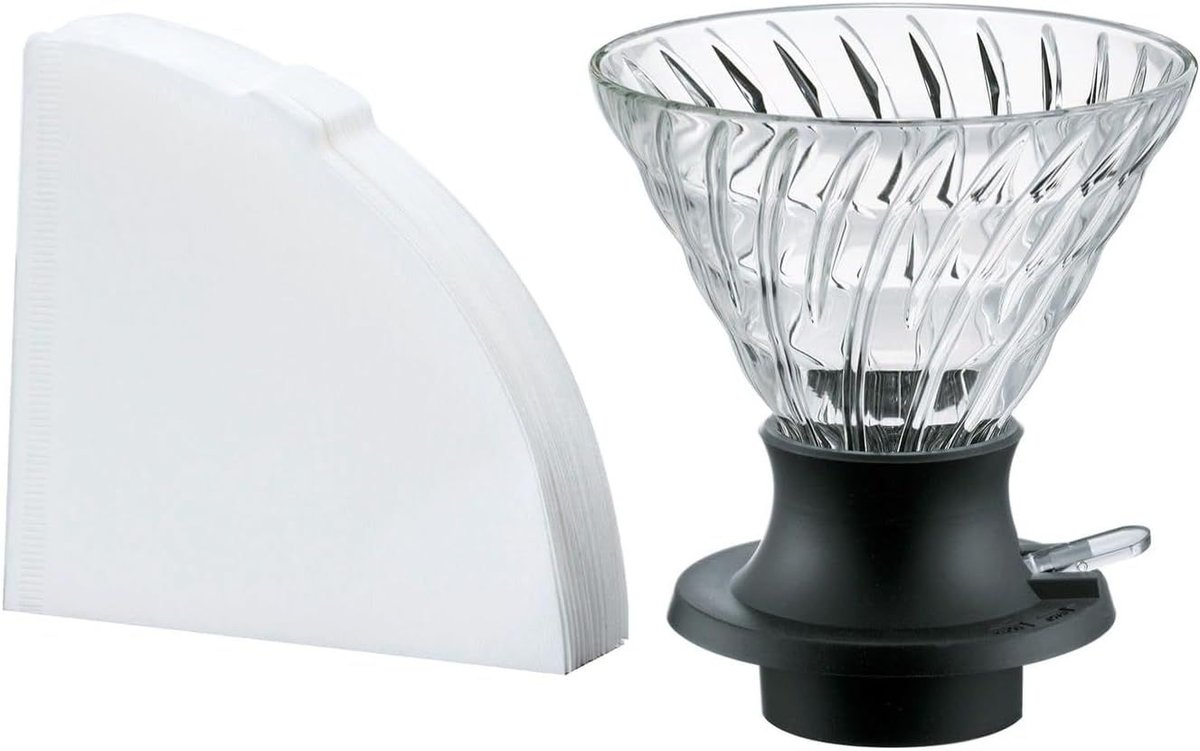
A V60-shaped dripper with a valve that combines immersion and percolation.
Price range
$28 – $45
Hario Switch on video
European Coffee Trip covers the Hario Switch in a 7-minute video. Watch the review below, then see the details and where to buy — all without leaving the page.
European Coffee Trip takes a hands-on look at the Hario Switch. We link it for its specs walkthrough and real-world impressions — form your own view by watching.
We may earn a commission when you buy through links on this page, at no additional cost to you.
More videos
Why this matters
The Hario Switch occupies a genuinely singular position in specialty coffee: it is the only brewer in Hario's lineup — and one of very few on the market — that allows a brewer to toggle between full immersion and percolation within a single session, using the same V60 paper filters already found in millions of home and café set-ups worldwide. Where the standard V60 rewards skilled, consistent pouring and punishes the distracted or under-practiced barista, the Switch removes that ceiling and floor simultaneously. Closing the ball valve traps water in the cone for a steep, generating a longer contact time and far more forgiving extraction; opening it releases the brew through the familiar V60 bed. This means a single device can faithfully reproduce a Clever Dripper-style recipe, a near-standard V60 percolation, or the hybrid protocols that have become a fixture of competition and specialty café menus. At $28–45 USD — only modestly more expensive than a bare V60 — it targets curious home brewers who want to experiment with contact time without buying a second brewer, as well as professionals developing recipes where repeatability matters more than manual virtuosity.
At a glance
Best for
- Hybrid recipes
- Forgiving pour-over
- Experimentation
Look elsewhere if
- You brew primarily at a busy café bar or travel frequently: the glass cone is fragile, and the mechanical valve adds a component that can be damaged if the brewer is dropped or knocked over during service.
- You are a pure V60 enthusiast who prizes the transparency and manual skill ceiling of straight percolation — the Switch's immersion capability adds complexity you will not use and costs extra for it.
- Your budget is under $20 USD: the Clever Dripper delivers similar immersion-to-percolation functionality at a lower price point with no glass components, and a bare plastic V60 costs a fraction of the Switch if you only want percolation.
- You want an immersion brewer primarily for cold brew or very long steeps: the Switch's valve seal and glass body are designed for hot brewing sessions, not multi-hour cold-steep protocols where dedicated cold-brew pitchers are better suited.
Closest alternatives
Featured in
## Build and Design
The Hario Switch is constructed from Hario's signature borosilicate heat-resistant glass — the same material the company has manufactured domestically in Japan since its founding — paired with a stainless steel base and a silicone-sealed stainless steel ball valve at the apex of the cone. The glass cone itself is dimensionally identical to a size 02 Hario V60: the same 60-degree interior angle, the same spiral ribs running the length of the interior walls, and the same large single outlet hole at the bottom. This means the flow dynamics when the valve is open are essentially those of a V60, not a redesigned bed. The stainless steel base plate elevates the cone above a standard server or large mug, providing just enough clearance to place a 400–500ml server beneath without obstruction. The ball valve is operated by pressing a small lever or button on the side of the base; in the closed position the silicone seal prevents any drip-through, and in the open position the full V60 aperture is exposed. The mechanism is mechanically simple — there are no springs, no electronics, no fragile threads — which contributes to long-term reliability. A ceramic version of the Switch (浸漬式セラミックドリッパー スイッチ) was added to Hario's catalogue in November 2023, offering an alternative for brewers who prefer the thermal inertia of ceramic over glass.
Filter compatibility is exactly that of a size-02 V60: Hario's own tabbed paper filters (white or natural), Chemex Bonded squares folded into a cone, or any third-party 02-compatible cone filter. This is a meaningful practical advantage over immersion-only brewers like the Clever Dripper, which uses a proprietary flat-bottom filter that is less universally stocked.
## Performance and Measured Workflow
The Switch's core performance proposition is contact-time control without grind-size compensation. In a pure-percolation V60 recipe, the brewer manages extraction almost entirely through grind coarseness, water temperature, and pour cadence; a stall at the wrong moment drives over-extraction. With the Switch closed, the brewer instead sets contact time by the clock and grind size plays a secondary role in regulating final flow speed once the valve opens. This makes the brewer substantially more tolerant of grind inconsistency across different burr sets.
In practice, hybrid recipes — where water is added, steeped for 30–45 seconds with the valve closed, then the valve is opened to allow drawdown — tend to produce cups with a fuller body and rounder mouthfeel compared to a straight percolation V60 at equivalent dose and ratio. This is because immersion brewing drives more even saturation across the entire coffee bed before the pressure gradient of drawdown begins. The result is that mid-roast and lighter coffees, which can taste thin or astringent through an aggressive V60 percolation, often express more sweetness and balance through a Switch hybrid protocol.
The valve mechanism itself is rated to function with water at full brew temperature (90–96°C / 194–205°F) without degradation of the silicone seal under normal use. The glass cone will cool measurably if not pre-heated, so rinsing the filter and warming the cone with hot water before brewing — standard V60 practice — remains important. The stainless steel base conducts minimal heat away from the brew, unlike some plastic or resin-bodied competitors.
## Day-to-Day Workflow and Ecosystem Fit
The Switch slots directly into any V60 workflow. Brewers who already own V60 servers, the Hario Buono or V60 Drip Kettle, V60 paper filters, or the V60 Drip Scale will find the Switch is a drop-in addition with zero new consumables. The footprint is identical to a 02 V60, so it fits any server or carafe designed for that dripper.
Cleaning requires rinsing the cone (no coffee oils accumulate differently than in a V60), and periodically inspecting the silicone ball-valve seal for staining or deformation. The ball valve disassembles without tools for deep cleaning, and Hario stocks replacement seals as spare parts through their standard parts channel. Unlike a French press or AeroPress, there is no mesh screen to degrade over time.
For recipe development, the Switch's ability to isolate the immersion variable is particularly valuable. Baristas can hold every other parameter constant — dose, ratio, grind, temperature, total water — and vary only steep time to chart extraction yield changes, which is a cleaner experimental condition than varying pour pattern on a standard V60. This has made it a preferred tool for shops developing house filter recipes where consistency across multiple baristas matters.
The glass construction does impose a fragility trade-off. The cone will crack if dropped on a hard surface or subjected to sudden thermal shock (adding cold water to a hot dry cone, for example). The stainless steel base is robust and can survive a drop independently, but the glass cone is the vulnerable element. For café environments with high-traffic bar conditions, the ceramic Switch variant or a resin-bodied alternative merits consideration. Hario does offer the glass cone as a standalone spare part, which limits the cost of replacing a broken cone without repurchasing the entire assembly.
## Honest Trade-offs
The Switch's most consequential limitation is also the most obvious: it is a glass brewer. At a busy home bar or a professional café service station, the glass cone sits one elbow-bump away from a floor. The stainless steel base will survive that fall; the cone almost certainly will not. Hario sells the glass cone as a spare, which softens the financial sting, but the workflow interruption mid-service is a real cost. The November 2023 ceramic variant addresses this partially — ceramic is still breakable but more thermally stable and slightly less shock-vulnerable — though the ceramic version adds weight.
The valve mechanism, while mechanically simple, adds a small but real cognitive step to each brew: the brewer must remember to close it before adding water and must be deliberate about when they open it. In a V60 workflow, the only variable the brewer actively controls is the pour; here, there is a second manual action. For experienced V60 practitioners, this is a negligible adjustment. For absolute beginners, it occasionally leads to forgetting to close the valve (producing a standard drip brew when an immersion was intended) or failing to open it promptly at the end of the steep (over-extracting).
At $28–45 USD, the Switch costs roughly two to three times a bare plastic V60 02. That premium is justified by the valve mechanism, the glass construction, and the recipe flexibility, but it is a premium nonetheless.
## Head-to-Head: Switch vs. Clever Dripper
The Clever Dripper ($22–28 USD) is the Switch's most direct functional competitor: both are immersion/percolation hybrids that release through a valve into the cup. The Clever uses a flat-bottom bed with proprietary trapezoid filters and a spring-loaded valve that opens when the brewer places it on a cup or server. The Switch uses V60 cone geometry, V60 filters, and a manually operated ball valve. In practical terms, the flat Clever bed produces a more even immersion extraction for very coarse grinds; the V60 cone in the Switch produces a slightly faster and more controlled drawdown once the valve opens, with more influence from grind size on final flow rate. The Clever's spring valve is effectively hands-free; the Switch's ball valve requires deliberate activation. For brewers already invested in V60 filters and servers, the Switch is the obvious choice. For brewers starting fresh with no existing V60 ecosystem, the Clever is cheaper and slightly simpler.
## Head-to-Head: Switch vs. Standard V60
Compared to a plastic V60 02 ($10–14 USD), the Switch sacrifices some of the tactile immediacy and near-zero breakage risk of polypropylene for the ability to control contact time. The V60 will produce a brighter, more articulate cup when poured well by a practiced barista. The Switch will produce a more consistent and typically more balanced cup across a wider range of pouring styles and grind settings. Brewers prioritizing peak expression through manual skill should stay on a V60; brewers prioritizing repeatability, experimentation, or forgiving daily brewing should move to the Switch.
## Head-to-Head: Switch vs. AeroPress
The AeroPress (~$35–40 USD) is also a manual immersion/pressure brewer but operates on entirely different mechanics: a plunger-driven pressure extraction into a micro-filter produces a very different cup profile — denser, less clarity-focused — compared to the Switch's gravity-fed drawdown through a paper V60 filter. The Switch produces a cup closer in character to a V60 than to an AeroPress; brewers seeking the AeroPress's espresso-adjacent concentration are not the Switch's target audience. The Switch is explicitly in the filter-coffee category.

Pros
- Switch toggles immersion and drawdown
- Uses standard V60 filters
- Forgiving and flexible
Cons
- Pricier than a bare V60
- Glass components
Who reviewed it
We synthesized this page from independent reviews and the manufacturer's own materials. Conclusions below are paraphrased, not quoted.
James Hoffmann
Generally regarded as praising the Switch's ability to make immersion brewing approachable for V60 users, noting it produces a more forgiving and repeatable cup than a standard V60 without abandoning the filter-coffee character V60 brewers expect.
Prima Coffee
Considered the Switch a versatile and genuinely useful addition to the V60 ecosystem, highlighting the direct filter and server compatibility as a key practical advantage over competing immersion brewers.
Source ↗Whole Latte Love
Positioned the Switch as a smart upgrade path for existing V60 owners who want more control over extraction without switching to a completely different brewing platform.
Source ↗Hario (manufacturer)
Markets the Switch as a dual-mode dripper that enables both immersion and percolation in a single V60-compatible device, with the ceramic variant (launched November 2023) expanding the lineup for brewers who prefer ceramic over glass.
Source ↗European Coffee Trip
Noted the Switch's appeal for specialty coffee shops developing consistent filter recipes, particularly praising the ability to isolate contact time as an independent variable during recipe development.
CoffeeGeek
Acknowledged the Switch as one of the more practically well-executed hybrid brewers, with the ball valve mechanism singled out as reliable and easy to clean compared to spring-loaded alternatives.
Frequently asked questions
What size V60 filters does the Hario Switch use?
The Switch uses size-02 V60 cone filters — the same filters used with a standard size-02 V60 dripper. Both Hario's own tabbed paper filters and third-party 02-compatible cone filters are compatible.
How does the Switch valve work?
A stainless steel ball valve at the bottom of the cone is operated by pressing a lever on the side of the steel base. When closed, a silicone seal prevents any water from passing through; when opened, the full V60 aperture is exposed and drawdown proceeds by gravity through the paper filter bed.
Can I use the Switch exactly like a regular V60?
Yes. With the valve open from the start, the Switch behaves like a standard V60 — water flows through continuously and the brew dynamics are governed by grind size, pour rate, and bed geometry. The valve only changes the experience when you close it to create an immersion steep.
What is a hybrid recipe on the Switch?
A hybrid recipe involves closing the valve, adding water to steep the coffee bed for a set time (commonly 30–60 seconds), then opening the valve to allow drawdown. This combines the even saturation of immersion with the clarity of paper-filtered percolation, typically producing a fuller body than straight percolation while retaining more brightness than a French press.
How does the Switch compare to the Clever Dripper?
Both are immersion/percolation hybrids, but they differ in filter type (V60 cone vs. proprietary trapezoid), valve operation (manual ball valve vs. spring-loaded cup-contact valve), and bed geometry (V60 cone vs. flat bottom). The Switch integrates directly into a V60 ecosystem; the Clever Dripper uses its own filter format and is generally cheaper at $22–28 USD.
Is the glass version or the ceramic version better?
The glass version lets you observe the brew as it steeps and drawsdown, which aids recipe development. The ceramic version (released November 2023) has better thermal stability — it retains heat longer once pre-warmed — and is marginally more resistant to mechanical shock, making it a better choice for café environments or brewers who have broken glass drippers before.
What is the price range for the Hario Switch?
The Switch retails between approximately $28 and $45 USD depending on the version (glass or ceramic) and the retailer. It is priced above a bare plastic V60 but below most automated or electric pour-over alternatives.
How do I clean the ball valve?
The ball valve assembly disassembles without tools, allowing the silicone seal and steel ball to be rinsed and inspected. Hario stocks replacement silicone seals as spare parts. Routine cleaning requires only rinsing after each brew; deep disassembly is only needed if the seal stains or begins to leak.
What servers or cups are compatible?
Any server or mug designed for a size-02 V60 will fit beneath the Switch's stainless steel base. Hario's own V60 glass servers (01 and 02 sizes) and the V60 Barista Server are confirmed-compatible. The base clearance is sufficient for most standard 400–600ml servers.
Is the Hario Switch good for beginners?
Yes, more so than a standard V60. The valve removes the pour-cadence pressure that makes the V60 demanding: a beginner can close the valve, add all their water at once, steep, then open the valve, achieving a consistent extraction without practiced gooseneck technique. The main new habit is remembering to close the valve before pouring.
Can the Switch be used for cold brew?
The Switch is designed for hot brewing. While nothing physically prevents adding cold water, the valve seal and glass body are optimized for typical brew-temperature sessions rather than multi-hour cold-steep workflows, for which a dedicated cold-brew pitcher is more appropriate.
Does Hario sell replacement glass cones for the Switch?
Yes. Hario offers spare parts including replacement glass cones and silicone valve seals through their standard parts channel, which means a cracked cone does not require purchasing the entire Switch assembly again.
Compare with
More brewers
Chemex
Chemex 6-Cup
The iconic hourglass carafe whose thick filters yield an exceptionally clean cup.
AeroPress
AeroPress Original
A versatile, near-indestructible immersion-and-pressure brewer with a global championship.
Kalita
Kalita Wave 185
A flat-bottom, three-hole dripper prized for forgiving, repeatable extractions.
AeroPress
AeroPress Go
A travel-oriented AeroPress that packs into its own mug.
We may earn a commission when you buy through links on this page, at no additional cost to you.
Last updated: June 13, 2026